












News
  • Login
  • Home
  • News
  • Sport
  • Worklife
  • Travel
  • Reel
  • Future
  • More
Monday, December 8, 2025
No Result
View All Result

NEWS

3 °c
London
8 ° Wed
9 ° Thu
11 ° Fri
13 ° Sat
  • Home
  • Video
  • World
    • All
    • Africa
    • Asia
    • Australia
    • Europe
    • Latin America
    • Middle East
    • US & Canada

    'We deserve to have a say' – Australian teens on the social media ban

    Trump criticises Henry Cuellar over not switching parties after pardon

    Benin coup thwarted by loyalist troops, President Talon tells nation

    India’s poll workers flag harsh conditions amid rising deaths

    New US security strategy aligns with Russia’s vision, Moscow says

    Death of Venezuelan opposition figure in custody ‘vile’, US says

    Bethlehem Christmas tree lights up for first time since Gaza war

    California wild mushroom poisoning leaves 1 dead, 20 injured

    Can you ban kids from social media? Australia is about to try

  • UK
    • All
    • England
    • N. Ireland
    • Politics
    • Scotland
    • Wales

    Heathrow ‘pepper spray attack’ and ‘Harry gun cop U-turn’

    Teenager Mitchell Lawrie beaten by Jimmy van Schie in WDF World Championship final

    Merthyr couple hope new room will stop A&E fear for ALN families

    Murder inquiry launched after child and woman die in fire

    Covid fraud and error cost taxpayers £10.9bn, report will say

    How Lando Norris achieved his lifetime’s ambition of F1 world title by ‘winning it my way’

    Army veteran shocked by XL bully owner’s sentence after attack

    Why do Gen Z have a growing appetite for retro tech?

    Champions Cup: Scarlets 16-17 Bristol – Louis Rees-Zammit seals win for Bears

  • Business
    • All
    • Companies
    • Connected World
    • Economy
    • Entrepreneurship
    • Global Trade
    • Technology of Business

    Can Japan get more female business leaders?

    Canadia airline to halt flights ahead of strike

    What is the Office for Budget Responsibility and why has its boss resigned?

    Sold 30 items on Vinted? Don’t panic if you get a message about tax

    West Midlands people urged to ‘shop local’ and back small firms

    People admit to ‘secret spending’ without telling partners

    Five takeaways from the blockbuster Netflix Warner Brothers deal

    Ryanair scraps printed boarding passes to go fully digital

    Reeves will not face ethics probe over pre-Budget remarks

  • Tech
  • Entertainment & Arts

    Dancers say Lizzo ‘needs to be held accountable’ over harassment claims

    Freddie Mercury: Contents of former home being sold at auction

    Harry Potter and the Cursed Child marks seven years in West End

    Sinéad O’Connor: In her own words

    Tom Jones: Neighbour surprised to find singer in flat below

    BBC presenter: What is the evidence?

    Watch: The latest on BBC presenter story… in under a minute

    Watch: George Alagiah’s extraordinary career

    BBC News presenter pays tribute to ‘much loved’ colleague George Alagiah

    Excited filmgoers: 'Barbie is everything'

  • Science
  • Health
  • In Pictures
  • Reality Check
  • Have your say
  • More
    • Newsbeat
    • Long Reads

NEWS

No Result
View All Result
Home Science

Humans may not have survived without Neanderthals

December 13, 2024
in Science
8 min read
235 17
0
491
SHARES
1.4k
VIEWS
Share on FacebookShare on Twitter


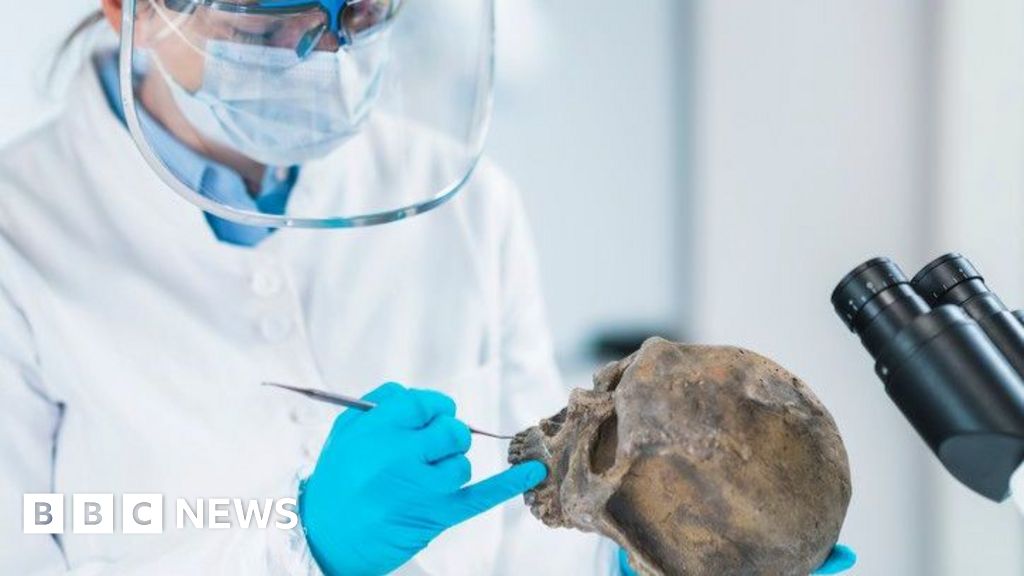
SPL Ancient DNA analysis. Female scientist holding micro tube with sample in ancient DNA laboratory.SPL

Scientists can tell how ancient human populations evovled by analysing their DNA

Far from triumphantly breezing out of Africa, modern humans went extinct many times before going on to populate the world, new studies have revealed.

The new DNA research has also shed new light on the role our Neanderthal cousins played in our success.

While these early European humans were long seen as a species which we successfully dominated after leaving Africa, new studies show that only humans who interbred with Neanderthals went on to thrive, while other bloodlines died out.

In fact, Neanderthal genes may have been crucial to our success by protecting us from new diseases we hadn’t previously encountered.

The research for the first time pinpoints a short period 48,000 years ago when Homo sapiens interbred with Neanderthals after leaving Africa, after which they went on to expand into the wider world.

Homo sapiens had crossed over from the African continent before this, but the new research shows these populations before the interbreeding period did not survive.

Prof Johannes Krause of the Max Planck Institute of Evolutionary Biology, in Germany, told BBC News that the history of modern humans will now have to be rewritten.

“We see modern humans as a big story of success, coming out of Africa 60,000 years ago and expanding into all ecosystems to become the most successful mammal on the planet,” he said. “But early on we were not, we went extinct multiple times.”

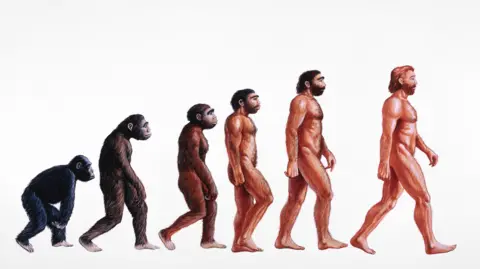
DAVID GIFFORD / SCIENCE PHOTO LIBRARY Stages in human evolution, illustration. At left, Proconsul (23-15 million years ago) is shown as an African ape with both primitive and advanced features. From it Australopithecus afarensis (>4- 2.5 Myr BP) evolved and displayed a bipedal, upright gait walking on two legs. Homo habilis (2.5 Myr BP) was truly human ('homo')DAVID GIFFORD / SCIENCE PHOTO LIBRARY

The story of our species’ smooth march through evolution will have to be rewritten, says scientists

For a long time, deciphering how the only surviving species of humans evolved was based on looking at the shapes of fossilised remains of our ancestors living hundreds of thousands of years ago and observing how their anatomy subtly changed over time.

The ancient remains have been sparse and often damaged. But the ability to extract and read the genetic code from bones that are many thousands of years old has lifted a veil on our mysterious past.

The DNA in the fossils tell the story of the individuals, how they are related to each other and their migration patterns.

Even after our successful interbreeding with Neanderthals, our population of Europe wasn’t without hitches.

Those first modern humans that had interbred with Neanderthals and lived alongside them died out completely in Europe 40,000 years ago – but not before their offspring had spread further out into the world.

It was the ancestors of these early international pioneers who eventually returned to Europe to populate it.

BBC News Four panels showing how 1. Humans left Africa, 2 interbred with Neanderthals 48,000 years ago, 3. 40, 000  years ago Both species of humans go extinct in Europe 4. A new wave of interbred Homo sapiens move inBBC News

The research also gives a new perspective on why Neanderthals died out so soon after modern humans arrived from Africa. No one knows why this happened, but the new evidence steers us away from theories that our species hunted them out of existence, or that we were somehow physically or intellectually superior.

Instead, Prof Krause says that it supports the view that it was due to environmental factors.

“Both humans and Neanderthals go extinct in Europe at this time,” he said. “If we as a successful species died out in the region then it is not a big surprise that Neanderthals, who had an even smaller population went extinct.”
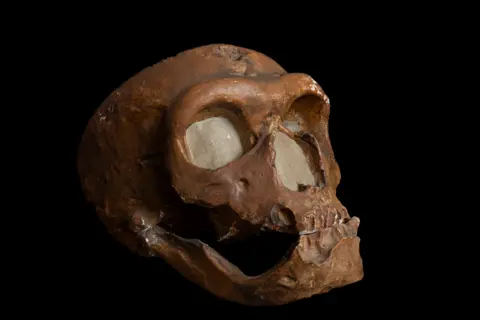
SPL Neanderthal skull featuring a large middle part of the face, angled cheekbones, and a huge nose for humidifying and warming cold, dry air. SPL

A Neanderthal skull. The species lived alongside us for thousands of years until they went extinct around 40,000 years ago

The climate was incredibly unstable at the time. It could switch from nearly as warm as it is today to being bitterly cold, sometimes within a person’s lifetime, according to Prof Chris Stringer of the Natural History Museum in London, who is independent of the new research.

“The study shows that near the end of their time on the planet, Neanderthals were very low in numbers, less genetically diverse than the modern human counterparts they lived alongside, and it may not have taken much to tip them over the edge to extinction,” he said.

A separate DNA study, published in the journal Science, shows that modern humans held on to some key genetic traits from Neanderthals that may have given them an evolutionary advantage.

One relates to their immune system. When humans emerged from Africa, they were extremely susceptible to new diseases they had never encountered. Interbreeding with Neanderthals gave their offspring protection.

“Perhaps getting Neanderthal DNA was part of the success because it gave us better adaptive capabilities outside of Africa,” said Prof Stringer. “We had evolved in Africa, whereas the Neanderthals had evolved outside of Africa.”

“By interbreeding with the Neanderthals we got a quick fix to our immune systems.”

Follow Pallab on Blue Sky and X


Source link

Tags: HumansNeanderthalssurvived

Related Posts

Volcanic eruption may have triggered Europe’s Black Death plague

December 8, 2025
0

Helen BriggsEnvironment correspondentGettyThe Black Death fundamentally altered medieval societyA volcanic eruption around the year 1345 may have set off...

Top UK scientist says research visa restrictions endanger economy

December 7, 2025
0

One of Britain's most distinguished scientists, Prof Sir Paul Nurse, says the government is "shooting itself in the foot"...

Over a third of animals impacted in deep sea mining test

December 6, 2025
0

Georgina RannardClimate and science correspondentNatural History Museum/ University of GothenburgA brittlestar found on the seafloor of the Clarion-Clipperton ZoneMachines...

  • Australia helicopter collision: Mid-air clash wreckage covers Gold Coast

    520 shares
    Share 208 Tweet 130
  • UK inflation: Supermarkets say price rises will ease soon

    513 shares
    Share 205 Tweet 128
  • Ballyjamesduff: Man dies after hit-and-run in County Cavan

    510 shares
    Share 204 Tweet 128
  • Somalia: Rare access to its US-funded 'lightning commando brigade

    508 shares
    Share 203 Tweet 127
  • Google faces new multi-billion advertising lawsuit

    508 shares
    Share 203 Tweet 127
  • Trending
  • Comments
  • Latest

Australia helicopter collision: Mid-air clash wreckage covers Gold Coast

January 10, 2023

UK inflation: Supermarkets say price rises will ease soon

April 19, 2023

Ballyjamesduff: Man dies after hit-and-run in County Cavan

August 19, 2022

Stranger Things actor Jamie Campbell Bower praised for addiction post

0

NHS to close Tavistock child gender identity clinic

0

Cold sores traced back to kissing in Bronze Age by Cambridge research

0

Volcanic eruption may have triggered Europe’s Black Death plague

December 8, 2025

Heathrow ‘pepper spray attack’ and ‘Harry gun cop U-turn’

December 8, 2025

Radio 1’s Big Weekend 2026 announced for Sunderland

December 8, 2025

Categories

Science

Volcanic eruption may have triggered Europe’s Black Death plague

December 8, 2025
0

Helen BriggsEnvironment correspondentGettyThe Black Death fundamentally altered medieval societyA volcanic eruption around the year 1345 may have set off...

Read more

Heathrow ‘pepper spray attack’ and ‘Harry gun cop U-turn’

December 8, 2025
News

Copyright © 2020 JBC News Powered by JOOJ.us

Explore the JBC

  • Home
  • News
  • Sport
  • Worklife
  • Travel
  • Reel
  • Future
  • More

Follow Us

  • Home Main
  • Video
  • World
  • Top News
  • Business
  • Sport
  • Tech
  • UK
  • In Pictures
  • Health
  • Reality Check
  • Science
  • Entertainment & Arts
  • Login

Copyright © 2020 JBC News Powered by JOOJ.us

Welcome Back!

Login to your account below

Forgotten Password?

Create New Account!

Fill the forms bellow to register

All fields are required. Log In

Retrieve your password

Please enter your username or email address to reset your password.

Log In
This website uses cookies. By continuing to use this website you are giving consent to cookies being used. Visit our Privacy and Cookie Policy.
News
More Sites

    MORE

  • Home
  • News
  • Sport
  • Worklife
  • Travel
  • Reel
  • Future
  • More
  • News

    JBC News