










Scientists have found new but tentative evidence that a faraway world orbiting another star may be home to life.
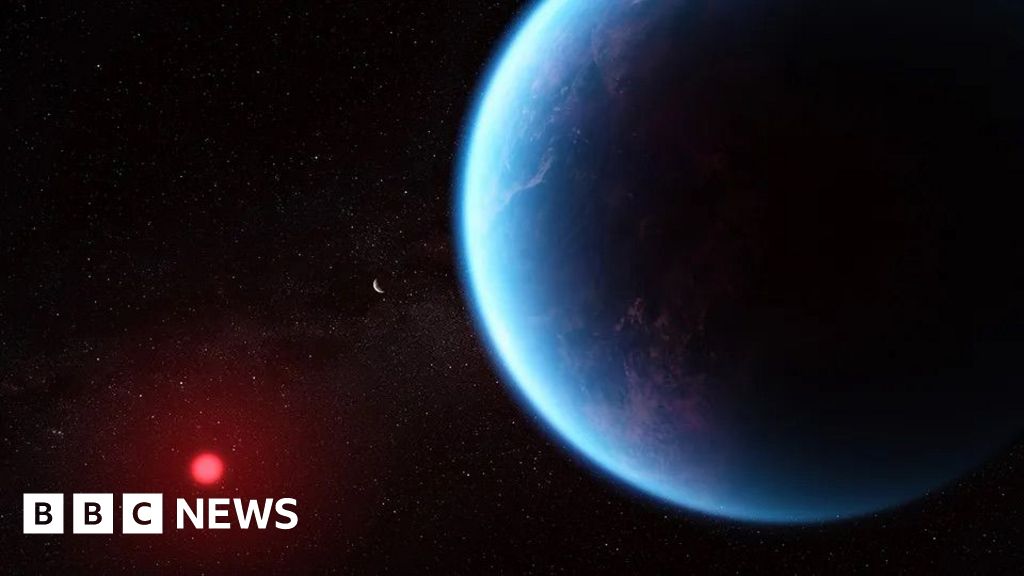
A Cambridge team studying the atmosphere of a planet called K2-18b has detected signs of molecules which on Earth are only produced by simple organisms.
This is the second, and more promising, time chemicals associated with life have been detected in the planet’s atmosphere by Nasa’s James Webb Space Telescope (JWST).
But the team and independent astronomers stress that more data is needed to confirm these results.
The lead researcher, Prof Nikku Madhusudhan, told me at his lab at Cambridge University’s Institute of Astronomy that he hopes to obtain the clinching evidence soon.
“This is the strongest evidence yet there is possibly life out there. I can realistically say that we can confirm this signal within one to two years.”
K2-18b is two-and-a-half times the size of Earth and is 700 trillion miles, or 124 light years, away from us – a distance far beyond what any human could travel in a lifetime.
JWST is so powerful that it can analyse the chemical composition of the planet’s atmosphere from the light that passes through from the small red Sun it orbits.
The Cambridge group has found that the atmosphere seems to contain the chemical signature of at least one of two molecules that are associated with life: dimethyl sulphide (DMS) and dimethyl disulphide (DMDS). On Earth, these gases are produced by marine phytoplankton and bacteria.
Prof Madhusudhan said he was surprised by how much gas was apparently detected during a single observation window.
“The amount we estimate of this gas in the atmosphere is thousands of times higher than what we have on Earth,” he said.
“So, if the association with life is real, then this planet will be teeming with life,” he added.
Prof Madhusudhan went further: “If we confirm that there is life on K2-18b, it should basically confirm that life is very common in the galaxy.”
He told BBC Radio 5Live on Thursday: “This is a very important moment in science, but also very important to us as a species.
“If there is one example, and the universe being infinite, there is a chance for life on many more planets.”
Dr Subir Sarkar, a lecturer in astrophysics at Cardiff University and part of the research team, said the research suggests K2-18b could have an ocean which could be potentially full of life – though he cautioned scientists “don’t know for sure”.
He added that the research team’s work will continue to focus on looking for life on other planets: “Keep watching this space.”
There are lots of “ifs” and “buts” at this stage, as Prof Madhusudhan’s team freely admits.
Firstly, this latest detection is not at the standard required to claim a discovery.
For that, the researchers need to be about 99.99999% sure that their results are correct and not a fluke reading. In scientific jargon, that is a five sigma result.
These latest results are only three sigma, or 99.7%. Which sounds like a lot, but it is not enough to convince the scientific community. However, it is much more than the one sigma result of 68% the team obtained 18 months ago, which was greeted with much scepticism at the time.
But even if the Cambridge team obtains a five sigma result, that won’t be conclusive proof that life exists on the planet, according to Prof Catherine Heymans of Edinburgh University and Scotland’s Astronomer Royal, who is independent of the research team.
“Even with that certainty, there is still the question of what is the origin of this gas,” she told BBC News.
“On Earth it is produced by microorganisms in the ocean, but even with perfect data we can’t say for sure that this is of a biological origin on an alien world because loads of strange things happen in the Universe and we don’t know what other geological activity could be happening on this planet that might produce the molecules.”
That view is one the Cambridge team agree with. They are working with other groups to see if DMS and DMDS can be produced by non-living means in the lab.
“There is still a 0.3% chance that it might be a statistical fluke,” Prof Madhusudhan said.
Suggesting life may exist on another planet was “a big claim if true”, he told BBC Radio 4’s Today programme, adding: “So we want to be really, really thorough, and make more observations, and get the evidence to the level that there is less than a one-in-a-million chance of it being a fluke.”
He said this should be possible in “maybe one or two years”.
Other research groups have put forward alternative, lifeless, explanations for the data obtained from K2-18b. There is a strong scientific debate not only about whether DMS and DMDS are present but also the planet’s composition.
The reason many researchers infer that the planet has a vast liquid ocean is the absence of the gas ammonia in K2-18b’s atmosphere. Their theory is that the ammonia is absorbed by a vast body of water below.
But it could equally be explained by an ocean of molten rock, which would preclude life, according to Prof Oliver Shorttle of Cambridge University.
“Everything we know about planets orbiting other stars comes from the tiny amounts of light that glance off their atmospheres. So it is an incredibly tenuous signal that we are having to read, not only for signs of life, but everything else,” he said.
“With K2-18b part of the scientific debate is still about the structure of the planet.”
Dr Nicolas Wogan at Nasa’s Ames Research Center has yet another interpretation of the data. He published research suggesting that K2-18b is a mini gas giant with no surface.
Both these alternative interpretations have also been challenged by other groups on the grounds that they are inconsistent with the data from JWST, compounding the strong scientific debate surrounding K2-18b.
Prof Chris Lintott, presenter of the BBC’s The Sky at Night, said he had “great admiration” for Prof Madhusudhan’s team, but was treating the research with caution.
“I think we’ve got to be very careful about claiming that this is ‘a moment’ on the search to life. We’ve [had] such moments before,” he told Today.
He said the research should be seen instead as “part of a huge effort to try and understand what’s out there in the cosmos”.
Prof Madhusudhan acknowledges that there is still a scientific mountain to climb if he is to answer one of the biggest questions in science. But he believes he and his team are on the right track.
“Decades from now, we may look back at this point in time and recognise it was when the living universe came within reach,” he said.
“This could be the tipping point, where suddenly the fundamental question of whether we’re alone in the universe is one we’re capable of answering.”
The research has been published in The Astrophysical Journal Letters.