





























News
  • Login
  • Home
  • News
  • Sport
  • Worklife
  • Travel
  • Reel
  • Future
  • More
Saturday, June 6, 2026
No Result
View All Result

NEWS

3 °c
London
8 ° Wed
9 ° Thu
11 ° Fri
13 ° Sat
  • Home
  • Video
  • World
    • All
    • Africa
    • Asia
    • Australia
    • Europe
    • Latin America
    • Middle East
    • US & Canada

    Why are devastating mice plagues happening in Australia?

    Fally Ipupa’s pride at being given top honour by DR Congo President Félix Tshisekedi

    Fall in official Ebola numbers appears to be good news but it's not that simple

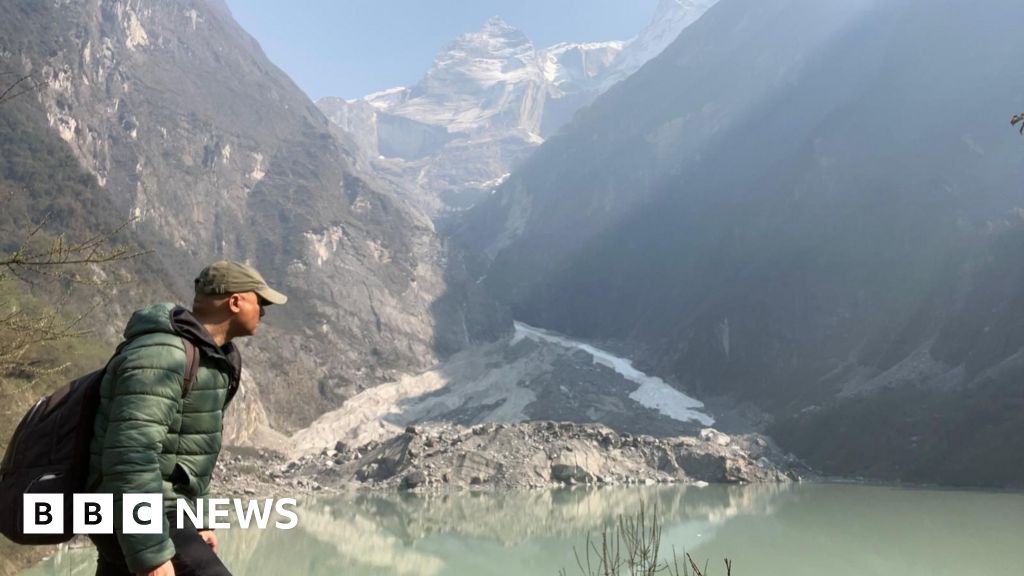
    Everest guide survived six-day ordeal by eating chocolate and 'chewing ice'

    Putin says there is no point meeting Zelensky over ending Ukraine war

    Protesters topple World Cup player statues in Mexico City

    Ex-wife of Dubai ruler's nephew in custody, prosecutors say

    Astronauts return to ISS after sheltering during air leak repair attempt

    Giant hissing cockroaches among $200,000 worth of illegal insects seized in Australia

  • UK
    • All
    • England
    • N. Ireland
    • Politics
    • Scotland
    • Wales

    The Papers: 'Flagship breaks down' and 'Beer we go!'

    Advantage Scotland as they await Erin Cuthbert injury news

    Human composting and water cremation considered to tackle burial space shortages

    Feuding within Ulster Unionists 'would make an Eastenders' scriptwriter blush'

    Downing Street hits out after Vance post about Henry Nowak

    T20 Blast round-up: Bairstow and Moeen star as Yorkshire inflict record defeat on Lancashire

    The Papers: 'Andrew cashed in' and 'Kate shares in mum's joy'

    Could this 'tram-like' bus be part of Aberdeen's transport future?

    T20 Blast: Glamorgan beat Somerset with last-ball boundary

  • Business
    • All
    • Companies
    • Connected World
    • Economy
    • Entrepreneurship
    • Global Trade
    • Technology of Business

    US stocks slump as fears over Big Tech shake Wall Street

    Hospitality jobs boom as US prepares for World Cup

    China cracks down on soft porn, violence and materialism in viral micro dramas

    British Heart Foundation plans to close 150 charity shops

    SpaceX says it’s worth $1.75tn as it nears stock market debut

    Three quarters of workers not on track for ‘moderate’ pension income, report suggests

    Puffin and bumblebee among 18 creatures shortlisted to feature on banknotes

    OpenAI let ChatGPT aid and abet mass shooters, Florida lawsuit claims

    Put a £5 deposit on vapes to stop littering, say waste companies

  • Tech
  • Entertainment & Arts

    Dancers say Lizzo ‘needs to be held accountable’ over harassment claims

    Freddie Mercury: Contents of former home being sold at auction

    Harry Potter and the Cursed Child marks seven years in West End

    Sinéad O’Connor: In her own words

    Tom Jones: Neighbour surprised to find singer in flat below

    BBC presenter: What is the evidence?

    Watch: The latest on BBC presenter story… in under a minute

    Watch: George Alagiah’s extraordinary career

    BBC News presenter pays tribute to ‘much loved’ colleague George Alagiah

    Excited filmgoers: 'Barbie is everything'

  • Science
  • Health
  • In Pictures
  • Reality Check
  • Have your say
  • More
    • Newsbeat
    • Long Reads

NEWS

No Result
View All Result
Home Science

Why the mighty Himalayas are getting harder and harder to see

May 13, 2025
in Science
12 min read
245 8
0
491
SHARES
1.4k
VIEWS
Share on FacebookShare on Twitter


Navin Singh Khadka

Environment correspondent, BBC World Service
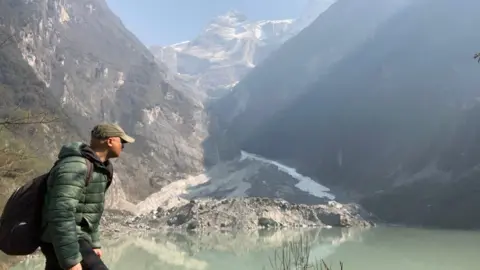
BBC BBC World Service environment correspondent Navin Singh Khadka trekking with mountains visible behind himBBC

Trekking in Nepal’s Annapurna region, where haze obscures visibility of the epic mountains even at close range

I grew up in Nepal’s capital watching the Himalayas. Ever since I left, I’ve missed sweeping, panoramic views of some of the highest mountain peaks on Earth.

Each time I visit Kathmandu, I hope to catch a glimpse of the dramatic mountain range. But these days, there’s usually no luck.

The main culprit is severe air pollution that hangs as haze above the region.

And it’s happening even during the spring and autumn months, which once offered clear skies.

Just last April, the international flight I was in had to circle in the sky nearly 20 times before landing in Kathmandu, because of the hazy weather impacting visibility at the airport.

The hotel I checked in at was at a reasonable height from which mountains are visible on a clear day – but there was no such day during my two-week stay.

Even from the major vantage point of Nagarkot, just outside Kathmandu, all that could be seen was haze, as if the mountains did not exist.

“I no longer brand the place for views of ‘sunrise, sunset and Himalayas’ as I did in the past,” said Yogendra Shakya, who has been operating a hotel at Nagarkot since 1996.

“Since you can’t have those things mostly now because of the haze, I have rebranded it with history and culture as there are those tourism products as well here.”

During an earlier trip a year ago, I was hopeful I would be able to see the mighty Himalayan peaks on a trek in the mesmerising Annapurna region – but had hardly any luck there either.

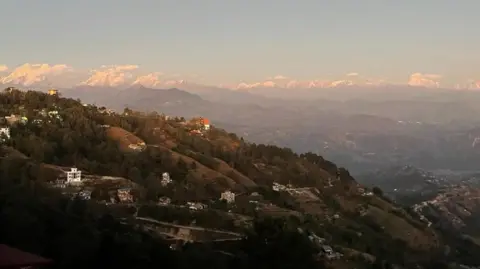
Yogendra Shakya View of a hill in the foreground with Himalaya mountains and some peaks visible in the backgroundYogendra Shakya

View of the Himalayas on an increasingly rare clear day from the Nagarkot vantage point

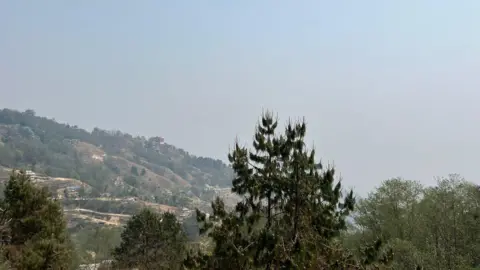
View of a hill in the foreground with nothing visible behind, due to haze

The hazy view from the same vantage point during my most recent visit

Scientists say hazy conditions in the region are becoming increasingly intense and lasting longer, reducing visibility significantly.

Haze is formed by a combination of pollutants like dust and smoke particles from fires, reducing visibility to less than 5,000m (16,400ft). It remains stagnant in the sky during the dry season – which now lasts longer due to climate change.

June to September is the region’s rainy season, when Monsoon clouds rather than haze keep the mountains covered and visibility low.

Traditionally, March to May and October to November were the best times for business because that was when skies remained clear and visibility was best.

But with rising temperatures and a lack of rain, and worsening air pollution, the spring months are now seeing thick haze with low visibility. Those conditions are beginning as early as December.

‘No sighting means no business’

Lucky Chhetri, a pioneering female trekking guide in Nepal, said hazy conditions had led to a 40% decrease in business.

“In one case last year, we had to compensate a group of trekkers as our guides could not show them the Himalayas due to the hazy conditions,” she added

An Australian tourist who has visited Nepal more than a dozen times since 1986 described not seeing the mountains as a “major let-down”.

“It wasn’t like this 10 years ago but now the haze seems to have taken over and it is extraordinarily disappointing for visitors like me,” said John Carrol.

Krishna Acharya, the provincial chair of the Trekking Agents Association of Nepal in the western Gandaki province, says the trekking industry is in deep trouble.

“Our member trekking operators are getting depressed because no sighting of the Himalayas means no business. Many of them are even considering changing professions,” he told the BBC.

Lucky Chhetri Lucky Chhetri, one of the pioneering women trekking guides in Nepal, poses in front of the Himalayas which can be clearly seenLucky Chhetri

Trekking guide Lucky Chhetri says business is down because of the hazy conditions

On the Indian side, near the central Himalayas, hoteliers and tour operators say haze is now denser and returns quicker than before.

“We have long dry spells and then a heavy downpour, unlike in the past. So with infrequent rain the haze persists for much longer,” said Malika Virdi, who heads a community-run tourism business in the state of Uttarakhand.

However, Ms Virdi says tourists are persistent – with many who didn’t catch the mountain range returning to try their luck again.

The western Himalayas in Pakistan have been relatively less affected by the haze because the mountains are relatively far from cities.

But locals say that even the ranges that were once easily visible from places like Peshawar and Gilgit are often no longer seen.

“The sheet of haze remains hanging for a longer period and we don’t see the mountains that we could in the past,” said Asif Shuja, the former head of Pakistan’s environmental protection agency.

Hazes and dust storms increasing

South Asian cities regularly top lists of places with highest levels of air pollution in the world.

Public health across the region has been badly impacted by the toxic air, which frequently causes travel disruption and school closures.

Vehicular and industrial emissions, dust from infrastructure construction and dry gravel roads as well as the open burning of waste are major sources of air pollution year-round.

This is compounded by soot from massive forest fires – which are increasing due to a longer dry season – and the burning of crop residues after the harvest by farmers in northern India, Pakistan and Nepal.

Weather conditions keeping warmer air above cooler air trap these pollutants and limit vertical air movement – preventing pollution from dispersing.

“Hazes and dust storms are increasing in South Asia, and this trend is projected to continue due to climate change and other factors,” Dr Someshwor Das from the South Asia Meteorological Association told the BBC.

In 2024, the number of hazy days recorded at the airport in Pokhara, a major tourism hub in western Nepal, was 168 – up from 23 in 2020 and 84 in 2021, according to Nepal’s department of hydrology and meteorology.
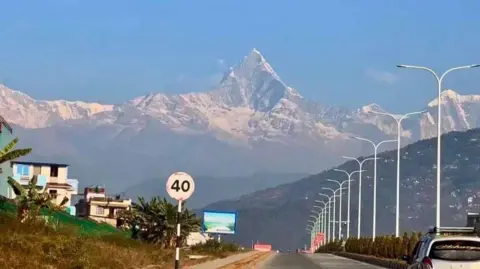
Yunish Gurung An image of Fishtail mountain in Nepal with clear skies clearly seen from the roadYunish Gurung

The Fishtail mountain in Nepal on a clear day

A similar image of Fishtail mountain in Nepal but now with hazy skies obscuring the view

The same mountain range covered in haze, taken from roughly the same location

Experts believe the Himalayas are probably the worst affected mountain range in the world given their location in a populous and polluted region.

This could mean the scintillating view of the Himalayas could now largely be limited to photographs, paintings and postcards.

“We are left to do business with guilt when we are unable to show our clients the mountains that they pay us for,” said trekking leader Ms Chhetri.

“And there is nothing we can do about the haze.”

A thin, grey banner promoting the News Daily newsletter. On the right, there is a graphic of an orange sphere with two concentric crescent shapes around it in a red-orange gradient, like a sound wave. The banner reads: "The latest news in your inbox first thing.”

Get our flagship newsletter with all the headlines you need to start the day. Sign up here.



Source link

Tags: harderHimalayasmighty

Related Posts

Jupiter and Venus to share 'cosmic kiss'

June 6, 2026
0

Elizabeth Rizzini looks at the prospects for seeing a spectacular planetary conjunction. Source link

Mangrove forests are healing after decades of human destruction

June 5, 2026
0

Swampy mangrove forests are staging a surprise comeback - which is good news for coastal communities and the climate....

Swifts 'displaced' after demolition – campaigners

June 4, 2026
0

Campaigners say nesting swifts may have been affected after part of a building was demolished. Source link

  • Australia helicopter collision: Mid-air clash wreckage covers Gold Coast

    523 shares
    Share 209 Tweet 131
  • UK inflation: Supermarkets say price rises will ease soon

    515 shares
    Share 206 Tweet 129
  • Ballyjamesduff: Man dies after hit-and-run in County Cavan

    510 shares
    Share 204 Tweet 128
  • Somalia: Rare access to its US-funded 'lightning commando brigade

    508 shares
    Share 203 Tweet 127
  • Google faces new multi-billion advertising lawsuit

    508 shares
    Share 203 Tweet 127
  • Trending
  • Comments
  • Latest

Australia helicopter collision: Mid-air clash wreckage covers Gold Coast

January 10, 2023

UK inflation: Supermarkets say price rises will ease soon

April 19, 2023

Ballyjamesduff: Man dies after hit-and-run in County Cavan

August 19, 2022

Stranger Things actor Jamie Campbell Bower praised for addiction post

0

NHS to close Tavistock child gender identity clinic

0

Cold sores traced back to kissing in Bronze Age by Cambridge research

0

Jupiter and Venus to share 'cosmic kiss'

June 6, 2026

The Papers: 'Flagship breaks down' and 'Beer we go!'

June 6, 2026

I wanted to quit Eurovision twice – then won it, says Bangaranga singer Dara

June 6, 2026

Categories

Science

Jupiter and Venus to share 'cosmic kiss'

June 6, 2026
0

Elizabeth Rizzini looks at the prospects for seeing a spectacular planetary conjunction. Source link

Read more

The Papers: 'Flagship breaks down' and 'Beer we go!'

June 6, 2026
News

Copyright © 2020 JBC News Powered by JOOJ.us

Explore the JBC

  • Home
  • News
  • Sport
  • Worklife
  • Travel
  • Reel
  • Future
  • More

Follow Us

  • Home Main
  • Video
  • World
  • Top News
  • Business
  • Sport
  • Tech
  • UK
  • In Pictures
  • Health
  • Reality Check
  • Science
  • Entertainment & Arts
  • Login

Copyright © 2020 JBC News Powered by JOOJ.us

Welcome Back!

Login to your account below

Forgotten Password?

Create New Account!

Fill the forms bellow to register

All fields are required. Log In

Retrieve your password

Please enter your username or email address to reset your password.

Log In
This website uses cookies. By continuing to use this website you are giving consent to cookies being used. Visit our Privacy and Cookie Policy.
News
More Sites

    MORE

  • Home
  • News
  • Sport
  • Worklife
  • Travel
  • Reel
  • Future
  • More
  • News

    JBC News