


































 Family photo
It has become a regular dilemma for parents during the holidays – how much screen time is acceptable?
With routines relaxed and new tech unwrapped, it’s more tempting than ever to let children loose on devices over the festive period, with parents caught between avoiding screen guilt and the realities of modern life.
A number of organisations in Wales have suggested relaxing family rules at Christmas, while the children’s commissioner for England, Dame Rachel de Souza, recently called for parents to turn their phones off to set a good example.
But Lucy Theo, a psychotherapist, counsellor and mother is urging parents to resist the “sanctimonious” idea that screens are inherently harmful.
A report published by the regulator Ofcom earlier this month highlighted concerns children had over the negative impacts of endless screen time and “brain rot”.
It found that children aged between eight and 14 are spending an average of nearly three hours online each day, and that up to a quarter of that time was between 21:00 GMT and 05:00.
But Lucy said: “There’s this narrative… about how our children are turning into complete dopamine junkies.
“But actually, we need to move away from just saying, ‘it’s too much’, and understand what screens give children and how to harness that.”
Lucy argues the festive break often heightens children’s need for digital social connection and has become “a vital lifeline” for older children who would otherwise feel isolated away from school friends and routine.
Mother-of-two Lauren, from Cardiff, agrees.
She says screen time is essential for her six-year-old, who is awaiting an autism assessment.
“It’s a really good tool for my son to use because it helps him with that transition from active playtime into downtime,” she explains.
“It’s one consistent thing he knows… he can watch the same program… it’s just something that’s consistent.”

 Contributor Picture
Lauren admits the rules get more relaxed over Christmas as, “everything’s expensive… and it’s raining and miserable and sometimes, there’s not that much for them to do”.
But she stresses the importance of parental controls, adding: “I think all these devices, they have so many parental controls… I deactivated web search and made it so he can’t purchase things in apps.”
For parents like Chelsey, from Newport, the key to a happy home isn’t just about allowing screens, but about structure and educational value.
Chelsey, mother to Jack, four, and Maddox, one, uses a “timer and switch” method to ensure technology doesn’t take over.
 Family photo
“We limit our four-year-old’s screen time to half an hour after his bath,” Chelsey explains.
“We set an alarm, and when it rings, Jack knows it’s time to dock his Switch.”
She is also planning time outdoors to minimise distractions from phones, tablets and gaming consoles.
Chelsey says: “Jack will be receiving a bike, so we’ll be at the park for an hour in the morning and Maddox has a new push-bike too.
“It’s about moving the focus from the screen to the outdoors.”
To ensure she isn’t tempted to constantly check her own device while taking festive photos, Chelsey has a clever hack.
“I’ve invested in a camera and tripod to set up in the corner of the room,” she added.
It allows me to fully engage in the present while ensuring all memories are captured.
“I look forward to enjoying Christmas without worrying about what I’m recording on my phone.”
Play Cymru, an organisation promoting children’s play, says parents should remember that festivities are a time for families to “relax a bit”, adding that easing rules temporarily can be beneficial for everyone.
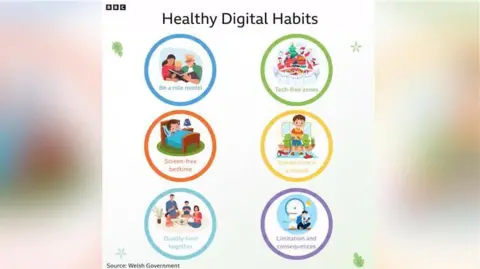
The Welsh government recommends things such as tech-free zones and limits to screen usage.
Katie, a mother of two from Swansea, was initially resistant to tech and wanted to be a “no-screens” household.
“I was just like, ‘no, I won’t use any screens, nothing’,” she recalls, before quickly realising the practical impossibility of that goal.
During Christmas flexibility becomes essential, she says. She allows her children to use devices more freely but with rules.
“We don’t do screens at the dinner table,” she says, “especially not at Christmas.”
She also rejects the idea that resorting to screen time is “lazy parenting”.
During a period of postnatal depression, she says, the short breaks screens provided were vital.
“That five minutes that I was given [by screen time] to myself contributed to saving my life,” she said.
It gave her space and time to refocus and concentrate on herself, she added.
“When you see another mother or father doing that, you don’t know their situation.”
Katie believes parents are judged either way, adding: “If your child is running around screaming at a Christmas gathering, you get judged.
“If they’re sitting quietly with a tablet, you get judged. You can’t win.”
 Contributor Picture
For other families, screen use is not a matter of preference but a medical issue.
Suzanne and her husband, Craig, from Sully in the Vale of Glamorgan, say their perspectives shifted dramatically after their daughter, Amayah, was diagnosed with severe myopia (short-sightedness) at just three-and-a-half years old.
“It will always get worse. It will never get better,” Suzanne says.
“Phones, tablets – anything close-up will make it worse.”
The diagnosis led to an immediate overhaul of the family’s routines.
Close screens were removed entirely and outdoor time increased significantly following medical advice recommending at least two hours outside a day.
“We were those parents at one point,” Suzanne says.
“But since the diagnosis we’ve seen a complete change in Amayah.
“She doesn’t even ask for the devices any more.”
The children’s commissioner for Wales, Rocio Cifuentes, said she hopes parents take a sensible approach to screen time and social media, including leading by example “so that it doesn’t interfere with the celebrations and is balanced with family interaction and physical activity.”
Ms Cifuentes ran a survey over the summer with children and young people, and found more than half already had rules in place about screen time.
She added: “Christmas should be a time for children and young people to relax and enjoy themselves – and for many that may involve activities using a screen.
“There is nothing wrong with that, for many it is a way to forge friendships and stay connected.
“However, it’s vital to ensure that the correct safeguarding measures are in place to protect our children from exposure to harmful content or contacts, particularly on any new devices.”