




























News
  • Login
  • Home
  • News
  • Sport
  • Worklife
  • Travel
  • Reel
  • Future
  • More
Tuesday, April 28, 2026
No Result
View All Result

NEWS

3 °c
London
8 ° Wed
9 ° Thu
11 ° Fri
13 ° Sat
  • Home
  • Video
  • World
    • All
    • Africa
    • Asia
    • Australia
    • Europe
    • Latin America
    • Middle East
    • US & Canada

    Man who murdered UK dad in Australia declared mentally unfit for trial

    Rescuers race to free survivors trapped inside train after fatal crash

    Russian fighters confirm withdrawal from northern Mali city after separatist attacks

    Executions in North Korea ramped up significantly during pandemic – report

    Venice opera house drops incoming music director after nepotism remarks

    Colombia offers record $1.4m-reward for rebel it blames for deadly bomb attack

    Israeli strikes kill 14 in Lebanon amid ongoing ceasefire

    King to defend 'democratic values' as US state visit begins

    Was Harry and Meghan’s Australia trip a success?

  • UK
    • All
    • England
    • N. Ireland
    • Politics
    • Scotland
    • Wales

    Keir Starmer faces vote on inquiry over Mandelson vetting claims

    What's the score with Scotland's World Cup holiday – and will schools be off?

    Family's plea to save dream Disney trip for girl, 6, left blind by brain tumour

    Free sign language classes to be offered for deaf children in UK first

    Five things to look out for in the leaders' debate

    John Higgins recovers to beat Ronnie O’Sullivan in Crucible epic, but Judd Trump is eliminated

    'It lit a fire in me' – the barrister who was told she'd never amount to much

    Win or bust for Rangers as Hearts test at Tynecastle on May bank holiday looms large

    URC: Wales hopeful Morgan Morris aims for strong finish to toughest year

  • Business
    • All
    • Companies
    • Connected World
    • Economy
    • Entrepreneurship
    • Global Trade
    • Technology of Business

    My tenant owes £15,000 in rent, but I can’t get them out of the property

    European flight prices are falling in short term, Wizz Air boss says

    'I don't want the children to see how worried we are': UK family finances hit by Iran war

    Oil prices rise as US-Iran peace talks stall

    How long has fast food been around and when did it become popular?

    Three ways the latest inflation figures affect you

    England shirt overpriced, says £40k kits collector

    McDonald's boss on abuse claims: 'I don't want to talk about the past'

    UK borrowing lowest for three years but Iran war clouds outlook

  • Tech
  • Entertainment & Arts

    Dancers say Lizzo ‘needs to be held accountable’ over harassment claims

    Freddie Mercury: Contents of former home being sold at auction

    Harry Potter and the Cursed Child marks seven years in West End

    Sinéad O’Connor: In her own words

    Tom Jones: Neighbour surprised to find singer in flat below

    BBC presenter: What is the evidence?

    Watch: The latest on BBC presenter story… in under a minute

    Watch: George Alagiah’s extraordinary career

    BBC News presenter pays tribute to ‘much loved’ colleague George Alagiah

    Excited filmgoers: 'Barbie is everything'

  • Science
  • Health
  • In Pictures
  • Reality Check
  • Have your say
  • More
    • Newsbeat
    • Long Reads

NEWS

No Result
View All Result
Home Science

Record year for wind and solar electricity in Great Britain in 2025

January 3, 2026
in Science
13 min read
245 7
0
491
SHARES
1.4k
VIEWS
Share on FacebookShare on Twitter


Mark Poynting,Climate researcher,

Becky Dale,Senior data journalist, BBC Verifyand

Jess Carr,Data designer
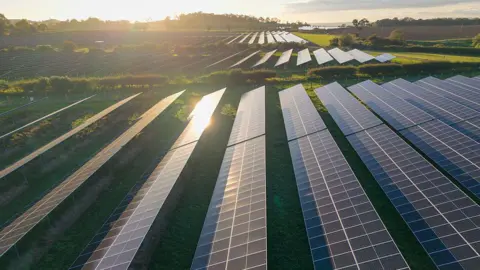
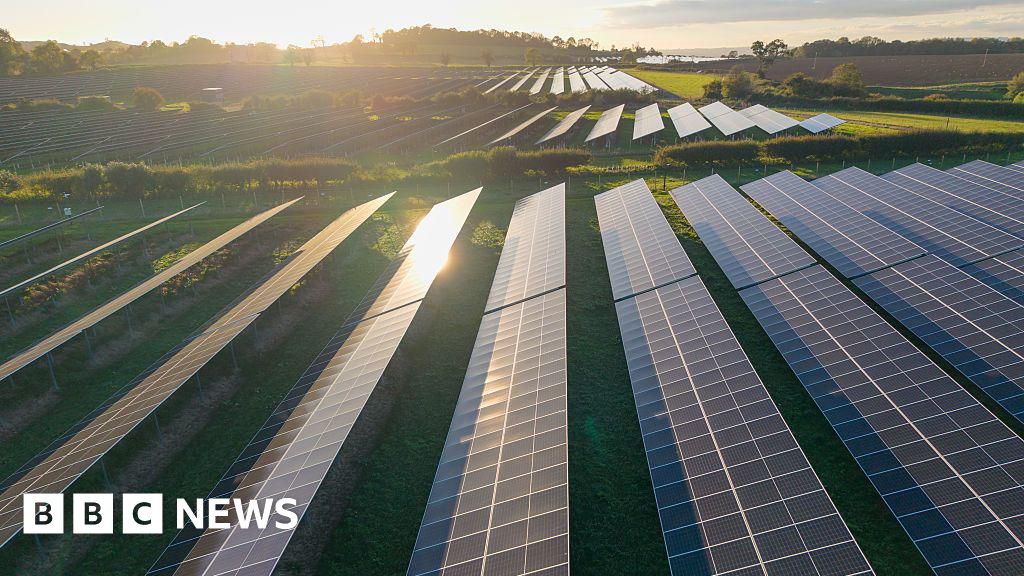
Getty Images Rows of solar panels in green fields and between hedgerows. Getty Images

Renewable energy – considered crucial to limiting climate change – produced a record amount of electricity in Great Britain in 2025, BBC analysis shows.

Wind was the biggest single renewable source of electricity, according to the provisional figures from the National Energy System Operator (Neso).

But solar-powered electricity rose by nearly a third on 2024 levels, helped by the UK’s sunniest year on record and the expansion of solar panels around the country.

While behind renewables, electricity from fossil gas also rose slightly, highlighting the challenge of reaching the government’s “clean power” target by 2030.

“It has been quite a strong year in terms of deployment of renewables,” said Pranav Menon, research senior associate at the Aurora Energy Research think tank.

“[But] what we’re not seeing is kind of the exponential scale-up that you’d need to get to clean power 2030, because those targets are very, very ambitious,” he added.

Under its “clean power” target, the government aims to use hardly any polluting gas to produce electricity by 2030. It is also under pressure to meet its pledge to bring energy bills down by up to £300 by then and has argued that clean power can achieve this.

Neso data – and the clean power target – only cover Great Britain and not Northern Ireland, which has its own electricity transmission system operator.

The recent growth of renewables has been one of the strongest areas of progress in the world’s attempts to tackle climate change.

The trend has been notable in Great Britain over the past decade too. The government wants to ramp up renewables even more quickly to help meet its own clean power goal and reduce its planet-warming carbon emissions.

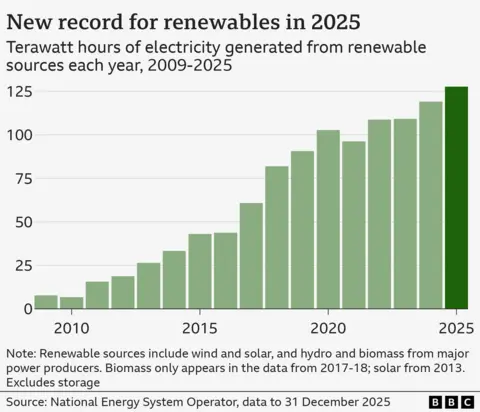
In 2025, wind, solar, hydro and biomass generated more than 127 terawatt hours (TWh) of electricity in Great Britain, according to BBC analysis of provisional Neso data.

That beats the previous high of 119TWh in 2024.

Green bar chart showing the total amount of electricity generated from renewable sources by year, from 2009 to 2025. The bar heights increase across the period from a low of 9 terawatt hours in 2010 to a high of 127 terawatt hours in 2025.

Wind generated more than 85TWh – nearly 30% – of Great Britain’s electricity last year, up slightly on 2024, according to analysis of Neso data.

But the most notable change was solar power.

Over the course of the year, solar panels generated more than 18TWh – over 6% of British electricity.

While that is still a relatively small share, it marks a growth of more than 4TWh versus 2024.

At its peak, solar was producing more than 40% of electricity for a small number of half-hour periods in July.

Back in 2013, no such period had more than roughly 5% of electricity generation from solar.
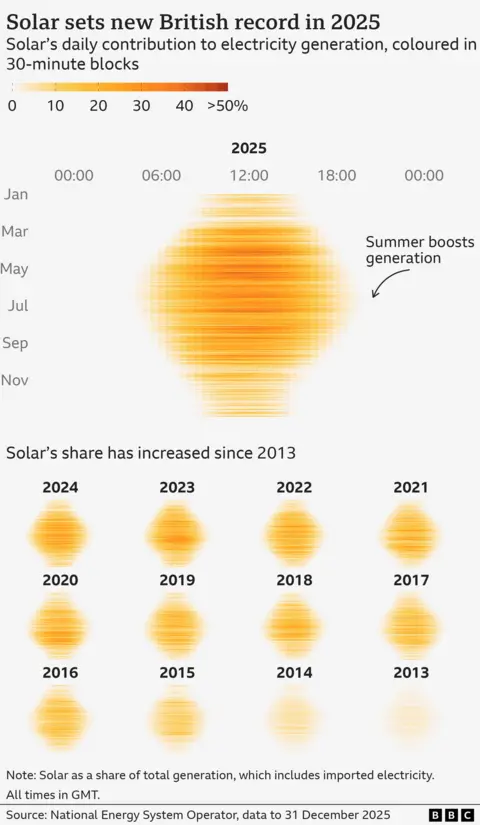
A two-section chart showing on top the daily contribution of solar to Britain's total electricity generation in 2025 broken into 30-minute periods which are coloured according to their intensity, from white representing 0% to a deep orange to represent 50% or higher. Every day is ordered top-to-bottom from 1 January to 31 December and left-to-right from midnight to 23:59. The days in summer have more shaded blocks as would be expected with longer days and winter days have fewer. The bottom section repeats this chart in multiple facets, one per year from 2013 to 2024, with the overall intensity of shading darkening as years progress to correspond to solar's increased share in generation.

Part of the reason is the expansion of solar panels across the UK. More large solar farms came online this year, including the biggest at Cleve Hill near Faversham, in Kent.

And it was a record year for solar panels on rooftops, with about 250,000 new small-scale installations reported to the Microgeneration Certification Scheme.

With 2025 the UK’s sunniest year on record, conditions were ideal for British solar panels to capitalise on long, sunny days through the spring and summer.

“Solar’s probably a bigger part of the system than we’d expected, given the cost has come down so much,” said Michael Grubb, professor of energy and climate change at University College London.

Renewables can generate significant amounts of electricity when conditions are right. On roughly a third of days in 2025, at least half of Britain’s electricity came from renewables, according to BBC analysis of Neso data.
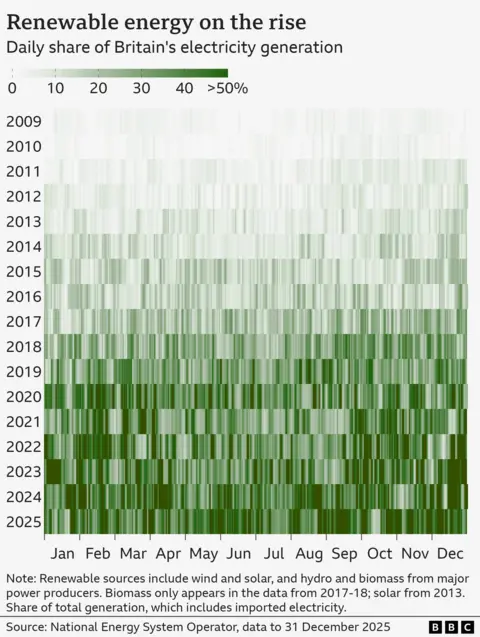
Tile chart with one tile per day arranged by year from 2009 at the top to 2025 at the bottom, shaded on a gradient scale where white represents 0% share of electricity generated from renewables to dark green which represents 50% or more. On average the years 2009 to 2013 are very light and the more recent years are much darker, with more days reaching the 50% mark.

But the British electricity grid often still leans heavily on fossil fuel gas.

Analysis of Neso’s figures shows gas generated more than 77TWh – roughly 27% – of electricity, up from 72TWh in 2024.

That increase could be down to several factors, including Britain importing slightly less electricity from Europe, lower nuclear generation, the closure of the last coal power station in 2024 and higher electricity demand.

Driven by the rise in gas, Britain’s electricity was slightly more polluting in 2025 than 2024, according to Neso’s data.

In 2025, each kilowatt-hour (kWh) of electricity generated 126g of planet-warming carbon dioxide on average – up from 124g/kWh in 2024 but down from 505g/kWh in 2012.
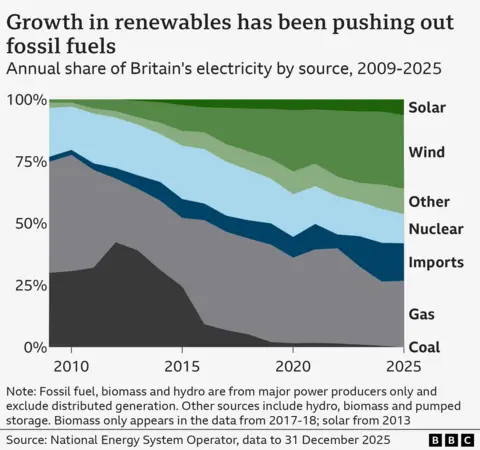
Area chart showing the proportion of Britain's electricity generation by different fuel sources for each year from 2009 to 2025. In 2009 about three-quarters of all electricity came from gas and coal, with nuclear picking up most of the remaining generation. Renewables including wind and solar were a tiny fraction at that time, but have steadily increased their share up to 2025, with fossil fuel generation decreasing at the same time.

With the exception of wind and solar, Neso’s figures only cover generation connected to the main transmission network.

They do not include smaller-scale gas, biomass and hydro operators feeding in electricity at a local level, but these contribute a relatively small fraction of Britain’s total generation.

Separate analysis of UK government data by the climate website Carbon Brief – which includes these smaller sources and Northern Ireland – shows very similar trends to the Neso data for Great Britain. That includes a new renewables record and a slight rise in gas generation.

Off track for clean power?

The government has defined its “clean power” target as 95% of all electricity generated in Britain coming from renewables and nuclear energy by 2030.

In 2024 clean sources produced almost three-quarters of total electricity generation for the year, according to government figures.

These numbers differ from Neso data, which includes imports as well as some gas generation not covered by the government’s clean power definition.

Government figures for 2025 will not be released until later this year – but the amount of gas still in the electricity mix shows there is much to be done.

“There’s still a significant number of periods in the year where the sun’s not shining, the wind’s not blowing, demand is high […] and that’s where the system is sort of forced to rely on gas-fired power to turn up and meet demand,” said Mr Menon.

He added that there were solutions to this challenge. They include technologies like batteries – to store renewable electricity to use when it is less sunny and windy – as well as other low-carbon sources like nuclear, which can provide dependable output.

One of the other struggles in meeting the clean power target is the need to upgrade the electricity grid, partly to connect new renewables and move their electricity around the country.

Sometimes the grid cannot cope with all of the renewable electricity that could be generated, leading to wind farms being paid to reduce their output.

Grid upgrades should help to reduce the problem but upgrades add to costs in the short term.

That could offset some of the savings from some of the cheapest renewables which are starting to displace gas power, according to Prof Grubb.

But he said he still expected bills to start to come down in the coming years – partly due to those renewables, but also assuming gas prices fall from their recent high levels.

In response to the renewables data, Energy Secretary Ed Miliband said: “After years of delay and underinvestment, this government is keeping its promise to take back control of Britain’s energy with clean homegrown power.”

This would “protect households against volatile fossil fuel markets”, he added.

But shadow energy secretary Claire Coutinho called on the government to ditch its clean power target, arguing it was raising energy bills.

“Britain is generating more renewable power than ever before, but people should know about the extra costs that come along with it,” she said.


Thin, green banner promoting the Future Earth newsletter with text saying, “The world’s biggest climate news in your inbox every week”. There is also a graphic of an iceberg overlaid with a green circular pattern.


Source link

Tags: BritainelectricityGreatrecordsolarwindyear

Related Posts

How do you restore the wild spaces in a corner of England?

April 28, 2026
0

Plans to improve nature have been unveiled, aiming to restore habitats and protect wildlife. Source link

UK's biggest ever environmental pollution claim reaches High Court

April 27, 2026
0

One of the UK's largest chicken producers and a water company accused of polluting three rivers including the River...

A 17th Century 'supercomputer' once owned by Indian royalty heads for auction

April 26, 2026
0

The astrolabe - or astronomical computer - is possibly the largest in existence and has never been exhibited before....

  • Australia helicopter collision: Mid-air clash wreckage covers Gold Coast

    523 shares
    Share 209 Tweet 131
  • UK inflation: Supermarkets say price rises will ease soon

    515 shares
    Share 206 Tweet 129
  • Ballyjamesduff: Man dies after hit-and-run in County Cavan

    510 shares
    Share 204 Tweet 128
  • Somalia: Rare access to its US-funded 'lightning commando brigade

    508 shares
    Share 203 Tweet 127
  • Google faces new multi-billion advertising lawsuit

    508 shares
    Share 203 Tweet 127
  • Trending
  • Comments
  • Latest

Australia helicopter collision: Mid-air clash wreckage covers Gold Coast

January 10, 2023

UK inflation: Supermarkets say price rises will ease soon

April 19, 2023

Ballyjamesduff: Man dies after hit-and-run in County Cavan

August 19, 2022

Stranger Things actor Jamie Campbell Bower praised for addiction post

0

NHS to close Tavistock child gender identity clinic

0

Cold sores traced back to kissing in Bronze Age by Cambridge research

0

How do you restore the wild spaces in a corner of England?

April 28, 2026

Keir Starmer faces vote on inquiry over Mandelson vetting claims

April 28, 2026

Lamine Yamal and Chris Martin help Polish influencer raise more than £50m for cancer patients

April 28, 2026

Categories

Science

How do you restore the wild spaces in a corner of England?

April 28, 2026
0

Plans to improve nature have been unveiled, aiming to restore habitats and protect wildlife. Source link

Read more

Keir Starmer faces vote on inquiry over Mandelson vetting claims

April 28, 2026
News

Copyright © 2020 JBC News Powered by JOOJ.us

Explore the JBC

  • Home
  • News
  • Sport
  • Worklife
  • Travel
  • Reel
  • Future
  • More

Follow Us

  • Home Main
  • Video
  • World
  • Top News
  • Business
  • Sport
  • Tech
  • UK
  • In Pictures
  • Health
  • Reality Check
  • Science
  • Entertainment & Arts
  • Login

Copyright © 2020 JBC News Powered by JOOJ.us

Welcome Back!

Login to your account below

Forgotten Password?

Create New Account!

Fill the forms bellow to register

All fields are required. Log In

Retrieve your password

Please enter your username or email address to reset your password.

Log In
This website uses cookies. By continuing to use this website you are giving consent to cookies being used. Visit our Privacy and Cookie Policy.
News
More Sites

    MORE

  • Home
  • News
  • Sport
  • Worklife
  • Travel
  • Reel
  • Future
  • More
  • News

    JBC News