






























Australia correspondent
Australia boasts plenty of superlatives when it comes to its natural landmarks. The Great Barrier Reef, the world’s biggest coral reef system on the north-east coast, is rightly recognised as a Unesco World Heritage Site. Buzzing with biodiversity, it’s a diver’s dream.
But there’s a lesser-known record breaker on the other side of the country, on Australia’s north-western coast: Ningaloo Reef.
A 14-hour drive north of Perth, Ningaloo is unique. The world’s largest fringing reef and another of Australia’s Unesco World Heritage Sites, it is home to a lush oceanic forest that spreads out along the coast for hundreds of kilometres.
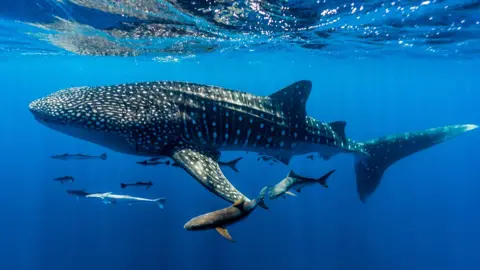
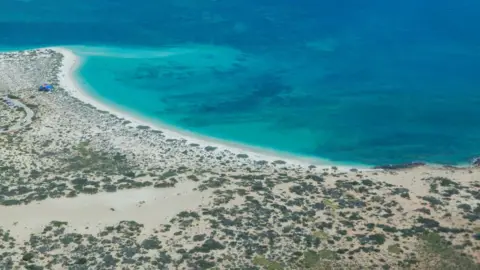
From the region’s remote desert beaches, you can wade into vibrant turquoise waters and almost immediately start snorkelling in a seascape as famous for its vibrant corals as the wildlife that surrounds them – manta rays, reef sharks and whale sharks.
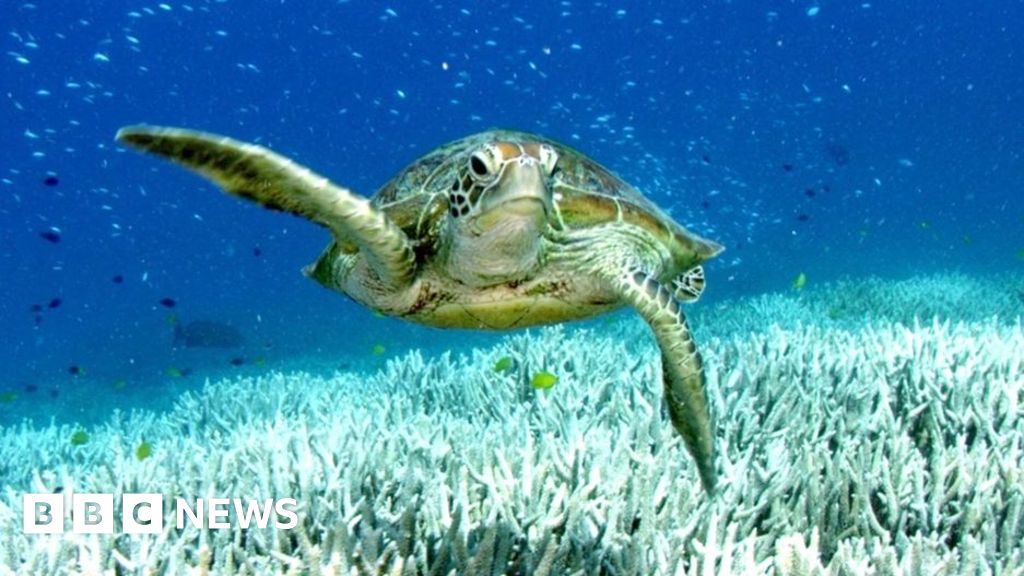
But this year, Ningaloo has found itself in trouble. Hit by a marine heatwave, higher water temperatures have stressed the corals and they’ve been turning white, in an effect known as ‘bleaching’. While some may recover, it’s not a given – and the damage has astounded scientists.
Not only that, but the heatwave is responsible for another, more worrying superlative. This is the first time that the reefs on both Australia’s western and eastern coasts have been bleached.
“It’s like a raging underwater bushfire that has persisted for months now, wreaking harm right along the coast,” says Paul Gamblin, who heads up the Australian Marine Conservation Society. “It’s an absolutely devastating event and people are reeling from it. It is enormous. It’s unprecedented. It’s absolutely not normal.”
 Getty Images
What’s going on?
The marine heatwave that’s damaging Ningaloo started in the Caribbean in 2023 . It then made its way across the Indo-Pacific, damaging coral reefs in its path. In 2024, while the Great Barrier Reef saw bleaching, Ningaloo was spared. But by the end of last year and the beginning of 2025 – peak summer – temperatures had begun to soar in Western Australia.
It’s all part of the fourth global bleaching event, which experts say has affected more than 80% of the world’s coral reefs.
Dr Kate Quigley, principal research scientist at Minderoo Foundation, likens the effect to a stomach bug.
“Instead of having bacteria in the human gut, corals have this little algal symbiont that lives inside their cells that allow them to do biological processes,” she explains, adding that this algae is what gives the corals their colour. When water becomes too warm, that relationship breaks down and bleaching begins.
“So, kind of like, if we got a stomach bug and the human body doesn’t function the same way, [it’s the] same thing with the coral,” she explains. “The warm water causes the biological processes inside that coral to go haywire. And just like humans get sick, corals get sick too.”
Of particular worry to Dr Quigley is the prolonged warming scientists have seen. They expected temperatures to drop by April as peak summer passed. This year, that didn’t happen.

 Getty Images
“In previous warming events, water temperatures might have increased for a bit of time and then gone back down again so the corals can essentially recover – they can bounce back,” explains Dr Quigley. “But what we’re really afraid of seeing, especially in the coming months, is really high levels of death.”
While government scientists have been monitoring the reef, there’s still a lot they don’t know.
“The natural world is an incredibly variable place, and sometimes we’re… shocked by what we see, [because] it doesn’t seem to follow the rules,” says Dr Tom Holmes, the Marine Science Programme Leader at the Department of Biodiversity, Conservation and Attractions in Western Australia.
Dr Holmes and his team are doing follow-up surveys between three and six months after the bleaching to assess how many corals have died.
“There are certainly records of corals [being] in a bleached state for that period of time and still surviving,” he says. “So we just need to play the waiting game now.”
Ningaloo attracts around 200,000 tourists to its waters each year. For swimmers and divers, though, the damage is clear.
“It was like snorkelling on a corpse,” says British-South African tourist Jenna-Rae Clark, who has been up and down the coastline of Ningaloo in recent weeks. “It was so grey and lifeless. You can sometimes hear fish munching on the coral – there was nothing.”
For residents, there’s an additional fear: that tourists will turn their back on Ningaloo.
“People have been really devastated off the back of summer, and a lot of people are talking about how they were crying in the water, coming out of the ocean just really upset,” says Sara Morgillo, who moved here from Perth to dive and work in conservation.
“There’s still amazing parts of the reef here that are worth seeing and we’re still running dive tours every day,” she adds.
“I think it’s also really important to witness what’s happening and [see] the effects of the marine heat wave that we’ve had.”
Why is this happening?
Scientists are all in agreement about what’s causing this heatwave: rising carbon emissions are heating up the planet and its oceans. According to Nasa, the ocean is where 90% of global warming is happening – and the last decade was its warmest since the 1800s. Last year was its warmest on record.
These more worrying superlatives are threatening Australia’s famous landmarks. But there’s another, more home-grown problem too.
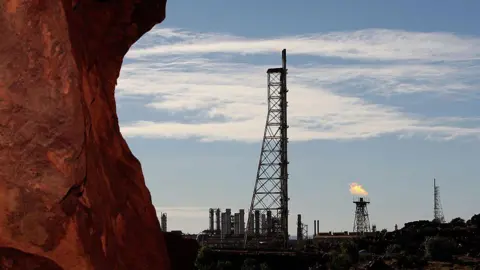
Just up the coast from Ningaloo is one of the world’s largest fossil fuel projects, the North West Shelf gas plant. In May, the Australian government announced it would allow Woodside, the company which runs the project, to keep it operating until 2070.
The same company is also trying to get approval to develop Australia’s biggest untapped gas reserves in the Browse Basin, further up the coast.
 Getty Images
While these projects alone don’t create the heat that’s damaging Ningaloo, it’s a symbol of the competing interests in Western Australia – where the gas industry fuels the economy far more than tourism.
“The Great Barrier Reef and Ningaloo are sources of deep wonder, the equivalent of Antarctica or the Serengeti or the Amazon,” says the Australian Marine Conservation Society’s Paul Gamblin.
“The juxtaposition is incomprehensible: at a time when places like Ningaloo are clearly suffering the consequences of climate change, for government even to contemplate opening up new fossil fuel projects… It shouldn’t happen, and governments need to draw a line in the sand and make a clear commitment not to make the situation even worse.”
Finding a fix
While the larger debate continues over the use of fossil fuels, scientists are working to better understand the reef in an effort to help it.
The University of Queensland’s Dr Chris Roelfsema and his team are mapping Ningaloo by taking photos of the corals and linking them with drone images. That way they can better track their health.
“People ask me, what can we do? Well, the first thing you can do is choose politicians that are considering reducing fossil fuels and are [supportive of] renewable energies,” says Dr Roelfsema. “Your vote has a voice for politicians, so you can choose that. But you can also drive less, [use] public transport, not have your air conditioning on all the time – these are all things that can help reduce our footprint.”
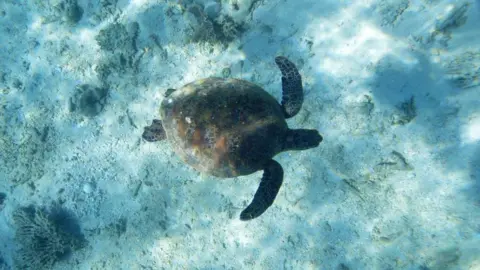
There’s also science being done in the lab. Dr Quigley and her team at Minderoo have been selectively breeding combinations of corals to find out which types are the most tolerant to higher temperatures.
“We have these fertilized eggs from many, many different genetic backgrounds and we raise them over a series of days until we have coral babies, coral teenagers,” she explains. “Just like butterflies, corals also undergo different metamorphoses and stages.”
By testing those corals, researchers can assess which ones are more tolerant to higher temperatures. Then the idea is to place them back in the water.
 Getty Images
While Dr Quigley has done this in the Great Barrier Reef, it’s at a much earlier stage here in Ningaloo – and she admits that the method is not ideal.
“It would be very hard to scale for all reefs around the world,” she concedes. “It would make much more sense to get at the root cause, which is emissions, for that long-term livelihood of coral reefs.”
Viewed by critics as merely a sticking plaster, there’s pressure for authorities to do more. That brings Dr Quigley back to the bushfire analogy.
“Interestingly, when bushfires happen here in Australia, the authorities are on it very quickly – there’s a lot of response,” she says. “You don’t see that on the coral reefs in Australia.”
One reason may be because it’s corals at risk, not people. After all, there are no houses in the path of the underwater bushfire.
Experts, however, say such a view is shortsighted. Coral reefs are home to 25% of all marine life. But they also look after human life.
“They are absolutely supercharged with nature and diversity and support the tiniest creatures to the biggest,” says Paul Gamblin. “They also support millions of people’s livelihoods all over the world, and protect the coast from storm surges and extreme storm events that we’re seeing more with climate change. So they provide enormous services to the planet.”
These services often get forgotten by those above the surface. But as fossil fuels continue to warm the planet, life in the oceans is feeling the heat.