






News
  • Login
  • Home
  • News
  • Sport
  • Worklife
  • Travel
  • Reel
  • Future
  • More
Tuesday, March 3, 2026
No Result
View All Result

NEWS

3 °c
London
8 ° Wed
9 ° Thu
11 ° Fri
13 ° Sat
  • Home
  • Video
  • World
    • All
    • Africa
    • Asia
    • Australia
    • Europe
    • Latin America
    • Middle East
    • US & Canada

    Carney to push his middle power strategy during Australia visit

    What happened on the third day of the US-Israeli war with Iran

    Anglican divisions deepen as rebel clerics pick rival to first female leader

    India and Canada reset ties with 'landmark' nuclear energy deal

    France to boost nuclear arsenal and extend deterrence to European allies

    BBC sees burnt cars in Puerto Vallarta after Mexican cartel violence

    How the US-Israel war with Iran is jeopardising shipping

    Melania Trump chairs UN Security Council meeting on children in conflict amid Iran strikes

    Asian Cup: Sam Kerr scores first goal in 28 months as Australia beat Philippines

  • UK
    • All
    • England
    • N. Ireland
    • Politics
    • Scotland
    • Wales

    One of UK's richest men wants German citizenship over 'hostility' to Jews

    Police brothel raids target organisers, not sex workers

    M4 relief road and income tax cuts in Welsh Tories' election manifesto

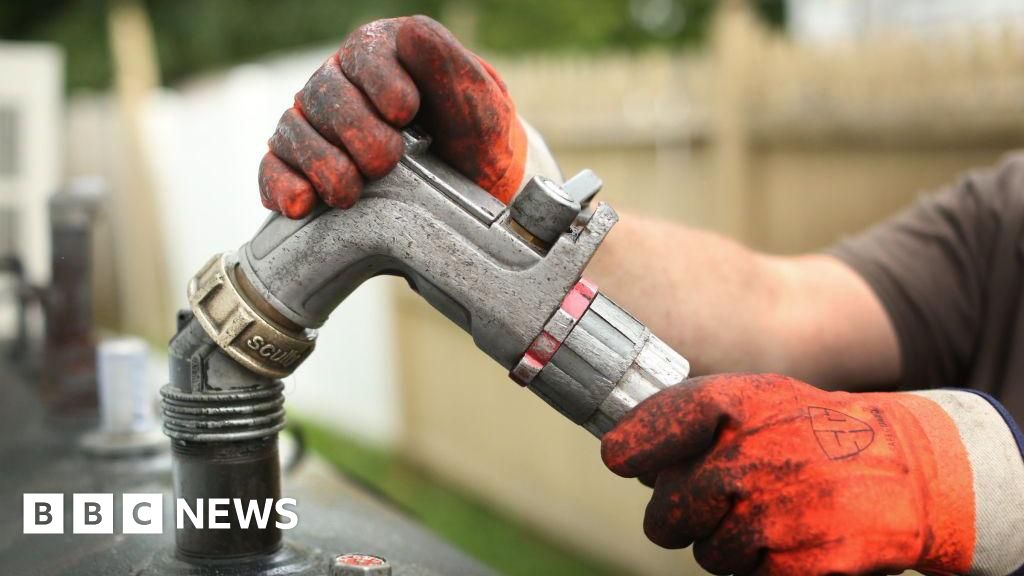
    Heating oil prices rise by more than £100 amid Middle East conflict

    Parents of nursery abuse victims to meet Bridget Phillipson

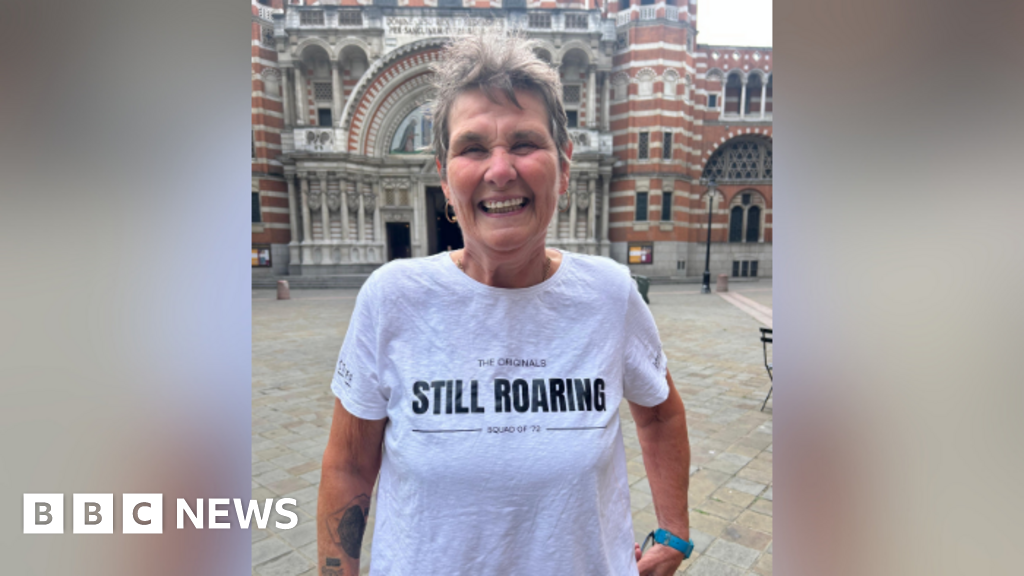
    England leads tributes to first Lioness Lynda Hale

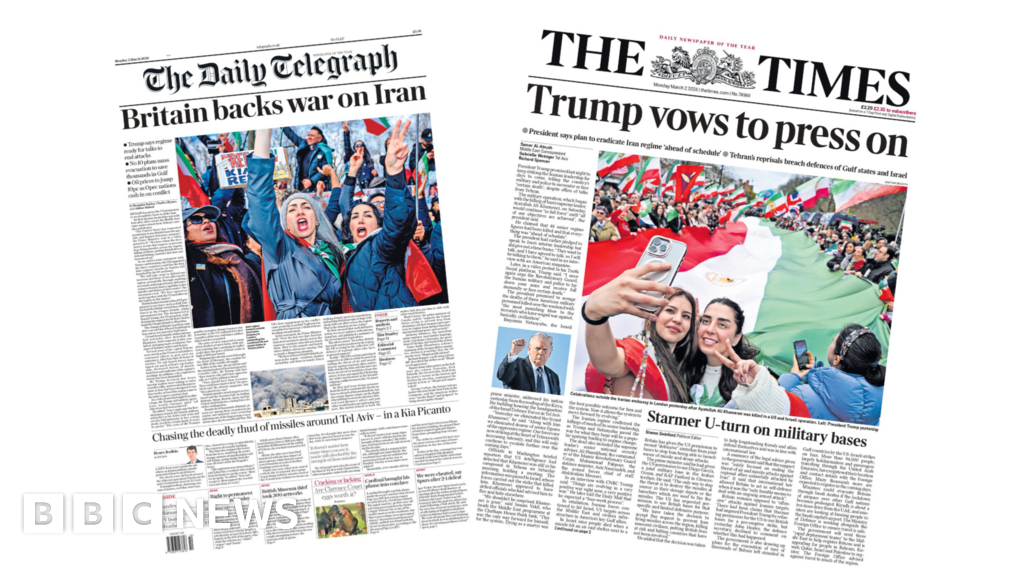
    The Papers: 'Britain backs war on Iran' and 'Trump vows to press on'

    Watch: Rangers v Celtic – Sportscene highlights

    Wales battle to draw with Chile in FIH World Cup qualifying

  • Business
    • All
    • Companies
    • Connected World
    • Economy
    • Entrepreneurship
    • Global Trade
    • Technology of Business

    'I've given up on hospitality. The £15,000 pay isn't worth the stress'

    Warmer weather hits profits at British Gas owner

    'The search is soul-destroying': Young jobseekers on the struggle to find work

    Oil prices rise after ships attacked near Strait of Hormuz

    Lobbying firm co-founded by Mandelson goes into administration

    Reeves fixated on 'dysfunctional' borrowing rules, says IFS

    What the Warner Bros deal could mean for streaming, cinemas and news

    Ocado to axe 1,000 jobs in cost-cutting drive

    What in the World – Why is the gold price so high right now?!

  • Tech
  • Entertainment & Arts

    Dancers say Lizzo ‘needs to be held accountable’ over harassment claims

    Freddie Mercury: Contents of former home being sold at auction

    Harry Potter and the Cursed Child marks seven years in West End

    Sinéad O’Connor: In her own words

    Tom Jones: Neighbour surprised to find singer in flat below

    BBC presenter: What is the evidence?

    Watch: The latest on BBC presenter story… in under a minute

    Watch: George Alagiah’s extraordinary career

    BBC News presenter pays tribute to ‘much loved’ colleague George Alagiah

    Excited filmgoers: 'Barbie is everything'

  • Science
  • Health
  • In Pictures
  • Reality Check
  • Have your say
  • More
    • Newsbeat
    • Long Reads

NEWS

No Result
View All Result
Home Science

Before and after images show glaciers vanishing before our eyes

October 5, 2025
in Science
12 min read
247 6
0
491
SHARES
1.4k
VIEWS
Share on FacebookShare on Twitter


Mark PoyntingClimate and science reporter, BBC News
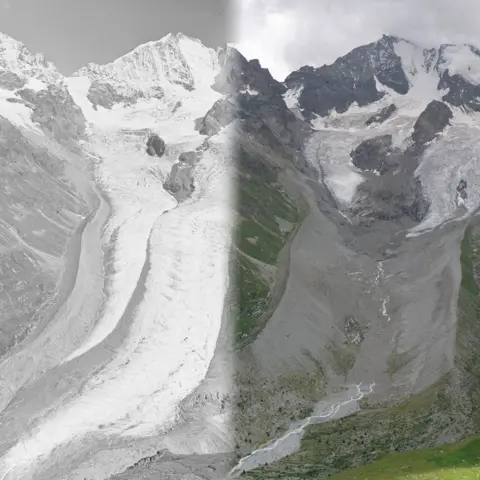
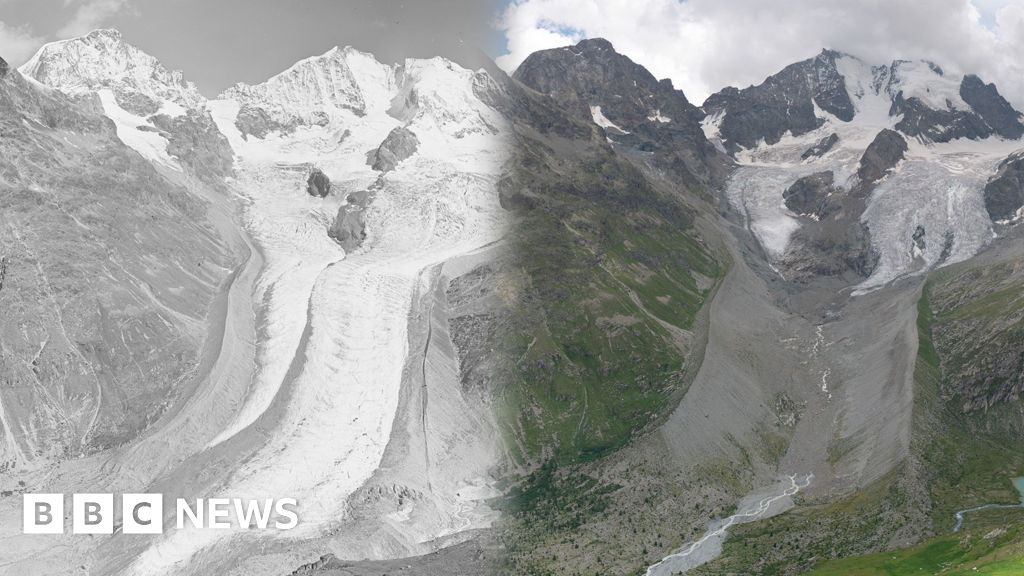
BBC Blended image comparison of the Tschierva Glacier in 1935 on the left and 2022 on the right. The glacier extends far down the valley in 1935 but has retreated way up the valley by 2022.BBC

When Matthias Huss first visited Rhône Glacier in Switzerland 35 years ago, the ice was just a short walk from where his parents would park the car.

“When I first stepped onto the ice… there [was] a special feeling of eternity,” says Matthias.

Today, the ice is half an hour from the same parking spot and the scene is very different.

“Every time I go back, I remember how it used to be,” recalls Matthias, now director of Glacier Monitoring in Switzerland (GLAMOS), “how the glacier looked when I was a child.”

There are similar stories for many glaciers all over the planet, because these frozen rivers of ice are retreating – fast.

In 2024, glaciers outside the giant ice sheets of Greenland and Antarctica lost 450 billion tonnes of ice, according to a recent World Meteorological Organization report.

That’s equivalent to a block of ice 7km (4.3 miles) tall, 7km wide and 7km deep – enough water to fill 180 million Olympic swimming pools.

“Glaciers are melting everywhere in the world,” says Prof Ben Marzeion of the Institute of Geography at the University of Bremen. “They are sitting in a climate that is very hostile to them now because of global warming.”

Switzerland’s glaciers have been particularly badly hit, losing a quarter of their ice in the last 10 years, measurements from GLAMOS revealed this week.

“It’s really difficult to grasp the extent of this melt,” explains Dr Huss.

But photos – from space and the ground – tell their own story.

Satellite images show how the Rhône Glacier has changed since 1990, when Dr Huss first visited. At the front of the glacier is a lake where there used to be ice.

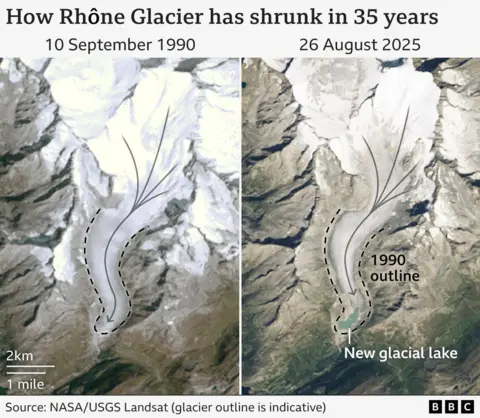
Satellite images showing how Rhône Glacier has shrunk between 1990 and 2025. The glacier flows from top to bottom of the image. The glacier front has noticeably retreated, and a glacial lake is now visible where the ice used to be.

Until recently, glaciologists in the Alps used to consider 2% of ice lost in a single year to be “extreme”.

Then 2022 blew that idea out of the water, with nearly 6% of Switzerland’s remaining ice lost in a single year.

That has been followed by significant losses in 2023, 2024 and now 2025 too.

Regine Hock, professor of glaciology at the University of Oslo, has been visiting the Alps since the 1970s.

The changes over her lifetime are “really stunning”, she says, but “what we see now is really massive changes within a few years”.

The Clariden Glacier, in north-eastern Switzerland, was roughly in balance until the late 20th Century – gaining about as much ice through snowfall as it lost to melting.

But this century, it’s melted rapidly.
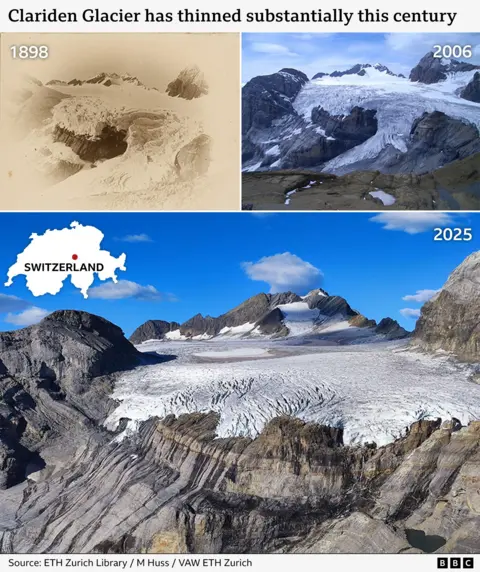
Two images showing Clariden Glacier in 1898 and 2006, above a larger image of the same glacier in 2025. The glacier has visibly shrunk between 1898 and 2006, but the changes between 2006 and 2025 are even more noticeable: the ice is thinner and has retreated.

For many smaller glaciers, like the Pizol Glacier in the north-east Swiss Alps, it’s been too much.

“This is one of the glaciers that I observed, and now it’s completely gone,” says Dr Huss. “It definitely makes me sad.”

Photographs allow us to look even further back in time.

The Gries Glacier, in southern Switzerland near the Italian border, has retreated by about 2.2km (1.4 miles) in the past century. Where the end of the glacier once stood is now a large glacial lake.
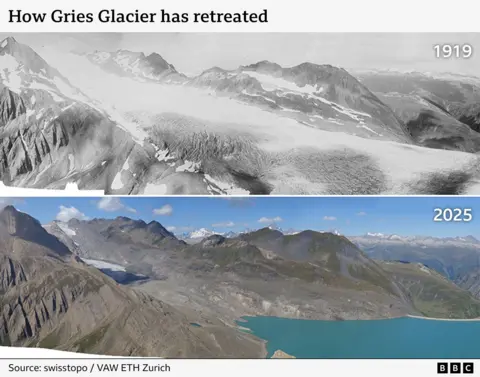
Two images of Gries Glacier, one in 1919 above and one in 2025 below. In 1919 a thick glacier is flowing from left to right, extending off the page. In 2025 the glacier only just enters at the left-hand side of the image. Where the ice once was is a large area of exposed bedrock, followed by a bright blue glacier lake.

In south-east Switzerland, the Pers Glacier once fed the larger Morteratsch Glacier, which flows down towards the valley. Now the two no longer meet.

And the largest glacier in the Alps, the Great Aletsch, has receded by about 2.3km (1.4 miles) over the past 75 years. Where there was ice, there are now trees.
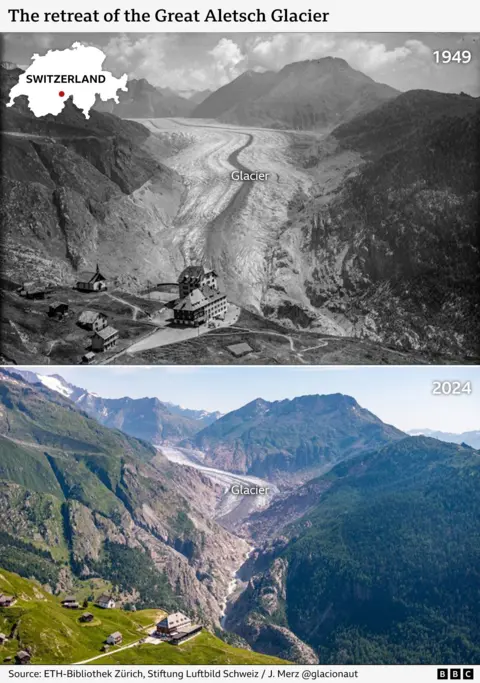
Two images of the Great Aletsch Glacier, one in 1949 above and one in 2024 below. The glacier emerges in between two steep valley walls. In 1949, the glacier extends almost all the way down the image; in 2024, it only just emerges in the background. There are trees and bedrock where there used to be ice.

Glaciers have grown and shrunk naturally for millions of years, of course.

In the cold snaps of the 17th, 18th and 19th Centuries – part of the Little Ice Age – glaciers regularly advanced.

During this time, many were considered cursed by the devil in Alpine folklore, their advances linked to spiritual forces as they threatened hamlets and farmland.

There are even tales of villagers calling on priests to talk to the spirits of glaciers and get them to move up the mountain.

Glaciers began their widespread retreat across the Alps in about 1850, though the timing varied from place to place.

That coincided with rising industrialisation, when burning of fossil fuels, particularly coal, began to heat up our atmosphere, but it’s hard to disentangle natural and human causes that far back in time.

Where there is no real doubt is that the particularly rapid losses of the past 40 years or so are not natural.

Without humans warming the planet – by burning fossil fuels and releasing huge amounts of carbon dioxide (CO2) – glaciers would be expected to be roughly stable.

“We can only explain it if we take into account CO2 emissions,” confirms Prof Marzeion.

What is even more sobering is that these large, flowing bodies of ice can take decades to fully adjust to the rapidly warming climate. That means that, even if global temperatures stabilised tomorrow, glaciers would continue to retreat.

“A large part of the future melt of the glaciers is already locked in,” explains Prof Marzeion. “They are lagging climate change.”

But all is not lost.

Half of the ice remaining across the world’s mountain glaciers could be preserved if global warming is limited to 1.5C above “pre-industrial” levels of the late 1800s, according to research published this year in the journal Science.

Our current trajectory is leading us towards warming of about 2.7C above pre-industrial levels by the end of this century – which would see three-quarters of ice lost eventually.

That extra water going into rivers and eventually the oceans means higher sea levels for coastal populations around the world.

But the loss of ice will be particularly acutely felt by mountain communities dependent on glaciers for fresh water.

Glaciers are a bit like giant reservoirs. They collect water as snowfall – which turns into ice – during cold, wet periods, and release it as meltwater during warm periods.

This meltwater helps to stabilise river flows during hot, dry summers – until the glacier disappears.

The loss of that water resource has knock-on effects for all those who rely on glaciers – for irrigation, drinking, hydropower and even shipping traffic.

Switzerland is not immune from those challenges, but the implications are much more profound for the high mountains of Asia, referred to by some as the Third Pole due to the volume of ice.

About 800 million people rely at least partly on meltwater from glaciers there, particularly for agriculture. That includes the upper Indus river basin, which serves parts of China, India, Pakistan, and Afghanistan.

In regions with drier summers, meltwater from ice and snow can be the only significant source of water for months.

“That’s where we see the biggest vulnerability,” says Prof Hock.

So how do scientists feel when confronted by the future prospects of glaciers in a warming world?

“It’s sad,” says Prof Hock. “But at the same time, it’s also empowering. If you decarbonise and reduce the [carbon] footprint, you can preserve glaciers.

“We have it in our hands.”

Top image: Tschierva Glacier, Swiss Alps, in 1935 and 2022. Credit: swisstopo and VAW Glaciology, ETH Zurich.

Additional reporting by Dominic Bailey and Erwan Rivault.

Thin, green banner promoting the Future Earth newsletter with text saying, “The world’s biggest climate news in your inbox every week”. There is also a graphic of an iceberg overlaid with a green circular pattern.


Source link

Tags: eyesglaciersImagesshowvanishing

Related Posts

Wild spaces for butterflies to be created in Glasgow

March 3, 2026
0

The Butterfly Conservation charity hopes to open 40 habitats for wildlife during the two-year project. Source link

Young trees planted to expand Dartmoor’s temperate rainforest

March 2, 2026
0

Emma Magee, head of communities and nature on Dartmoor at The Duchy of Cornwall, said: "We are delighted to...

I went to rural Wales to bathe in starlight and the Milky Way blew me away

March 1, 2026
0

I join two tourists in the mountains to immerse ourselves in the wonders of the night sky with a...

  • Australia helicopter collision: Mid-air clash wreckage covers Gold Coast

    522 shares
    Share 209 Tweet 131
  • UK inflation: Supermarkets say price rises will ease soon

    515 shares
    Share 206 Tweet 129
  • Ballyjamesduff: Man dies after hit-and-run in County Cavan

    510 shares
    Share 204 Tweet 128
  • Somalia: Rare access to its US-funded 'lightning commando brigade

    508 shares
    Share 203 Tweet 127
  • Google faces new multi-billion advertising lawsuit

    508 shares
    Share 203 Tweet 127
  • Trending
  • Comments
  • Latest

Australia helicopter collision: Mid-air clash wreckage covers Gold Coast

January 10, 2023

UK inflation: Supermarkets say price rises will ease soon

April 19, 2023

Ballyjamesduff: Man dies after hit-and-run in County Cavan

August 19, 2022

Stranger Things actor Jamie Campbell Bower praised for addiction post

0

NHS to close Tavistock child gender identity clinic

0

Cold sores traced back to kissing in Bronze Age by Cambridge research

0

Wild spaces for butterflies to be created in Glasgow

March 3, 2026

One of UK's richest men wants German citizenship over 'hostility' to Jews

March 3, 2026

Tour or residency? Top artists give their views on live music debate

March 3, 2026

Categories

Science

Wild spaces for butterflies to be created in Glasgow

March 3, 2026
0

The Butterfly Conservation charity hopes to open 40 habitats for wildlife during the two-year project. Source link

Read more

One of UK's richest men wants German citizenship over 'hostility' to Jews

March 3, 2026
News

Copyright © 2020 JBC News Powered by JOOJ.us

Explore the JBC

  • Home
  • News
  • Sport
  • Worklife
  • Travel
  • Reel
  • Future
  • More

Follow Us

  • Home Main
  • Video
  • World
  • Top News
  • Business
  • Sport
  • Tech
  • UK
  • In Pictures
  • Health
  • Reality Check
  • Science
  • Entertainment & Arts
  • Login

Copyright © 2020 JBC News Powered by JOOJ.us

Welcome Back!

Login to your account below

Forgotten Password?

Create New Account!

Fill the forms bellow to register

All fields are required. Log In

Retrieve your password

Please enter your username or email address to reset your password.

Log In
This website uses cookies. By continuing to use this website you are giving consent to cookies being used. Visit our Privacy and Cookie Policy.
News
More Sites

    MORE

  • Home
  • News
  • Sport
  • Worklife
  • Travel
  • Reel
  • Future
  • More
  • News

    JBC News