































News
  • Login
  • Home
  • News
  • Sport
  • Worklife
  • Travel
  • Reel
  • Future
  • More
Tuesday, March 17, 2026
No Result
View All Result

NEWS

3 °c
London
8 ° Wed
9 ° Thu
11 ° Fri
13 ° Sat
  • Home
  • Video
  • World
    • All
    • Africa
    • Asia
    • Australia
    • Europe
    • Latin America
    • Middle East
    • US & Canada

    Iranian footballer says 'everything will be fine' as she trains with Oz team

    Utah bereavement author found guilty of fatally poisoning her husband

    'Fire came from the sky and burned them' – life on the brink of civil war in South Sudan

    Can India’s $300bn outsourcing industry survive AI?

    Wary allies show there's no quick fix to Trump's Iran crisis

    UN receives reports alleging torture of detainees in Venezuela continues

    'My mother cried out one last time': Palestinian boy, 12, describes how Israeli forces killed his family in car

    Trump says presidents 'should not have learning disabilities' as he mocks Newsom's dyslexia

    Inside the Australian hotel where Iranian footballers escaped to claim asylum

  • UK
    • All
    • England
    • N. Ireland
    • Politics
    • Scotland
    • Wales

    Trump 'not happy' with UK response to Iran conflict

    Your questions answered on the huge fire next to Glasgow Central

    Playing Huw Edwards a challenge on a number of levels – Martin Clunes

    Scammed out of £17k, one woman flew across UK to try to confront the suspect

    Chris Mason: Why Starmer thinks he's called it right on war despite Trump barbs

    Emma Raducanu: British number one pulls out of Miami Open as she continues recovery from illness

    We didn't view Dad's body after being told it had changed so much

    Players Championship: Cameron Young snatches title from Matt Fitzpatrick

    Ex-football player says his MND is 'gradually getting worse'

  • Business
    • All
    • Companies
    • Connected World
    • Economy
    • Entrepreneurship
    • Global Trade
    • Technology of Business

    Trump seeks to delay meeting with Xi in China

    Car park firm NCP collapses with nearly 700 jobs at risk

    UK economy flatlines in January as people cut back on eating out

    Starmer to set out support plan for heating oil costs

    How the Iran war may affect your money and bills

    Banknotes, beavers and a very British backlash

    ‘Gruesome’ war bets fuel calls for Kalshi Polymarket crackdown

    'We're not profiteering on fuel. But my staff still face abuse'

    Customer sues Costco for tariff refunds

  • Tech
  • Entertainment & Arts

    Dancers say Lizzo ‘needs to be held accountable’ over harassment claims

    Freddie Mercury: Contents of former home being sold at auction

    Harry Potter and the Cursed Child marks seven years in West End

    Sinéad O’Connor: In her own words

    Tom Jones: Neighbour surprised to find singer in flat below

    BBC presenter: What is the evidence?

    Watch: The latest on BBC presenter story… in under a minute

    Watch: George Alagiah’s extraordinary career

    BBC News presenter pays tribute to ‘much loved’ colleague George Alagiah

    Excited filmgoers: 'Barbie is everything'

  • Science
  • Health
  • In Pictures
  • Reality Check
  • Have your say
  • More
    • Newsbeat
    • Long Reads

NEWS

No Result
View All Result
Home Science

Canada’s first lunar rover looks to future space exploration

September 1, 2025
in Science
12 min read
247 5
0
491
SHARES
1.4k
VIEWS
Share on FacebookShare on Twitter


Ali Abbas AhmadiBBC News, Toronto
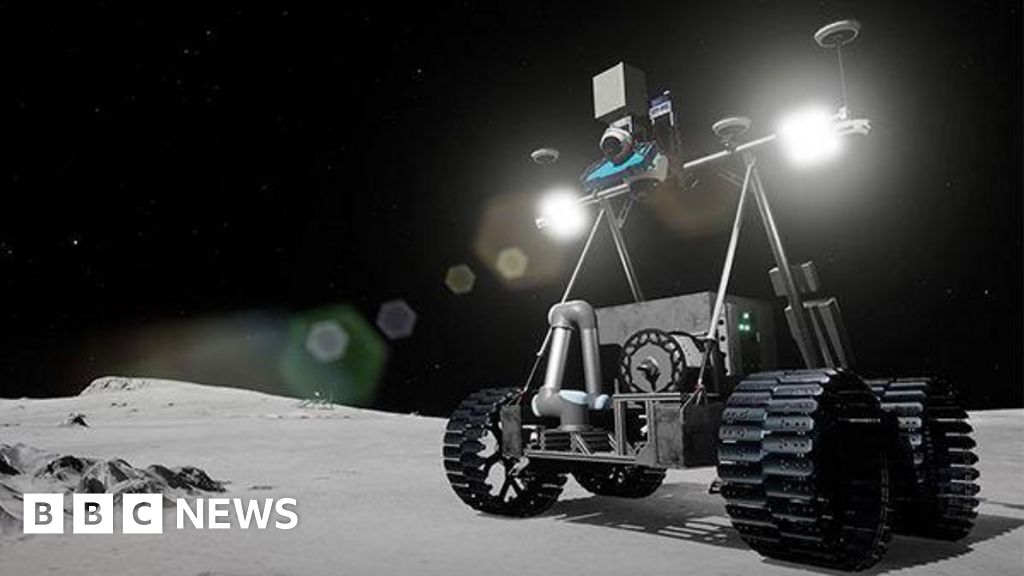
Canadian Space Agency A computer generated image of the lunar vehicle on the surface of the MoonCanadian Space Agency

A computer generated image of what the lunar vehicle could look like on the Moon

In a shopping plaza an hour outside Toronto, flanked by a day spa and a shawarma joint, sits a two-storey building with blue tinted windows reflecting the summer sun.

It is the modest headquarters of Canadensys Aerospace, where Canada is charting its first trip to the Moon.

Canadensys is developing the first-ever Canadian-built rover for exploring the Earth’s only natural satellite, in what will be the first Canadian-led planetary exploration endeavour.

Models, maps and posters of outer space line the office walls, while engineers wearing anti-static coats work on unfamiliar-looking machines.

Sending this rover to the Moon is part of the company’s “broader strategy of really moving humanity off the Earth”, Dr Christian Sallaberger, Canadensys’ president and CEO, told the BBC.

Learning about the Moon – which is seen to have the potential to become a base for further space exploration – is the “logical first step”, he said.

“People get all excited about science fiction films when they come out. You know, Star Wars or Star Trek. This is the real thing.”

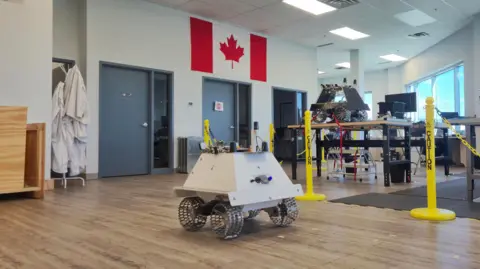
Two prototypes of the Moon rover, one white one in the foreground and the grey one on the table, with the Canadian flag in the background

Prototypes of the lunar rover, both designed and built by Canadensys

The Canadian vehicle is part of Nasa’s Artemis programme, which aims to establish a sustainable human presence on the Moon.

As part of that overarching goal, this rover aims to find water and measure radiation levels on the lunar surface in preparation for future manned missions, and survive multiple lunar nights (equivalent to about 14 days on Earth).

The rover will also demonstrate Canadian technology, building on Canada’s history in space.

Canada was the third country to launch a satellite, designed the Canadarm robotic arms for the Space Shuttle and the International Space Station, and is known for astronauts such as Chris Hadfield and Jeremy Hansen – the latter of whom will orbit the Moon on the Artemis II mission next year.

The 35kg rover is scheduled to be launched as part of a Nasa initiative in 2029 at the earliest. It will land on the Moon’s south polar region – one of the most inhospitable places on the lunar surface.

The vehicle does not have a name yet. The Canadian Space Agency held an online competition to select one, and is expected to announce the winner in the future.
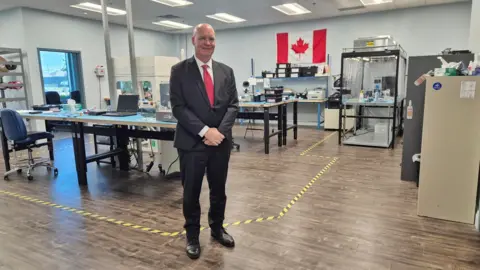
Canadensys President Christian Sallaberger standing in one of the company's labs, with a Canadian flag visible on the back wall

Canadensys President Christian Sallaberger said he is excited to be playing a role in humanity’s quest to explore space

Canadensys is currently working on several prototypes of the rover. The final vehicle, Mr Sallaberger said, would be assembled shortly before launch.

Each component is tested to ensure it can survive the Moon’s harsh conditions.

Temperature is one of the main obstacles. Lunar nights can plummet to -200C (-328F) and rise to a scorching daytime of 100C (212F).

“It’s one of the biggest engineering challenges we have because it’s not so much even surviving the cold temperature, but swinging between very cold and very hot,” he said.

Designing the wheels is another challenge, as the Moon’s surface is covered with a sticky layer of fragmented rock and dust called regolith.

“Earth dirt, if you look at it microscopically, has been weathered off. It’s more or less in a round shape; but on the Moon the lunar dirt soil is all jagged,” Mr Sallaberger said.

“It’s like Velcro dirt,” he said, noting it “just gums up mechanisms”.
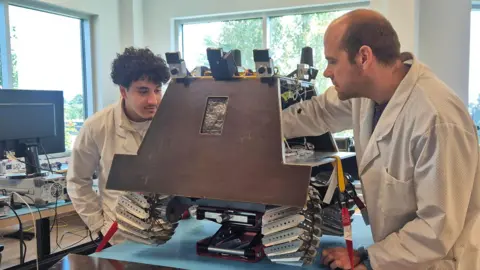
Engineers Misha Hartmann and Adam Abdulahad work on a prototype of the rover at the Canadensys headquarters. Both wear white lab coats and are working on the vehicle, which is siting on a table, and has metal wheels and visible wires.

Engineers Misha Hartmann (L) and Adam Abdulahad work on a prototype of the rover at the Canadensys headquarters

The search for water on the lunar surface is especially exciting, considering the Moon was generally thought to be bone dry following the Apollo missions in the 1960s and 70s, the US human spaceflight programme led by Nasa.

That perception changed in 2008, Dr Gordon Osinski, the mission’s chief scientist, told the BBC, when researchers re-analysed some Apollo mission samples and found particles of water.

Around the same time, space crafts observing the Moon detected its presence from orbit.

It has yet to be verified on the ground and many questions remain, the professor at Western University in London, Ontario, said.

“Is it like a patch of ice the size of this table? The size of a hockey rink? Most people think, like in the Arctic, it’s probably more like grains of ice mixed in with the soil,” he said.

Water on the Moon could have huge implications for more sustainable exploration. He noted one of the heaviest things they need to transport is often water, so having a potential supply there would open doors.

Water molecules can also be broken down to obtain hydrogen, which is used in rocket fuel. Mr Osinski described a future where the Moon could become a sort of petrol station for spacecrafts.

“It gets more in the realms of sci- fi,” he said.
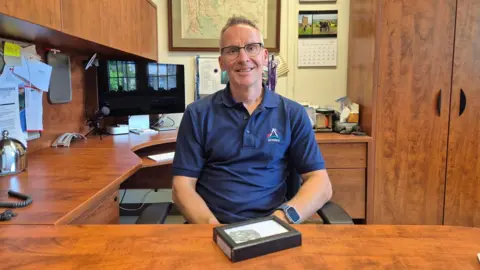
Dr Gordon Osinski seated at a wooden desk in his office in Western University, wearing an Artemis programme t shirt with a rock from the Moon on the desk in front of him

Dr Osinski, an expert in lunar geology and has experience training astronauts in Canada’s Arctic, showed off a lunar rock during the BBC interview

Canada has wanted to build a lunar surface vehicle for decades, with talk of a Canadian-made spacecraft even in the early 2000s – but it was not until 2019 that concrete plans were announced.

Canadensys was awarded the C$4.7m ($3.4m; £2.5m) contract three years later.

Founded in 2013, Canadensys has worked on a variety of aerospace projects for organisations like Nasa and the Canadian Space Agency, as well as commercial clients.

More than 20 instruments built by the company have been used in a host of missions on the Moon.

But there are challenges ahead – as even landing on the Moon is no easy feat.

In March, a spacecraft by commercial US firm Intuitive Machines toppled over onto its side during landing, ending the mission prematurely.

Three months later, Japanese company iSpace’s Resilience lost touch with Earth during its landing, and eventually failed.

“That’s the nature of the business we’re in,” Mr Sallaberger said. “Things do go wrong, and we try to do the best we can to mitigate that.”
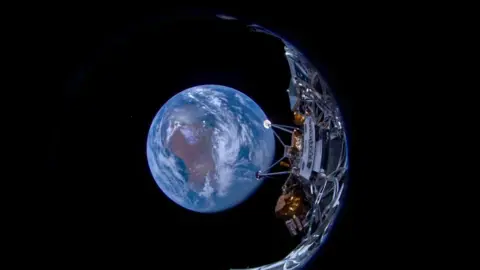
Intuitive Machines/The Planetary Society An instrument designed by Canadensys, on the Intuitive Machines' lander in space. Earth is seen below it against a black sky. Intuitive Machines/The Planetary Society

A picture of the Earth taken by a Canadensys-built camera was selected as the Best Space Exploration Image of 2024 by the Planetary Society

Space exploration has been a collaborative field over the years, with countries – even rivals, such as the United States and Russia – working together on the International Space Station.

But that might be changing, Mr Osinski said. As the prospect of a permanent presence on the Moon becomes more realistic, wider geopolitical questions have begun to swirl around the ownership of the satellite.

“There’s more talk around who owns the Moon and space resources,” Mr Osinski said.

In 2021, the US passed a law to protect the Apollo Moon landing site “because they had a concern that China could just go and grab the US flag, or take a piece of an Apollo lander”, he said.

But he had some encouraging words about the Artemis missions, which are “even way more international than the space station”.

The Artemis Accords, which is a set of ideals to promote sustainable and peaceful exploration of outer space, has been signed by more than 50 countries – including ones like Uruguay, Estonia and Rwanda, which are not traditionally seen as key space race nations.

Space is also becoming more accessible. Private companies like SpaceX and Blue Origin have taken an increasingly important role and are able to take anyone with the money and barely any training – like Amazon founder Jeff Bezos and pop star Katy Perry – into space for a few minutes.

But the Moon is the Holy Grail, as it opens up all sorts of possibilities.

Mr Sallaberger said that Canadensys is involved in longer-term projects, such as lunar greenhouses for food production.

Those still remain many years in the future, but the rover is a starting point.

“If you design something that can survive on the lunar surface long-term, you’re pretty bulletproof anywhere else in the solar system.”


Source link

Tags: CanadasexplorationfutureLunarRoverSpace

Related Posts

Elusive nightjar birds making remarkable comeback, conservationists say

March 17, 2026
0

An ecological survey has found 109 nightjar territories in the lowland heaths of east Hampshire. Source link

Funding for green community initiatives

March 16, 2026
0

Staffordshire Moorlands District Council says projects can receive up to £5.000. Source link

Former dairy farm could become peat research centre

March 15, 2026
0

Honeygar Farm is one of the few areas in the UK that still holds deep lowland peatland. Source...

  • Australia helicopter collision: Mid-air clash wreckage covers Gold Coast

    522 shares
    Share 209 Tweet 131
  • UK inflation: Supermarkets say price rises will ease soon

    515 shares
    Share 206 Tweet 129
  • Ballyjamesduff: Man dies after hit-and-run in County Cavan

    510 shares
    Share 204 Tweet 128
  • Somalia: Rare access to its US-funded 'lightning commando brigade

    508 shares
    Share 203 Tweet 127
  • Google faces new multi-billion advertising lawsuit

    508 shares
    Share 203 Tweet 127
  • Trending
  • Comments
  • Latest

Australia helicopter collision: Mid-air clash wreckage covers Gold Coast

January 10, 2023

UK inflation: Supermarkets say price rises will ease soon

April 19, 2023

Ballyjamesduff: Man dies after hit-and-run in County Cavan

August 19, 2022

Stranger Things actor Jamie Campbell Bower praised for addiction post

0

NHS to close Tavistock child gender identity clinic

0

Cold sores traced back to kissing in Bronze Age by Cambridge research

0

Elusive nightjar birds making remarkable comeback, conservationists say

March 17, 2026

Trump 'not happy' with UK response to Iran conflict

March 17, 2026

Bridgerton star on dealing with One Piece casting backlash

March 17, 2026

Categories

Science

Elusive nightjar birds making remarkable comeback, conservationists say

March 17, 2026
0

An ecological survey has found 109 nightjar territories in the lowland heaths of east Hampshire. Source link

Read more

Trump 'not happy' with UK response to Iran conflict

March 17, 2026
News

Copyright © 2020 JBC News Powered by JOOJ.us

Explore the JBC

  • Home
  • News
  • Sport
  • Worklife
  • Travel
  • Reel
  • Future
  • More

Follow Us

  • Home Main
  • Video
  • World
  • Top News
  • Business
  • Sport
  • Tech
  • UK
  • In Pictures
  • Health
  • Reality Check
  • Science
  • Entertainment & Arts
  • Login

Copyright © 2020 JBC News Powered by JOOJ.us

Welcome Back!

Login to your account below

Forgotten Password?

Create New Account!

Fill the forms bellow to register

All fields are required. Log In

Retrieve your password

Please enter your username or email address to reset your password.

Log In
This website uses cookies. By continuing to use this website you are giving consent to cookies being used. Visit our Privacy and Cookie Policy.
News
More Sites

    MORE

  • Home
  • News
  • Sport
  • Worklife
  • Travel
  • Reel
  • Future
  • More
  • News

    JBC News