































News
  • Login
  • Home
  • News
  • Sport
  • Worklife
  • Travel
  • Reel
  • Future
  • More
Thursday, January 15, 2026
No Result
View All Result

NEWS

3 °c
London
8 ° Wed
9 ° Thu
11 ° Fri
13 ° Sat
  • Home
  • Video
  • World
    • All
    • Africa
    • Asia
    • Australia
    • Europe
    • Latin America
    • Middle East
    • US & Canada

    Australian Open 2026: Sebastian Ofner celebrates early before losing to Nishesh Basavareddy in qualifying

    Denmark warns of ‘fundamental disagreement’ with US over Greenland

    Israel’s recognition of Somaliland and Yemen conflict fuel tensions

    At least 32 dead after construction crane falls on train

    Pandoro cake influencer cleared of aggravated fraud in Italy

    Trump administration says Venezuela has released jailed US citizens

    Who is Erfan Soltani, protester due to be executed in Iran?

    Why two Canadian provinces are in a spat over Crown Royal whisky

    Australian Open: How former junior champion Oliver Anderson is trying to rebuild career after match-fixing ban

  • UK
    • All
    • England
    • N. Ireland
    • Politics
    • Scotland
    • Wales

    ‘World on the brink’ and Trump intent on ‘conquering’ Greenland

    Hearts ‘underdogs by long shot’ but still setting Premiership pace

    Killer gets longer jail term and trampoline park fined over food hygiene

    Man worked on farm for five hours with heart attack

    Twenty councils in England ask for election delays

    Masters snooker 2026 – all matches end 6-2: Neil Robertson & Judd Trump complete sequence

    How much are tuition fees in the UK and is university worth it?

    Who are the winners and losers from the Scottish budget?

    Top Welsh restaurant Ynyshir told food safety needs ‘major improvement’

  • Business
    • All
    • Companies
    • Connected World
    • Economy
    • Entrepreneurship
    • Global Trade
    • Technology of Business

    California investigates Grok over AI deepfakes

    TGI Fridays closes 16 UK stores, with 456 job losses

    Reeves doesn’t rule out more support for hospitality sector

    US approves sale of Nvidia’s advanced H200 chips to China

    World central bank chiefs declare support for US Fed chair

    Trump announces 25% tariff on countries that do business with Iran

    Heineken boss steps down as beer sales slow

    Trump faces extraordinary moment in spat with Fed chair Powell

    Why luxury carmakers are now building glitzy skyscrapers

  • Tech
  • Entertainment & Arts

    Dancers say Lizzo ‘needs to be held accountable’ over harassment claims

    Freddie Mercury: Contents of former home being sold at auction

    Harry Potter and the Cursed Child marks seven years in West End

    Sinéad O’Connor: In her own words

    Tom Jones: Neighbour surprised to find singer in flat below

    BBC presenter: What is the evidence?

    Watch: The latest on BBC presenter story… in under a minute

    Watch: George Alagiah’s extraordinary career

    BBC News presenter pays tribute to ‘much loved’ colleague George Alagiah

    Excited filmgoers: 'Barbie is everything'

  • Science
  • Health
  • In Pictures
  • Reality Check
  • Have your say
  • More
    • Newsbeat
    • Long Reads

NEWS

No Result
View All Result
Home Tech

Could powerful lasers power a working reactor?

September 10, 2024
in Tech
9 min read
235 17
0
491
SHARES
1.4k
VIEWS
Share on FacebookShare on Twitter


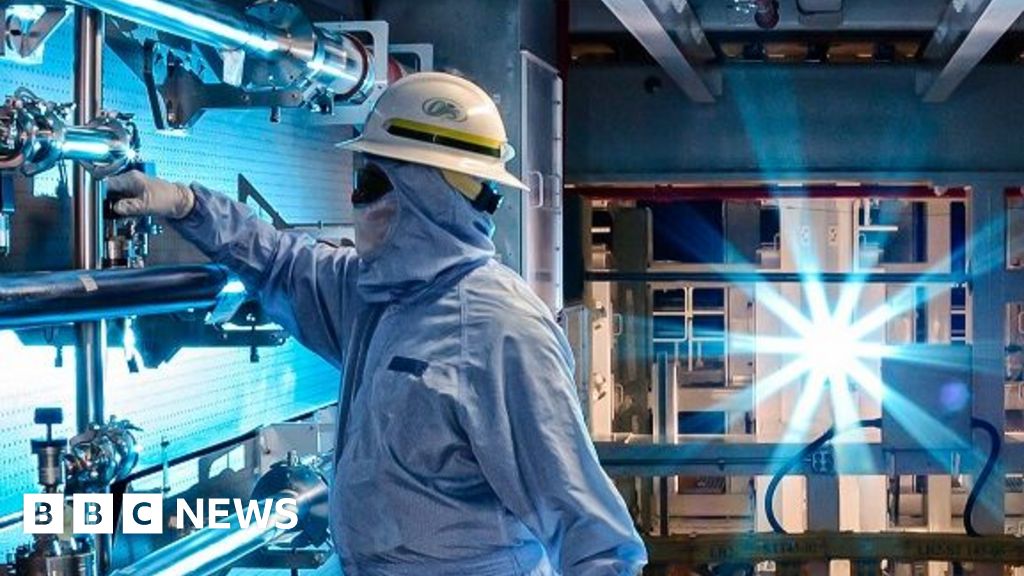
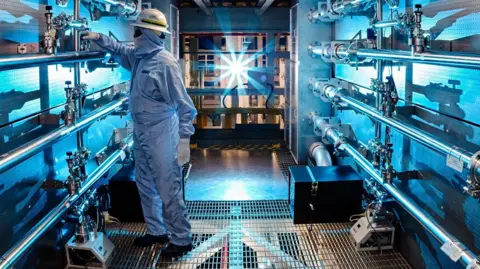
Damien Jemison A technician adjusts some of the optical equipment of the National Ignition Facility.Damien Jemison

The National Ignition Facility in California uses powerful lasers to spark fusion reactions

Deep under the Nevada desert in the 1980s the US conducted secret nuclear weapons research.

Among the experiments was an effort to see if nuclear fusion, the reaction which powers the sun, could be sparked on earth in a controlled setting.

The experiments were classified, but it was widely known among physicists that the results had been promising.

That knowledge caught the attention of two young graduate students working at the Los Alamos National Laboratory in the late 2000s, Conner Galloway and Alexander Valys.

The Los Alamos lab was originally set up in 1943 as a top-secret site to develop the first nuclear weapons. Located near Santa Fe, New Mexico it is now a US government research and development facility.

“When Alex and I learned about those tests at Los Alamos, our reaction was like ‘wow, inertial fusion has already worked!’. Laboratory-scale pellets were ignited, the details were classified, but enough was made public that we knew that ignition was achieved,” says Mr Galloway.

Nuclear fusion is the process of fusing hydrogen nuclei together, which produces immense amounts of energy. The reaction creates helium and not the long-lived radioactive waste of the fission process which is used in existing nuclear power stations.

If fusion can be harnessed, then it promises abundant electricity, generated without producing CO2.

Those tests in the 1980s led to the US government building the National Ignition Facility (NIF) in California, a project to see if nuclear fuel pellets could be ignited using a powerful laser.

After more than a decade of work, in late 2022 researchers at NIF made a breakthrough. Scientists conducted the first controlled fusion experiment to produce more energy from the reaction than that supplied by the lasers which sparked it.

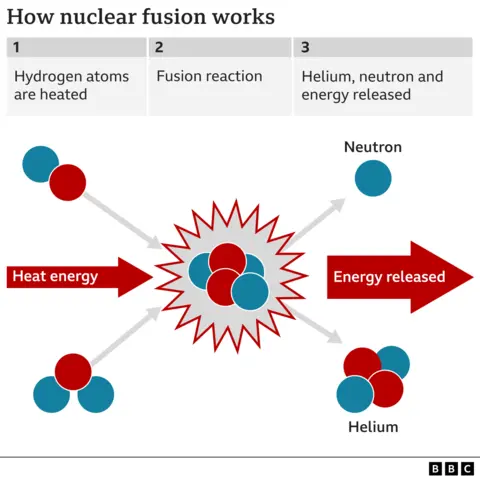
A graphic showing the fusion reaction

While physicists around the world marvelled at that breakthrough, it had taken the scientists at NIF much longer than expected.

“They were energy starved,” says Mr Galloway.

He doesn’t mean they needed more snacks, instead the NIF laser was only just powerful enough to ignite the fuel pellet.

Mr Galloway and Mr Valys think that more powerful lasers will make it possible to build a working fusion reaction that can supply electricity to the power grid. To do that they founded Xcimer, based in Denver.

NIF had to make do with a laser that could pump out two megajoules of energy. Mr Galloway and Mr Valys are planning to experiment with lasers that can supply up to 20 megajoules of energy.

“We think 10 to 12 [megajoules] is the sweet spot for a commercial power plant,” says Mr Galloway.

Such a laser beam would hit the fuel capsule with a powerful punch. It would be like taking the energy of a 40-tonne articulated lorry travelling at 60mph and focussing it on the centimetre-sized capsule for a few billionths of a second.

More powerful lasers will allow Xcimer to use larger and simpler fuel capsules than NIF, which found it difficult to perfect them.
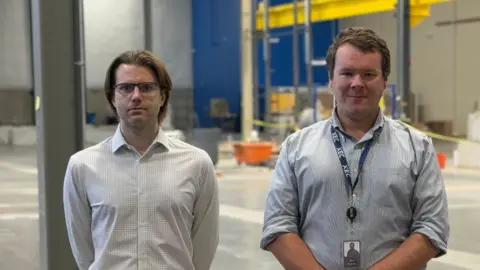
Xcimer Conner Galloway (left) and Alexander Valys stading in the big empty factory which will one day house their laser-based fusion project.Xcimer

Conner Galloway (left) and Alexander Valys founders of fusion firm Xcimer

Xcimer joins dozens of other organisations around the world trying to build a working fusion reactor.

There are two main approaches. Smashing a fuel pellet with lasers falls under the category of inertial confinement fusion.

The other way, known as magnetic confinement fusion, uses powerful magnets to trap a burning cloud of atoms called plasma.

Both approaches have daunting engineering challenges to overcome.

In particular, how do you extract the heat generated during fusion so you can do something useful with it, like drive a turbine to make electricity?

“I suppose my scepticism is, I haven’t yet even seen a persuasive conceptual diagram of how you manage the process of taking energy out while keeping the fusion reaction going,” says Prof Ian Lowe at Griffith University in Australia.

He has spent his long career working in energy research and policy. While Prof Lowe supports the development of fusion technology, he just argues that a working fusion reactor won’t come fast enough to help bring down CO2 emissions and tackle climate change.

“My concern is that even the most optimistic view is that we’d be lucky to have commercial fusion reactors by 2050. And long before then we need to have decarbonized the energy supply if we’re not going to melt the planet,” he says.

Another challenge is that the fusion reaction produces high energy particles that will degrade steel, or any other material that lines the reactor core.

Getty Images A truck exits the Los Alamos national laboratory, in New Mexico. A sign in the foreground says: "No Trespassing."Getty Images

Secret fusion tests were conducted at the Los Alamos National Laboratory in the 1980s

Those in the fusion industry don’t deny the engineering challenges, but feel they can be overcome.

Xcimer plans to use a “waterfall” of molten salt flowing around the fusion reaction to absorb the heat.

The founders are confident that they can fire the lasers and replace the fuel capsules (one every two seconds) while keeping that flow going.

The flow of molten salt will also be thick enough to absorb high energy particles that could potentially damage the reactor.

“We just have two relatively small laser beams coming in from either side [of the fuel pellet]. So you only need a gap in the flow big enough for those beams, and so you don’t have to turn off and turn on the entire flow,” says Mr Valys.

But how quickly can them make such a system work?

Xcimer plans to experiment with the lasers for two years, before building a target chamber, where they can target the fuel pellets.

The final stage would be the working reactor, which they hope would be plugged into the electricity grid in the mid-2030s.

To fund the first phase of their work, Xcimer has raised $100m (£77m) . The money will be used to build a facility in Denver and the prototype laser system.

Hundreds of millions dollars more will be needed to build a working reactor.

But for the founders of Xcimer, and other fusion start-ups, the prospect of cheap, carbon-free electricity is irresistible.

“You know, it’ll change the trajectory of what’s possible for humanity’s progress,” says Mr Valys.


More Technology of Business


Source link

Tags: laserspowerPowerfulreactorWorking

Related Posts

Elon Musk’s X to block Grok from undressing images of real people

January 15, 2026
0

Elon Musk's AI model Grok will no longer be able to edit photos of real people to show them...

Is small the new big?

January 14, 2026
0

Zoe KleinmanTechnology editorAFP via Getty ImagesLarge numbers of vast data centres continue to be build around the worldOne day...

Why more CEOs are sharing the top job

January 13, 2026
0

MaryLou CostaTechnology ReporterBoard IntelligenceCo-chief executives Jennifer Sundberg (left) and Pippa BeggFor almost 16 years, Pippa Begg ran Board Intelligence...

  • Australia helicopter collision: Mid-air clash wreckage covers Gold Coast

    522 shares
    Share 209 Tweet 131
  • UK inflation: Supermarkets say price rises will ease soon

    515 shares
    Share 206 Tweet 129
  • Ballyjamesduff: Man dies after hit-and-run in County Cavan

    510 shares
    Share 204 Tweet 128
  • Somalia: Rare access to its US-funded 'lightning commando brigade

    508 shares
    Share 203 Tweet 127
  • Google faces new multi-billion advertising lawsuit

    508 shares
    Share 203 Tweet 127
  • Trending
  • Comments
  • Latest

Australia helicopter collision: Mid-air clash wreckage covers Gold Coast

January 10, 2023

UK inflation: Supermarkets say price rises will ease soon

April 19, 2023

Ballyjamesduff: Man dies after hit-and-run in County Cavan

August 19, 2022

Stranger Things actor Jamie Campbell Bower praised for addiction post

0

NHS to close Tavistock child gender identity clinic

0

Cold sores traced back to kissing in Bronze Age by Cambridge research

0

Serial houseplant killer? Here’s how to keep them alive

January 15, 2026

‘World on the brink’ and Trump intent on ‘conquering’ Greenland

January 15, 2026

Wicked’s Ariana Grande and Jonathan Bailey set for stage reunion

January 15, 2026

Categories

Science

Serial houseplant killer? Here’s how to keep them alive

January 15, 2026
0

Getty ImagesHave you lost count of the times you've had high hopes for a pot plant but despite careful...

Read more

‘World on the brink’ and Trump intent on ‘conquering’ Greenland

January 15, 2026
News

Copyright © 2020 JBC News Powered by JOOJ.us

Explore the JBC

  • Home
  • News
  • Sport
  • Worklife
  • Travel
  • Reel
  • Future
  • More

Follow Us

  • Home Main
  • Video
  • World
  • Top News
  • Business
  • Sport
  • Tech
  • UK
  • In Pictures
  • Health
  • Reality Check
  • Science
  • Entertainment & Arts
  • Login

Copyright © 2020 JBC News Powered by JOOJ.us

Welcome Back!

Login to your account below

Forgotten Password?

Create New Account!

Fill the forms bellow to register

All fields are required. Log In

Retrieve your password

Please enter your username or email address to reset your password.

Log In
This website uses cookies. By continuing to use this website you are giving consent to cookies being used. Visit our Privacy and Cookie Policy.
News
More Sites

    MORE

  • Home
  • News
  • Sport
  • Worklife
  • Travel
  • Reel
  • Future
  • More
  • News

    JBC News