


























Medical editor
Global health producer
 BBC
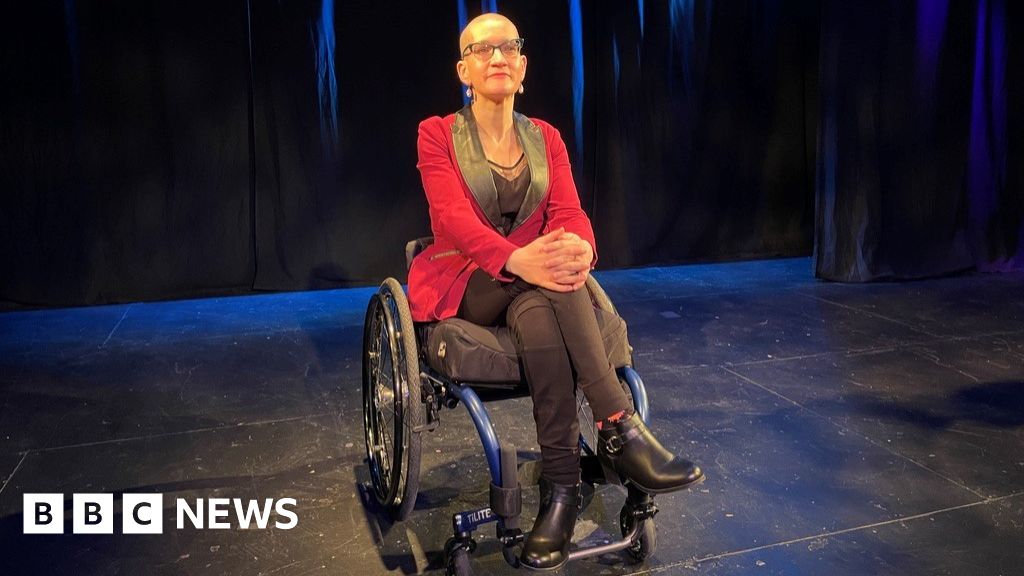
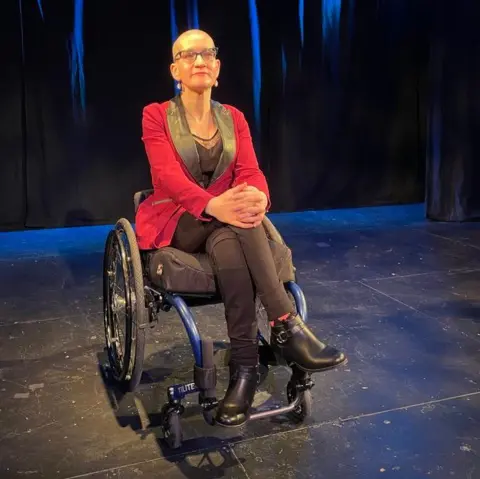
BBCApril Hubbard sits on the theatre stage where she plans to die later this year.
She is not terminally ill, but the 39-year-old performance and burlesque artist has been approved for assisted dying under Canada’s increasingly liberal laws.
Warning: This article contains details and descriptions some readers may find disturbing
She is speaking to BBC News from the Bus Stop Theatre, an intimate auditorium with a little under 100 seats, in the eastern city of Halifax, Nova Scotia.
Illuminated by a single spotlight on a stage she has performed on many times before, she tells me she plans to die here “within months” of her imminent 40th birthday. She’ll be joined by a small group of her family and friends.
April plans to be in a “big comfy bed” for what she calls a “celebratory” moment when a medical professional will inject a lethal dose into her bloodstream.
“I want to be surrounded by the people I love and just have everybody hold me in a giant cuddle puddle and get to take my last breath, surrounded by love and support,” she says.
April was born with spina bifida and was later diagnosed with tumours at the base of her spine which she says have left her in constant, debilitating pain.
She’s been taking strong opioid painkillers for more than 20 years and applied for Medical Assistance in Dying (Maid) in March 2023. While she could yet live for decades with her condition, she qualified to end her life early seven months after applying. For those who are terminally ill it is possible to get approval within 24 hours.
“My suffering and pain are increasing and I don’t have the quality of life anymore that makes me happy and fulfilled,” April says. Every time she moves or breathes, she says it feels like the tissues from the base of her spine “are being pulled like a rubber band that stretches too far”, and that her lower limbs leave her in agony.
We meet April as, almost 3,000 miles away, MPs are scrutinising proposals to legalise assisted dying in England and Wales. They voted in principle in support of those plans in November 2024, but months of detailed scrutiny have followed – and further votes in the Commons and Lords are required before the bill could possibly become law.
This week, the BBC witnessed a man’s death in California, where assisted dying laws are far more similar to those being considered in Westminster.
Critics say Canada is an example of the “slippery slope”, meaning that once you pass an assisted dying law it will inevitably widen its scope and have fewer safeguards.
Canada now has one of the most liberal systems of assisted dying in the world, similar to that operating in the Netherlands and Belgium. It introduced Maid in 2016, initially for terminally ill adults with a serious and incurable physical illness, which causes intolerable suffering. In 2021, the need to be terminally ill was removed, and in two years’ time, the Canadian government plans to open Maid to adults solely with a mental illness and no physical ailment.
Opponents of Maid tell us that death is coming to be seen as a standard treatment option for those with disabilities and complex medical problems.
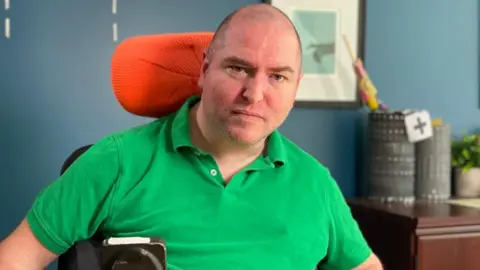
“It is easier in Canada to get medical assistance in dying than it is to get government support to live,” says Andrew Gurza, a disability awareness consultant and friend of April’s.
Andrew, who has cerebral palsy and uses a wheelchair, says he respects April’s decision, but tells us: “If my disability declines and my care needs got higher, I’d still want to be here. To know there’s a law that’s saying you could easily end your life – it’s just really scary.”

Before she was approved for Maid, April was assessed by two independent physicians who were required to inform her of ways to alleviate her suffering and offer alternative treatments.
“The safeguards are there,” she says, when we press her about disabled people who feel threatened by assisted dying, or whether Maid is being used as a shortcut to better quality care. “If it’s not right for you and you’re not leading the charge and choosing Maid, you’re not going to be able to access it unless it’s for the right reasons,” she adds.
There were 15,343 Maid deaths in 2023, representing around one in 20 of all deaths in Canada – a proportion that has increased dramatically since 2016 and is one of the highest in the world. The average age of recipients was 77.
In all but a handful of cases, the lethal dose was delivered by a doctor or nurse, which is also known as voluntary euthanasia. One doctor we spoke to, Eric Thomas, said he had helped 577 patients to die.
Dr Konia Trouton, president of the Canadian Association of Maid Assessors and Providers, has also helped hundreds of patients to die since the law was introduced.
The procedure is the same each time – she arrives at the home of the person who has been given approval for Maid and asks if they wish to go ahead with it that day. She says the patients always direct the process and then give her the “heads up and ready to go”.
“That gives me an honour and a duty and a privilege to be able to help them in those last moments with their family around them, with those who love them around them and to know that they’ve made that decision thoughtfully, carefully and thoroughly,” she adds. If the answer is yes, she opens her medical bag.
Demonstrating to the BBC what happens next, Dr Trouton briefly puts a tourniquet on my arm. She shows me where the needle would be inserted into a vein in the back of my hand to allow an intravenous infusion of lethal drugs.
In her medical bag she also has a stethoscope. “Strangely, these days I use it more to determine if someone has no heartbeat rather than if they do,” she tells me.
A list of organisations in the UK offering support and information with some of the issues in this story is available at BBC Action Line
Some 96% of Maid provisions are under “track one” where death is “reasonably foreseeable”. Dr Trouton says that means patients are on a “trajectory toward death”, which might range from someone who has rapidly spreading cancer and only weeks to live or another with Alzheimer’s “who might have five to seven years”.
The other 4% of Maid deaths come under “track two”. These are adults, like April, who are not dying but have suffering which is intolerable to them from a “grievous and irremediable medical condition”.
That is in stark contrast to Labour MP Kim Leadbeater’s bill to legalise assisted dying in England and Wales, which says patients must be expected to die within six months. The Westminster bill would not allow doctors to give a lethal dose – rather patients would have to self-administer the drugs, usually by swallowing them.
Death via intravenous infusion normally takes just a few minutes, as the lethal drugs go straight into the bloodstream, whereas swallowing the drugs means patients usually take around an hour or two to die, but can take considerably longer, although they are usually unconscious after a few minutes.
Dr Trouton told me she regarded the Canadian system as quicker and more effective, as do other Maid providers. “I’m concerned that if some people can’t swallow because of their disease process, and if they’re not able to take the entire quantity of medication because of breathing difficulties or swallowing difficulties, what will happen?”
‘Canada has fallen off a cliff’
But opponents argue it’s being used as a cheaper alternative to providing adequate social or medical support.
One of them is Dr Ramona Coelho, a GP in London, Ontario, whose practice serves many marginalised groups and those struggling to get medical and social support. She’s part of a Maid Death Review Committee, alongside Dr Trouton, which examines cases in the province.
Dr Coelho told me that Maid was “out of control”. “I wouldn’t even call it a slippery slope,” she says “Canada has fallen off a cliff.”
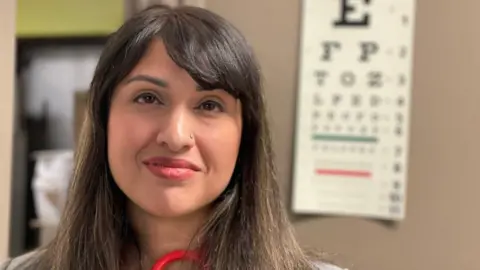
“When people have suicidal ideations, we used to meet them with counselling and care, and for people with terminal illness and other diseases we could mitigate that suffering and help them have a better life,” she says. “Yet now we are seeing that as an appropriate request to die and ending their lives very quickly.”
While at Dr Coelho’s surgery I was introduced to Vicki Whelan, a retired nurse whose mum Sharon Scribner died in April 2023 of lung cancer, aged 81. Vicki told me that in her mum’s final days in hospital she was repeatedly offered the option of Maid by medical staff, describing it as like a “sales pitch”.
The family, who are Catholic, discharged their mother so she could die at home, where Vicki says her mum had a “beautiful, peaceful death”. “It makes us think that we can’t endure, and we can’t suffer a little bit, and that somehow now they’ve decided that dying needs to be assisted, where we’ve been dying for years.
“All of a sudden now we’re telling people that this is a better option. This is an easy way out and I think it’s just robbing people of hope.”
‘Not a way I want to live’
So is Canada an example of the so-called slippery slope? It’s certainly true that the eligibility criteria has broadened dramatically since the law was introduced nine years ago, so for critics the answer would be an emphatic yes and serve as a warning to Britain.
Canada’s assisted dying laws were driven by court rulings. Its Supreme Court instructed Parliament that a prohibition on assisted dying breached the country’s Charter of Rights and Freedoms. The extension of eligibility for those who were not terminally ill was in part a response to another court decision.
In Britain, judges in the most senior courts have repeatedly said any potential change to the law around assisted dying is a matter for Parliament, after the likes of Tony Nicklinson, Diane Pretty and Noel Conway brought cases arguing the blanket ban on assisted suicide breached their human rights.
April knows some people may look at her, a young woman, and wonder why she would die.
“We’re the masters of masking and not letting people see that we’re suffering,” she says. “But in reality, there’s days that I just can’t hide it, and there’s many days where I can’t lift my head off the pillow and I can’t eat anymore.
“It’s not a way I want to live for another 10 or 20 or 30 years.”
Additional reporting by Joshua Falcon.