























News
  • Login
  • Home
  • News
  • Sport
  • Worklife
  • Travel
  • Reel
  • Future
  • More
Saturday, January 31, 2026
No Result
View All Result

NEWS

3 °c
London
8 ° Wed
9 ° Thu
11 ° Fri
13 ° Sat
  • Home
  • Video
  • World
    • All
    • Africa
    • Asia
    • Australia
    • Europe
    • Latin America
    • Middle East
    • US & Canada

    Canadian teen who died in Australia remembered for 'infectious laugh' and adventurous spirit

    Stay or go – what's next for coyote that swam to Alcatraz?

    This army chief threatened to castrate opposition leader and claimed descent from Jesus

    This tiny Australian town is up for sale – but the locals don't want to leave

    Chips, anyone? German farm gives away millions of potatoes after bumper harvest

    "It's 'Operation Don't Come Last' at the Olympics"

    South Africa and Israel expel each other’s envoys in diplomatic row

    Schitt's Creek and Home Alone star Catherine O'Hara dies aged 71

    Heatwave warnings across Australia as millions celebrate national day

  • UK
    • All
    • England
    • N. Ireland
    • Politics
    • Scotland
    • Wales

    Epstein invited 'The Duke' to meet Russian woman

    Why tartan is 'having a moment' in fashion again

    Sending my son to nursery in odd shoes helped me realise I was losing my sight

    Passengers warned of disruptions in weekend engineering works

    Labubu to open seven UK shops, after PM's China visit

    Public backs sacked bus driver who punched thief

    China to relax travel rules for British visitors, UK says

    Journalist dreams & Robbie Keane reunion? How Martin O’Neill continues to revive Celtic

    He calls me sweetheart and winks at me – but he's not my boyfriend, he's AI

  • Business
    • All
    • Companies
    • Connected World
    • Economy
    • Entrepreneurship
    • Global Trade
    • Technology of Business

    Three reasons for the record rise in gold prices, and one why they are falling

    Will Trump's pick to lead US central bank get him the change he wants?

    Trump threatens tariffs on countries selling oil to Cuba

    Co-operative groups merge after vote

    US Fed holds interest rates and defends central bank independence

    'You don't feel judged': Why we buy more at self-service terminals

    The Original Factory Shop collapses into administration

    Water bills to rise again: Use our tool to find out by how much

    EasyJet ad banned for claiming bags available for £5.99

  • Tech
  • Entertainment & Arts

    Dancers say Lizzo ‘needs to be held accountable’ over harassment claims

    Freddie Mercury: Contents of former home being sold at auction

    Harry Potter and the Cursed Child marks seven years in West End

    Sinéad O’Connor: In her own words

    Tom Jones: Neighbour surprised to find singer in flat below

    BBC presenter: What is the evidence?

    Watch: The latest on BBC presenter story… in under a minute

    Watch: George Alagiah’s extraordinary career

    BBC News presenter pays tribute to ‘much loved’ colleague George Alagiah

    Excited filmgoers: 'Barbie is everything'

  • Science
  • Health
  • In Pictures
  • Reality Check
  • Have your say
  • More
    • Newsbeat
    • Long Reads

NEWS

No Result
View All Result
Home Science

The hits and near-misses you never hear about

February 23, 2025
in Science
10 min read
250 2
0
491
SHARES
1.4k
VIEWS
Share on FacebookShare on Twitter


Georgina Rannard

Climate and science reporter
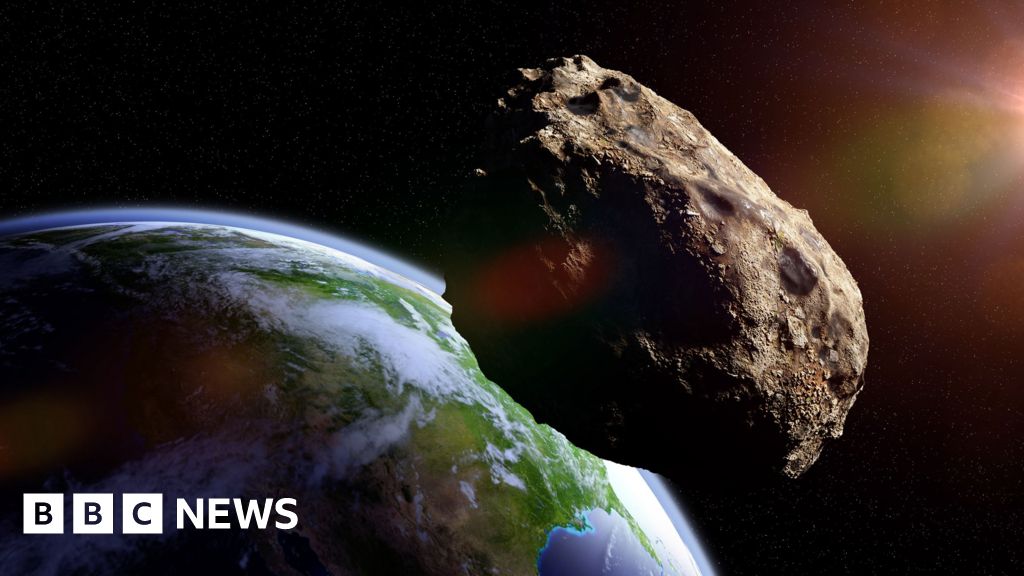
Getty Images Illustration showing meteorite close to planet EarthGetty Images

A large asteroid known as 2024 YR4 has grabbed headlines this week as scientists first raised its chances of hitting earth, then lowered them.

The latest estimate says the object has a 0.28% chance of hitting Earth in 2032, significantly lower than the 3.1% chance earlier in the week.

Scientists say it is now more likely to smash into the Moon, with Nasa estimating the probability of that happening at 1%.

But in the time since 2024 YR4 was first spotted through a telescope in the desert in Chile two months ago, tens of other objects have passed closer to Earth than the Moon, which in astronomical terms sounds like a near miss.

It is likely that others, albeit much smaller, have hit us or burned up in the atmosphere but gone unnoticed.

This is the story of the asteroids that you never hear about – the fly-bys, the near-misses and the direct hits.

The vast majority are harmless. But some carry the most valuable clues for unlocking mysteries in our universe, information we are desperate to get our hands on.

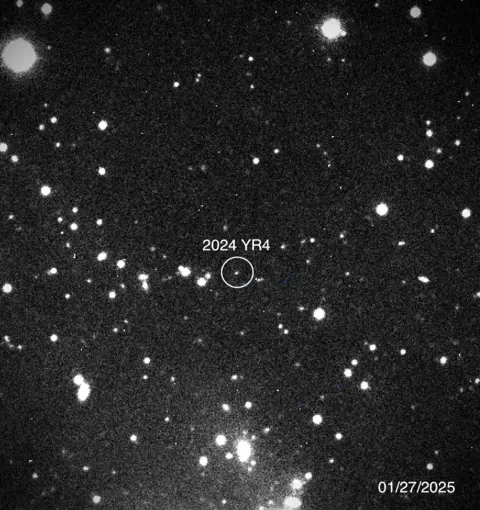
Drs. Bill and Eileen Ryan, Magdalena Ridge Observatory 2.4m Telescope, New Mexico Tech An image of the night sky showing the detection of 2024 YR4 using the Magdalena Ridge Observatory 2.4m Telescope, New Mexico TechDrs. Bill and Eileen Ryan, Magdalena Ridge Observatory 2.4m Telescope, New Mexico Tech

2024 YR4 was first detected in December and there is small chance it could hit Earth on 22 December 2032

Asteroids, also sometimes called minor planets, are rocky pieces left over from the formation of our solar system about 4.6 billion years ago.

Rocks routinely orbit close to Earth, pushed by the gravity of other planets.

For most of human history, it has been impossible to know how close we have come to being struck by a large asteroid.

Serious monitoring of objects near Earth only started in the late 20th century, explains Professor Mark Boslough from the University of New Mexico. “Before that we were blissfully oblivious to them,” he says.

We now know that quite large objects – 40m across or more – pass between Earth and the Moon several times a year. That’s the same size of asteroid that exploded over Siberia in 1908 injuring people and damaging buildings over 200 square miles.

The most serious near-miss, and the closest comparison with YR4, was an asteroid called Apophis which was first spotted in 2004 and measured 375 meters across, or around the size of a cruise ship.

Professor Patrick Michel from French National Centre for Scientific Research (CNRS) tracked Apophis and recalls it was considered the most hazardous asteroid ever detected.

It took until 2013 to get enough observations to understand that it was not going to hit Earth.

But he says there was one big difference with YR4. “We didn’t know what to do. We discovered something, we determined an impact probability, and then thought, who do we call?” he says. Scientists and governments had no idea how to respond, he says.
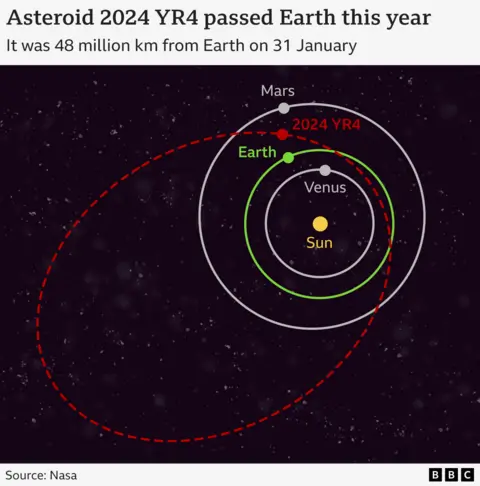
A graphic showing the orbit of asteroid 2024 YR4. It was 48 million km from Earth on 31 January

A large asteroid strike could be catastrophic if it hits an area where humans live.

We don’t know exactly how big YR4 is yet, but if it is at the top end of estimates, about 90m across, it would likely remain substantially intact rather than break up as it enters the Earth’s atmosphere.

“The surviving asteroid mass could create a crater. Structures in the immediate vicinity would likely be destroyed and people within the local region (dozens of kilometers) would be at risk of serious injury,” explains Professor Kathryn Kunamoto from Lawrence Livermore National Laboratory. Some people could die.

But since Apophis, there have been huge advances in what is called planetary defence.

Prof Michel is part of the international Space Mission Planning Advisory Group.

Its delegates advise governments on how to respond to an asteroid threat and run rehearsal exercise for direct hits. There is one going on right now.

If the asteroid was on course for a town or city, Dr Boslough compares the response to preparations made for a major hurricane, including evacuations and measures to protect infrastructure.

The Space Mission Planning Advisory Group will meet again in April to decide what to do about YR4.

By then most scientists expect the risk to have almost entirely gone, as their calculations of its trajectory become more precise.
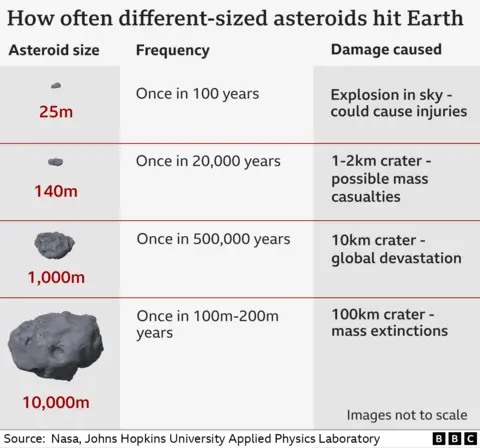
A graphic showing different-sized asteroids and the impact they would have if they hit Earth and the predicted frequency of an event

We do have options beyond “taking a hit”, as Dr Kumamoto puts it.

Nasa and the European Space Agency have developed technologies to nudge dangerous asteroids off course.

Nasa’s Double Asteroid Redirection Test (DART) successfully slammed a spacecraft into the asteroid Dimorphos to change its path.

However scientists are sceptical if that would work in the case of YR4 due to uncertainty about what it is made of and the short window of time to successfully deflect it.

And what about the asteroids that do hit Earth? An awkward truth for scientists is that a direct strike on land far from humans is the ideal scenario for asteroids.

That gives them actual pieces from distant objects within of our solar system, as well as insights into Earth’s impact history.

Nearly 50,000 asteroids have been found in Antarctica. The most famous, called ALH 84001, is believed to have originated on Mars and contains minerals with vital evidence about the planet’s history, suggesting it was warm and had water on its surface billions of years ago.

In 2023 scientists detected an asteroid called 33 Polyhymnia which could have an element denser than anything found on Earth.

This superheavy element would be something entirely new to our planet. 33 Polyhymnia is at least 170 million kilometers away, but it’s an indication of the incredible potential of asteroids for our understanding of science.
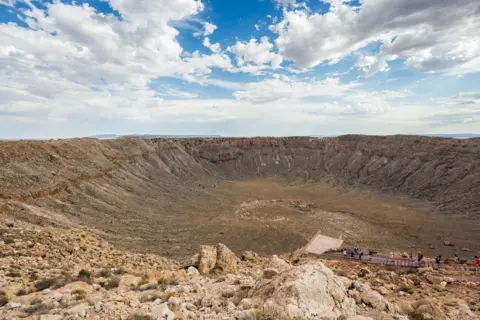
Getty Images A photograph of the Barringer Crater in Arizona, US was formed by a meteorite about 50m across that hit 50,000 years agoGetty Images

The Barringer Crater in Arizona, US was formed by a meteorite about 50m across that hit 50,000 years ago

Now that the chances are higher that YR4 will hit the Moon, some scientists are getting excited about that.

An impact could give real-world answers to questions they have only been able to simulate using computers.

“To have even one data point of a real example would be incredibly powerful,” says Prof Gareth Collins from Imperial College London.

“How much material comes out when the asteroid hits? How fast does it go? How far does that travel?” he asks.

It would help them test the scenarios they have modelled about asteroid impacts on Earth, helping create better predictions.

YR4 has reminded us that we live on a planet vulnerable to collisions with something the solar system is full of – rocks.

Scientists warn against complacency, saying it is a matter of when, not if, a large asteroid will threaten human life on Earth, although most expect that to be in the coming centuries rather than decades.

In the meantime, our ability to monitor space keeps improving. Later this year the largest digital camera ever built will begin working at the Vera Rubin Observatory in Chile, able to capture the night sky in incredible detail.

And the closer and longer we look, the more asteroids spinning close to Earth we are likely to spot.

Source link

Tags: hearhitsnearmisses

Related Posts

Treasures found on HS2 route stored in secret warehouse

January 31, 2026
0

Archaeological finds from the planned HS2 train line have been shown exclusively to the BBC. Source link

BBC Inside Science – Should we rethink navigating by GPS?

January 30, 2026
0

Available for 33 daysThis week 14 European countries warned that “maritime safety and security” was being put in jeopardy...

Sunken Thames barges create new Essex island for birds

January 29, 2026
0

Matt Wilson, countryside manager for the National Trust, said: "The new island, located just off the eastern shore of...

  • Australia helicopter collision: Mid-air clash wreckage covers Gold Coast

    522 shares
    Share 209 Tweet 131
  • UK inflation: Supermarkets say price rises will ease soon

    515 shares
    Share 206 Tweet 129
  • Ballyjamesduff: Man dies after hit-and-run in County Cavan

    510 shares
    Share 204 Tweet 128
  • Somalia: Rare access to its US-funded 'lightning commando brigade

    508 shares
    Share 203 Tweet 127
  • Google faces new multi-billion advertising lawsuit

    508 shares
    Share 203 Tweet 127
  • Trending
  • Comments
  • Latest

Australia helicopter collision: Mid-air clash wreckage covers Gold Coast

January 10, 2023

UK inflation: Supermarkets say price rises will ease soon

April 19, 2023

Ballyjamesduff: Man dies after hit-and-run in County Cavan

August 19, 2022

Stranger Things actor Jamie Campbell Bower praised for addiction post

0

NHS to close Tavistock child gender identity clinic

0

Cold sores traced back to kissing in Bronze Age by Cambridge research

0

Treasures found on HS2 route stored in secret warehouse

January 31, 2026

Epstein invited 'The Duke' to meet Russian woman

January 31, 2026

Olivia Dean's standout year continues as she is set to 'light up' Mobo Awards stage

January 31, 2026

Categories

Science

Treasures found on HS2 route stored in secret warehouse

January 31, 2026
0

Archaeological finds from the planned HS2 train line have been shown exclusively to the BBC. Source link

Read more

Epstein invited 'The Duke' to meet Russian woman

January 31, 2026
News

Copyright © 2020 JBC News Powered by JOOJ.us

Explore the JBC

  • Home
  • News
  • Sport
  • Worklife
  • Travel
  • Reel
  • Future
  • More

Follow Us

  • Home Main
  • Video
  • World
  • Top News
  • Business
  • Sport
  • Tech
  • UK
  • In Pictures
  • Health
  • Reality Check
  • Science
  • Entertainment & Arts
  • Login

Copyright © 2020 JBC News Powered by JOOJ.us

Welcome Back!

Login to your account below

Forgotten Password?

Create New Account!

Fill the forms bellow to register

All fields are required. Log In

Retrieve your password

Please enter your username or email address to reset your password.

Log In
This website uses cookies. By continuing to use this website you are giving consent to cookies being used. Visit our Privacy and Cookie Policy.
News
More Sites

    MORE

  • Home
  • News
  • Sport
  • Worklife
  • Travel
  • Reel
  • Future
  • More
  • News

    JBC News