


























 Pool/BBC
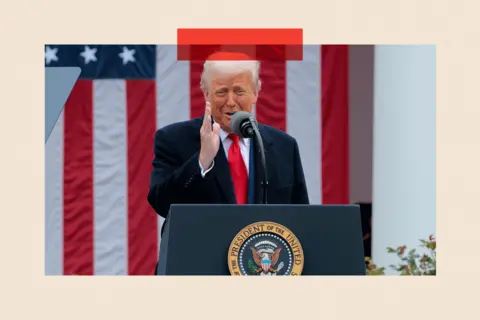
President Donald Trump has built another wall, and he thinks everyone else is going to pay for it. But his decision to impose sweeping tariffs of at least 10% on almost every product that enters the US is essentially a wall designed to keep work and jobs within it, rather than immigrants out.
The height of this wall needs to be put in historical context. It takes the US back a century in terms of protectionism. It catapults the US way above the G7 and G20 nations into levels of customs revenue, associated with Senegal, Mongolia and Kyrgyzstan.
What occurred this week was not just the US starting a global trade war, or sparking a rout in stock markets. It was the world’s hyper power firmly turning its back on the globalisation process it had championed, and from which it handsomely profited in recent decades.
And in so doing, using the equation that underpinned his grand tariff reveal on the Rose Garden’s lawns, the White House also turned its back on some fundamentals of both conventional economics and diplomacy.
The great free trade debate
Trump talked a lot about 1913 in his announcement. This was a turning point when the US both created federal income tax and significantly lowered its tariffs.
Before this point, from its inception, the US government was funded mainly by tariffs, and was unapologetically protectionist, based on the strategy of its first Treasury Secretary Alexander Hamilton.
Follow live: US tariffs have global leaders scrambling
The basic lesson the White House has taken from this is that high tariffs made America, made it “great” the first time, and also meant that there was no need for a federal income tax.
On this side of the Atlantic, underpinning globalisation and free trade are the theories of 19th-Century British economist David Ricardo. In particular, the 1817 Theory of Comparative Advantage.
There are equations, but the basics are pretty easy to understand: Individual countries are good at making different things, based on their own natural resources and the ingenuity of their populations.
Broadly speaking, the whole world, and the countries within it, are better off, if everyone specialises in what they are best at, and then trades freely.
 Reuters
Here in Britain this remains a cornerstone of the junction between politics and economics. Most of the world still believes in comparative advantage. It is the intellectual core of globalisation.
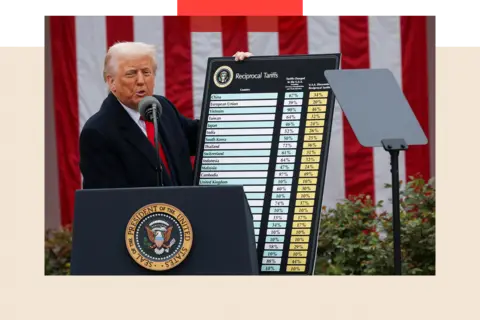
But the US was never a full convert at the time. The underlying reluctance of the US never disappeared. And this week’s manifestation of that was the imaginative equation created by the US Trade Representative to generate the numbers on Trump’s big board.
The rationale behind ‘reciprocal’ tariffs
It is worth unpacking the rationale for these so-called “reciprocal” tariffs. The numbers bear little resemblance to the published tariff rates in those countries.
The White House said adjustments had been made to account for red tape and currency manipulation. A closer look at the, at-first, complicated looking equation revealed it was simply a measure of the size of that country’s goods trade surplus with the US. They took the size of the trade deficit and divided it by the imports.
In the hour before the press conference a senior White House official explained it quite openly. “These tariffs are customised to each country, calculated by the Council of Economic Advisers… The model they use is based on the concept the trade deficit that we have is the sum of all the unfair trade practices, the sum of all cheating.”
This is really important. According to the White House, the act of selling more goods to the US than the US sells to you, is by definition “cheating” and is deserving of a tariff that is calculated to correct that imbalance.
 Shutterstock
This is why the surreal stories about the US tariffing rarely visited islands only inhabited by penguins matter. It reveals the actual method.
The long-term aim, and the target of the policy, is to get the US $1.2 trillion trade deficit and the largest country deficits within that down to zero. The equation was simplistically designed to target those countries with surpluses, not those with recognisable quantifiable trade barriers. It targeted poor countries, emerging economies and tiny irrelevant islets based on that data.
While these two different factors overlap, they are not the same thing.
There are many reasons why some countries have surpluses, and some have deficits. There is no inherent reason why these numbers should be zero. Different countries are better at making different products, and have different natural and human resources. This is the very basis of trade.
The US appears no longer to believe in this. Indeed if the same argument was applied solely to trade in services, the US has a $280bn (£216bn) surplus in areas such as financial services and social media tech.
Yet services trade was excluded from all the White House calculations.
‘China shock’ and the ripple effect
There is something bigger here. As the US Vice President JD Vance said in a speech last month, globalisation has failed in the eyes of this administration because the idea was that “rich countries would move further up the value chain, while the poor countries made the simpler things”.
That has not panned out, especially in the case of China, so the US is moving decisively away from this world.
For the US, it is not David Ricardo who matters, it is David Autor, the Massachusetts Institute of Technology (MIT) economist and the coiner of the term “China shock”.
In 2001, as the world was distracted by the aftermath of 9/11, China joined the World Trade Organisation (WTO), having relatively free access to US markets, and so transforming the global economy.
Living standards, growth, profits and stock markets boomed in the US as China’s workforce migrated from the rural fields to the coastal factories to produce exports more cheaply for US consumers. It was a classic example of the functioning of “comparative advantage”. China generated trillions of dollars, much of which was reinvested in the US, in the form of its government bonds, helping keep interest rates down.
 Getty Images
Everyone was a winner. Well, not quite. Essentially US consumers en masse got richer with cheaper goods, but the quid pro quo was a profound loss of manufacturing to East Asia.
Autor’s calculation was that by 2011, this “China shock” saw the loss of one million US manufacturing jobs, and 2.4 million jobs overall. These hits were geographically concentrated in the Rust Belt and the south.
The trade shock impact on lost jobs and wages was remarkably persistent.
Autor further updated his analysis last year and found that while the Trump administration’s first term dabble with tariff protection had little net economic impact, it did loosen Democrat support in affected areas, and boosted support for Trump in the 2020 presidential election.
Fast forward to this week, and the array of union car workers and oil and gas workers celebrating the tariffs in the White House.
So the promise is that these jobs will return, not just to the Rust Belt, but across the US. This is indeed likely to some degree. The president’s clear message to foreign companies is to avoid the tariffs by moving your factories. The carrots offered by Biden followed by the stick from Trump could well lead to material progress on this.
But the president’s characterisation of the past half century of freer trade as having “raped and pillaged” the US obviously doesn’t reflect the overall picture, even if it has not worked for specific regions, sectors or demographics.
The US service sector thrived, dominating the world from Wall Street and Silicon Valley. US consumer brands used hyper-efficient supply chains stretching into China and East Asia to make incredible profits selling their aspirational American products everywhere.
The US economy did very well indeed. The problem, simply, was that it was not evenly distributed among sectors. And what the US lacked was levels of redistribution and adaptation to spread that wealth across the country. This reflects America’s political choices.
The first social media trade war
Now, as the US chooses to reshore its manufacturing with a sudden jolt of protectionism, other countries also have choices as to whether to support the flows of capital and trade that have made the US rich.
The world’s consumers have choices.
It is little wonder major blue chip American companies, which have built cash machines on hyper-efficient East Asian supply chains producing cheaply and then selling to the whole world based on their attractive aspirational brands, have a big problem.
Their share prices are particularly badly affected because the president has both decimated their supply chain strategies, and also risks greatly impairing their brand image amongst global consumers.
 Shutterstock
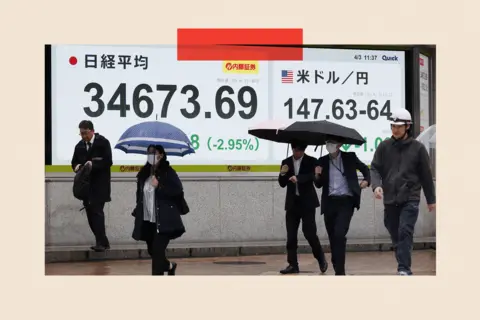
Ultimately, this is the first social media trade war. The experience of Tesla’s sale slump and Canada’s backlash against US goods may prove contagious. That would be as powerful as any counter-tariff.
These countries that bet on being the workshops for US consumers have choices over trade too. New alliances will form and intensify that seek to cut out an erratic US.
The president’s sensitivity to this was apparent when he threatened to increase tariffs if the EU and Canada joined forces over retaliation. This would be the nightmare scenario.
In the game theory of trade wars, credibility does matter. The US has unrivalled military and technological might, which helps. But to transform the global trading system using an arbitrary formula, that throws up transparent absurdities, even without the penguins, is likely to encourage the other side to resist.
This is especially the case when the rest of the world thinks that the loaded gun that the president is holding is being aimed at his own foot. The stock market fell most in the US. Inflation will go up most in the US. It is Wall Street now calculating a more-than-evens chance of a recession in the US.
Perhaps there is some substance to the theory that the real objective here is to weaken the dollar and lower US borrowing costs.
For now, the US is checking out of the global trade system it created. It can continue without it. But the transition is going to be very messy indeed.
BBC InDepth is the home on the website and app for the best analysis, with fresh perspectives that challenge assumptions and deep reporting on the biggest issues of the day. And we showcase thought-provoking content from across BBC Sounds and iPlayer too. You can send us your feedback on the InDepth section by clicking on the button below.