













 NASA
NASAIn June two American astronauts left Earth expecting to spend eight days on the International Space Station (ISS).
But after fears that their Boeing Starliner spacecraft was unsafe to fly back on, Nasa delayed Suni Williams and Butch Wilmore’s return until 2025.
They are now sharing a space about the size of a six-bedroom house with nine other people.
Ms Williams calls it her “happy place” and Mr Wilmore says he is “grateful” to be there.
But how does it really feel to be 400km above Earth? How do you deal with tricky crewmates? How do you exercise and wash your clothes? What do you eat – and, importantly, what is the “space smell”?
Talking to BBC News, three former astronauts divulge the secrets to surviving in orbit.


Every five minutes of the astronauts’ day is divided up by mission control on Earth.
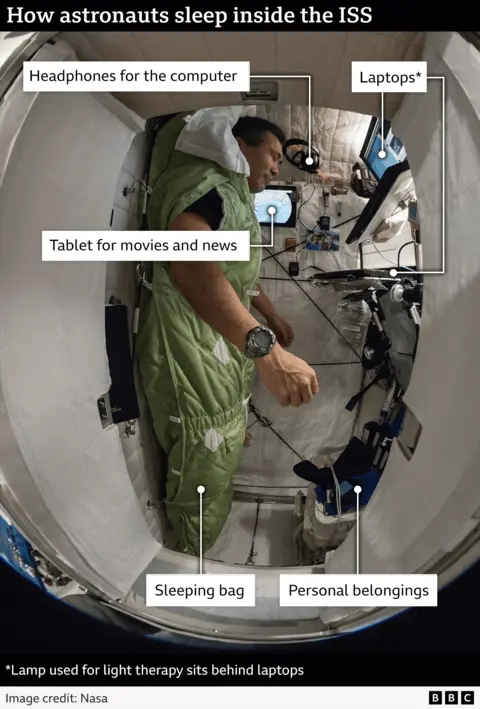
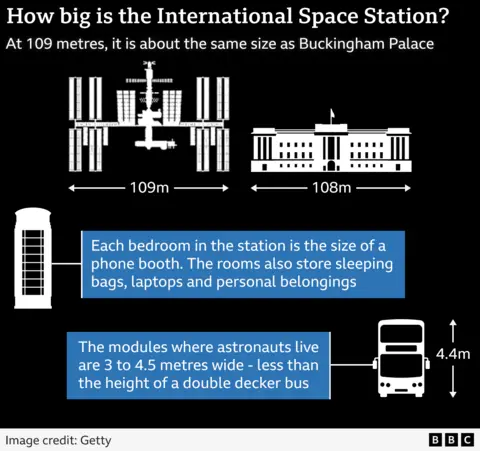
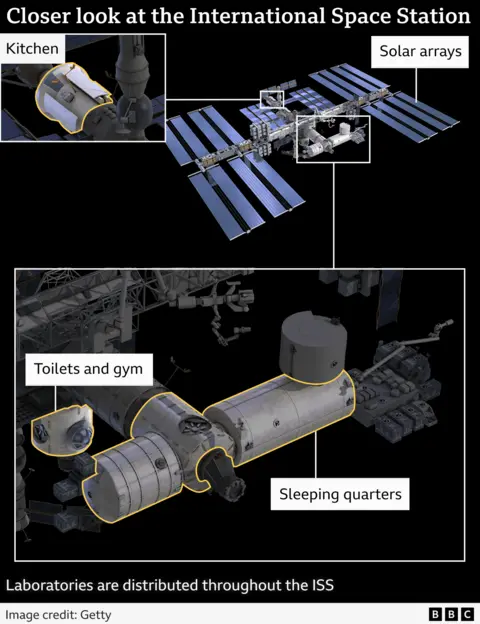
They wake early. At around 06:30 GMT, astronauts emerge from the phone-booth size sleeping quarter in the ISS module called Harmony.
“It has the best sleeping bag in the world,” says Nicole Stott, an American astronaut with Nasa who spent 104 days in space on two missions in 2009 and 2011.
The compartments have laptops so crew can stay in contact with family and a nook for personal belongings like photographs or books.
The astronauts might then use the bathroom, a small compartment with a suction system. Normally sweat and urine is recycled into drinking water but a fault on the ISS means the crew must currently store urine instead.
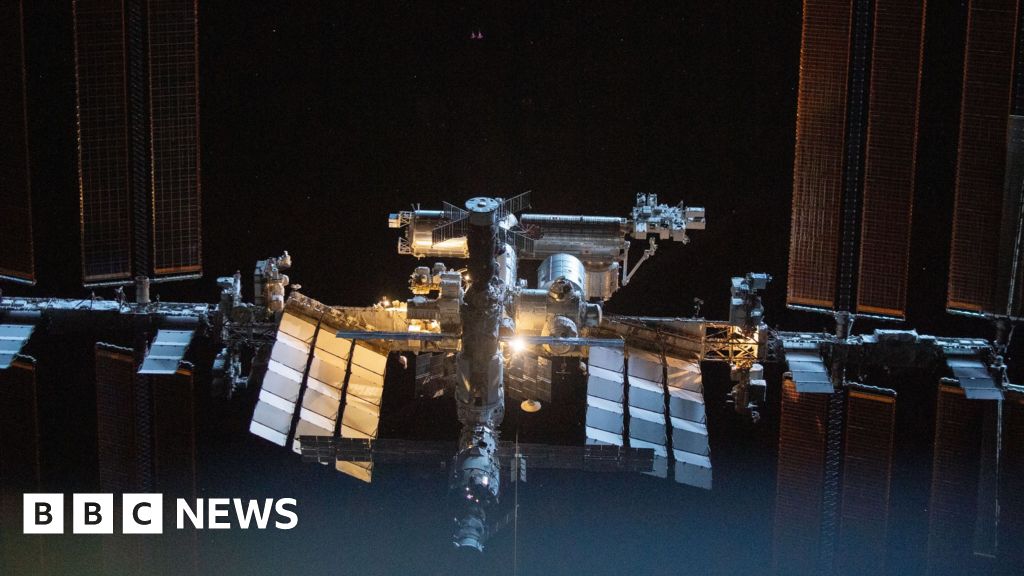
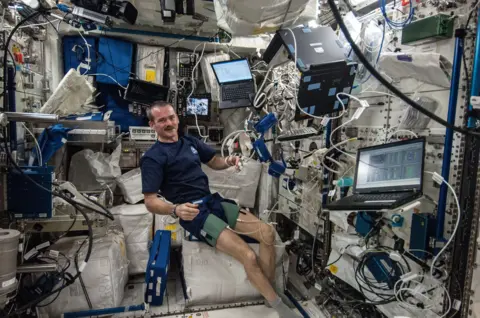
Then the astronauts get to work. Maintenance or scientific experiments take up most time on the ISS, which is about the size of Buckingham Palace – or an American football field.
“Inside it’s like many buses all bolted together. In half a day you might never see another person,” explains Canadian astronaut Chris Hadfield, commander on the Expedition 35 mission in 2012-13.
“People just don’t go zipping through the station. It’s big and it’s peaceful,” he says.
The ISS has six dedicated labs for experiments, and astronauts wear heart, brain or blood monitors to measure their responses to the challenging physical environment.
“We’re guinea pigs,” says Ms Stott, adding that “space puts your bones and muscles into an accelerated ageing process, and scientists can learn from that”.
If the astronauts can, they work faster than mission control predicts.
Mr Hadfield explains: “Your game is to find five free minutes. I would float to the window to watch something go by. Or write music, take photographs or write something for my children.”
 Nasa
NasaA lucky few are asked to do a spacewalk, leaving the ISS for the space vacuum outside. Mr Hadfield has done two. “Those 15 hours outside, with nothing between me and the universe but my plastic visor, was as stimulating and otherworldly as any other 15 hours of my life.”
But that spacewalk can introduce something novel to the space station – the metallic “space smell”.
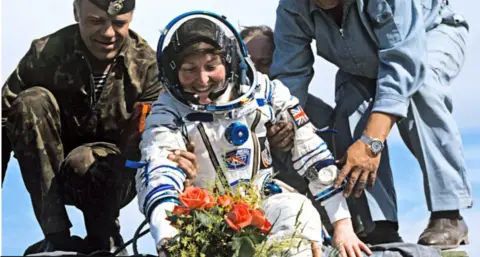
“On Earth we have lots of different smells, like washing machine laundry or fresh air. But in space there’s just one smell, and we get used to it quickly,” explains Helen Sharman, the first British astronaut, who spent eight days on the Soviet space station Mir in 1991.
Objects that go outside, like a suit or scientific kit, are affected by the strong radiation of space. “Radiation forms free radicals on the surface, and they react with oxygen inside the space station, creating a metallic smell,” she says.
When she returned to Earth, she valued sensory experiences much more. “There’s no weather in space – no rain on your face and or wind in your hair. I appreciate those so much more to this day now,” she says, 23 years later.
In between working, astronauts on long stays must do two hours of exercise daily. Three different machines help to counter the effect of living in zero gravity, which reduces bone density.
The Advanced Resistive Exercise Device (ARED) is good for squats, deadlifts, and rows that work all the muscle groups, says Ms Stott.
Crew use two treadmills that they must strap into to stop themselves floating away, and a cycle ergometer for endurance training.
‘One pair of trousers for three months’
All that work creates a lot of sweat, Ms Stott says, leading to a very important issue – washing.
“We don’t have laundry – just water that forms into blobs and some soapy stuff,” she explains.
Without gravity pulling sweat off the body, the astronauts get covered in a coating of sweat – “way more than on Earth”, she says.
“I would feel the sweat growing on my scalp – I had to swab down my head. You wouldn’t want to shake it because it just would fly everywhere.”
 Nasa
NasaThose clothes become so dirty that they are thrown out in a cargo vehicle that burns up in the atmosphere.
But their daily clothes stay clean, she says.
“In zero-gravity, clothes float on the body so oils and everything else don’t affect them. I had one pair of trousers for three months,” she explains.
Instead food was the biggest hazard. “Somebody would open up a can, for example, meats and gravy,” she says.
“Everybody was on alert because little balls of grease drifted out. People floated backwards, like in the Matrix film, to dodge the balls of meat juice.”
At some point another craft might arrive, bringing a new crew or supplies of food, clothes, and equipment. Nasa sends a few supply vehicles a year. Arriving at the space station from Earth is “amazing”, says Mr Hadfield.
“It’s a life-changing moment when you catch sight of the ISS there in the eternity of the universe – seeing this little bubble of life, a microcosm of human creativity in the blackness,” he says.
After a hard day’s work, it is time for dinner. Food is mostly reconstituted in packets, separated into different compartments by nation.
“It was like camping food or military rations. Good but it could be healthier,” Ms Stott says.
“My favourite was Japanese curries, or Russian cereal and soups,” she says.
Families send their loved ones bonus food packs. “My husband and son picked little treats, like chocolate-covered ginger,” she says.
The crew share their food most of the time.
Astronauts are pre-selected for personal attributes – tolerant, laid-back, calm – and trained to work as a team. That reduces the likelihood of conflict, explains Ms Sharman.
“It’s not just about putting up with somebody’s bad behaviour, but calling it out. And we always give each other metaphorical pats-on-the back to support each other,” she says.
 Ria Novosti/Science Photo Library
Location, location, location
And finally, bed again, and time to rest after a day in a noisy environment (fans run constantly to disperse pockets of carbon dioxide so the astronauts can breathe, making it about as loud as a very noisy office).
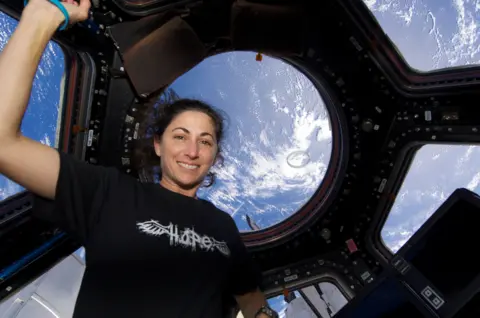
“We can have eight hours of sleep – but most people get stuck in the window looking at Earth,” Ms Stott says.
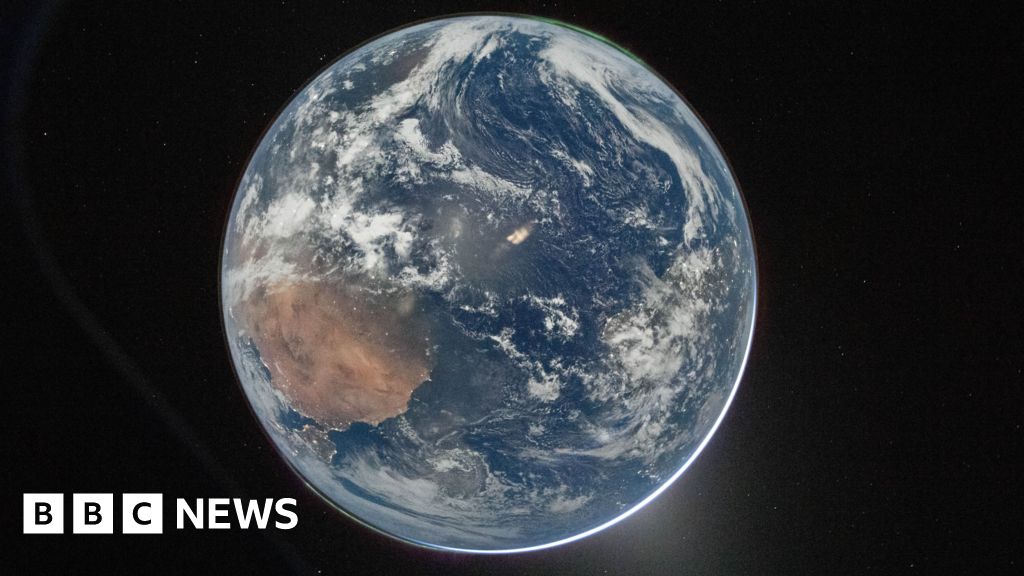
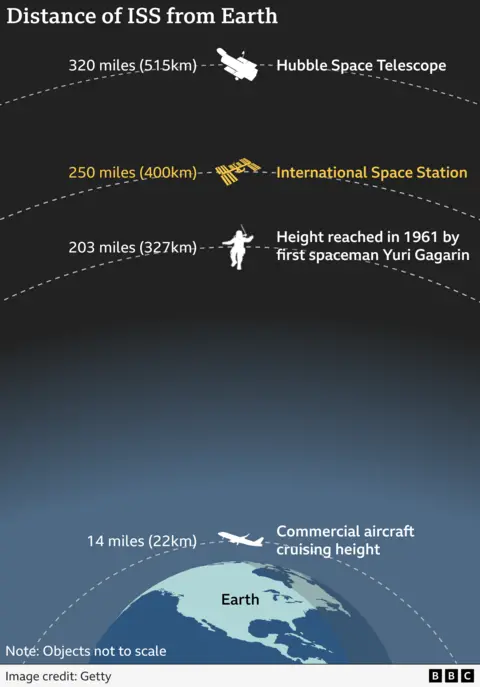
All three astronauts talked about the psychological impact of seeing their home planet from 400km in orbit.
“I felt very insignificant in that vastness of space,” Ms Sharman says. “Seeing Earth so clearly, the swirls of clouds and the oceans, made me think about the geopolitical boundaries that we construct and how actually we are completely interconnected.”
Ms Stott says she loved living with six people from different countries “doing this work on behalf of all life on Earth, working together, figuring out how to deal with problems”.
“Why can’t that be happening down on our planetary spaceship?” she asks.
Eventually all astronauts must leave the ISS – but these three say they would return in a heartbeat.
They don’t understand why people think the Nasa astronauts Suni Williams and Butch Wilmore are “stranded”.
“We dreamed, worked and trained our entire lives hoping for an extended stay in space,” says Mr Hadfield. “The greatest gift you can give a professional astronaut is to let them stay longer.”
And Ms Stott says that as she left the ISS she thought: “You’re gonna have to pull my clawing hands off the hatch. I don’t know if I’m going to get to come back.”
Graphics by Katherine Gaynor and Camilla Costa