








By Katy Watson, Australia correspondent
 BBC
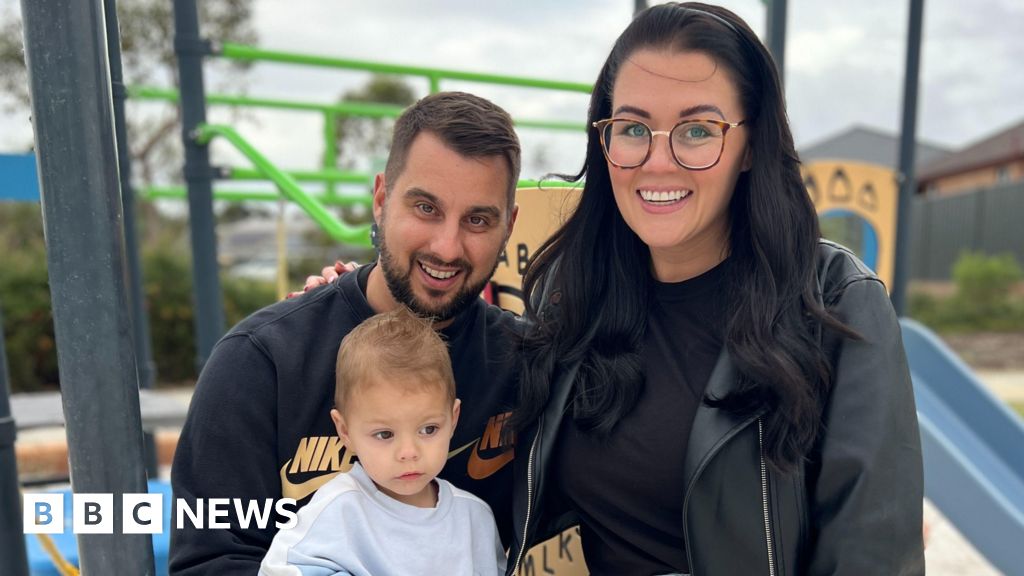
BBCWhen Luca was born in a Perth hospital two years ago, it flipped his parents’ world in ways they never expected.
With the joy came a shocking diagnosis: Luca had cystic fibrosis. Then Australia – Laura Currie and her husband Dante’s home for eight years – said they couldn’t stay permanently. Luca, his parents were told, could be a financial burden on the country.
“I think I cried for like a week – I just feel really, really sorry for Luca,” Ms Currie says. “He’s just a defenceless two-and-a-half-year-old and doesn’t deserve to be discriminated against in that way.”
With a third of its population born abroad, Australia has long seen itself as a “migration nation” – a multicultural home for immigrants that promises them a fair go and a fresh start. The idea is baked into its identity. But the reality is often different, especially for those who have a disability or a serious medical condition.
It is one of few countries that routinely rejects immigrants’ visas on the basis of their medical needs – specifically if the cost of care exceeds A$86,000 ($57,000; £45,000) over a maximum of 10 years. New Zealand has a similar policy but Australia’s is much stricter.
The government defends the law as necessary to curb government spending and protect citizens’ access to healthcare. It says these visas aren’t technically rejected. But neither are they granted. Some can apply for a waiver, although not all visas allow it. They could also appeal the decision but the process is lengthy and expensive.
Campaigners see this as discriminatory and out of step with modern attitudes towards disability. And after years of fighting for it, they are hoping for change in the coming weeks, with an official review of the health requirements under way.
Laura Currie and Dante Vendittelli had moved from Scotland for jobs that Australia desperately needs. She is a nursery teacher and he is a painter-decorator. They had started their application for permanent residency before Luca was born. But now they feel like the life they built here and the taxes they paid meant little.
“It’s like, we’re here for you [Australia] when you need us, but when the roles are reversed and we need you, it’s like, nope, sorry, you cost too much money, you go back to your own country.”
Australia has form when it comes to its strict immigration policies. It had its own version of “stop the boats”, which sent people arriving by boat to offshore detention centres in Papua New Guinea and the Pacific Island of Nauru and made controversial headlines in recent years. It was only in the 1970s that it entirely rid itself of the “White Australia” policy that started in 1901 with the Immigration Restriction Act, which limited the number of non-white immigrants.
The disability and health discriminations, which also date back to 1901, are still in place, says Jan Gothard, an immigration lawyer: “We still treat people with disability in the same way as we did in 1901 and we think they’re not people who are welcome in Australia.”
She is part of Welcoming Disability, an umbrella group that’s been pressuring the government to overhaul the law. Surprisingly, Australia’s Migration Act is exempt from its own Disability Discrimination Act.
Put simply, it doesn’t matter how long you’ve lived in Australia, if you were born in Australia, if you have private health insurance or even if you can pay for the support yourself – if you are deemed too much of a financial burden, you will fail the health requirement.
The government says that 99% of visa applicants meet the health requirement – 1,779 of them did not meet the bar between 2021 and 2022, according to official figures.
Immigration minister Andrew Giles, who declined to be interviewed, recently said that “any child born in Australia and adversely affected by the migration health rules can apply for ministerial intervention”, and that he himself had “positively intervened” in cases.
But families say that the process is gruelling at an already difficult time.
The price to stay
“There’s so much in your life going on when a child is sick, so much struggle and you’re struggling and begging and asking for petitions, asking people to help you,” says Mehwish Qasim, who knows the challenge first-hand. She and her husband Qasim fought to stay in Australia in a case that drew global attention.
Their son Shaffan was born in 2014 with a rare genetic condition and a damaged spinal cord. He needs around-the-clock care. The couple, originally from Pakistan, intended to return eventually, but Shaffan’s birth changed everything. Now, getting on a plane would risk his life.
Finally, in 2022 they were told they could stay. For those eight years, Qasim, a trained accountant, was unable to work in his chosen profession. Instead, he found jobs in cafes, in supermarkets and taxi apps to make ends meet.
“They should realise that’s a very difficult situation – you shouldn’t put people in the limelight,” Ms Qasim says.
Ms Currie and her husband aren’t giving up either – Australia is home now for Luca and they are filling jobs that the country needs. They’re hoping that is enough to win them their appeal. If they lose, they will have 28 days to leave the country.
For Luca, the sticking point is a pricey drug, Trikafta. He is not on it and may not even be compatible with it. But it’s the basis of Australian estimates of his treatment – around A$1.8m That puts his medical costs over the permissible limit – A$86,000 over 10 years, also known as the Significant Cost Threshold.
While campaigners have welcomed the recent rise of the threshold – from A$51,000 to A$86,000 – they still don’t think it reflects average costs.
The government’s own data shows it spends at least $17,610 per year on the average citizen – the most recent figures from 2021-2022 showing $9,365 per head on health goods and services and a further A$8,245 per person on welfare costs. Over a 10-year period – the maximum period assessed for a visa – that would amount to more than A$170,000. So campaigners have questioned how the government comes up with the threshold, which is half of that amount.
They also want the cost of educational support to be removed from the calculations. This impacts families whose children have been diagnosed with conditions such as Down Syndrome, ADHD and autism.

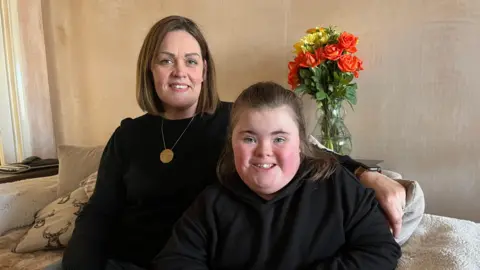
It’s a snag that has hit Claire Day’s plans for her and her family to follow her brother, who moved to Australia a few years ago.
Her younger daughter Darcy, who is nearly 10, has Down Syndrome. She’s been told by migration experts that because of that, she has little chance of being granted a visa.
On an overcast afternoon in Kent, she talks wistfully of the life she is looking forward to Down Under. Sunshine is no small attraction, but also “the lifestyle – [I want] a better environment for the children to grow up in,” she says.
An officer with London’s Metropolitan Police force for 21 years, she wants to take advantage of a major recruitment drive by Australian police forces. Their social media feeds are full of promotional videos fronted by former British police officers, showing them living the Australian dream, patrolling the beach in sand buggies and relaxing in the surf. They make up just some of the 30,000 British people who moved to Australia last year, according to government statistics.
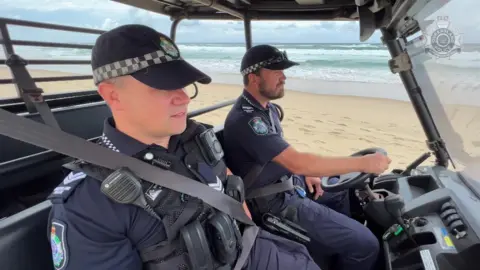 Queensland Police Service
Ms Day has not one, but two job offers – from Queensland’s police force and from South Australia. As part of the job, she’s also entitled to a permanent visa. Now, she is not so sure.
“I had hoped that it wouldn’t be an issue because Darcy doesn’t have any medical problems. She’s fit and she’s healthy, she goes to school and she participates in clubs and all of that sort of stuff.”
Stories like this have convinced campaigners that, at its heart, the policy is ableist.
“If we say to people with disability, ‘you’re not welcome here, we’re saying directly to people living with disability in this country, ‘you’re not welcome here either,” Dr Gothard says.
“[We’re saying] you know, given the opportunity, we would rather not have you.”
Social worker Shizleen Aishath says she was “gobsmacked” to find out about the health requirement – and she discovered it the hard way.
A former UN employee, she came to Australia for a further degree with every intention of returning to the Maldives. But she had an emergency C-section when her son Kayban was born in 2016. Forceps were used during the delivery. Kayban had undiagnosed haemophilia and suffered a serious brain bleed. He now needs round-the-clock care and the family chose to stay in Australia.
But Kayban was refused a temporary visa because he was deemed too much of a burden – although the family have private health insurance and don’t use state resources. The rest of the family were granted their visas.
“Disability is the only thing that stops you from migrating, there is nothing else,” Ms Aishath says.
After a lengthy appeal, Kayban was allowed to remain. His family is now preparing for their next fight – to stay in Australia indefinitely.