


















News
  • Login
  • Home
  • News
  • Sport
  • Worklife
  • Travel
  • Reel
  • Future
  • More
Friday, May 1, 2026
No Result
View All Result

NEWS

3 °c
London
8 ° Wed
9 ° Thu
11 ° Fri
13 ° Sat
  • Home
  • Video
  • World
    • All
    • Africa
    • Asia
    • Australia
    • Europe
    • Latin America
    • Middle East
    • US & Canada

    Police say they believe abducted child was murdered as body found in Outback

    Violence in Australian town after arrest of man over girl's murder

    Man sentenced to death for murder of toddlers at Ugandan nursery

    Singapore court fines women for pro-Palestinian walk

    Trump says US studying troop cuts in Germany, as spat with Merz intensifies

    US soldier accused of betting on Maduro's removal pleads not guilty to fraud charges

    Israel intercepts Gaza flotilla near Crete and detains 175 activists

    Oscar goes missing after Academy Award winner is blocked from taking it on flight

    Bondi shooting inquiry calls for gun reform and more security at Jewish festivals

  • UK
    • All
    • England
    • N. Ireland
    • Politics
    • Scotland
    • Wales

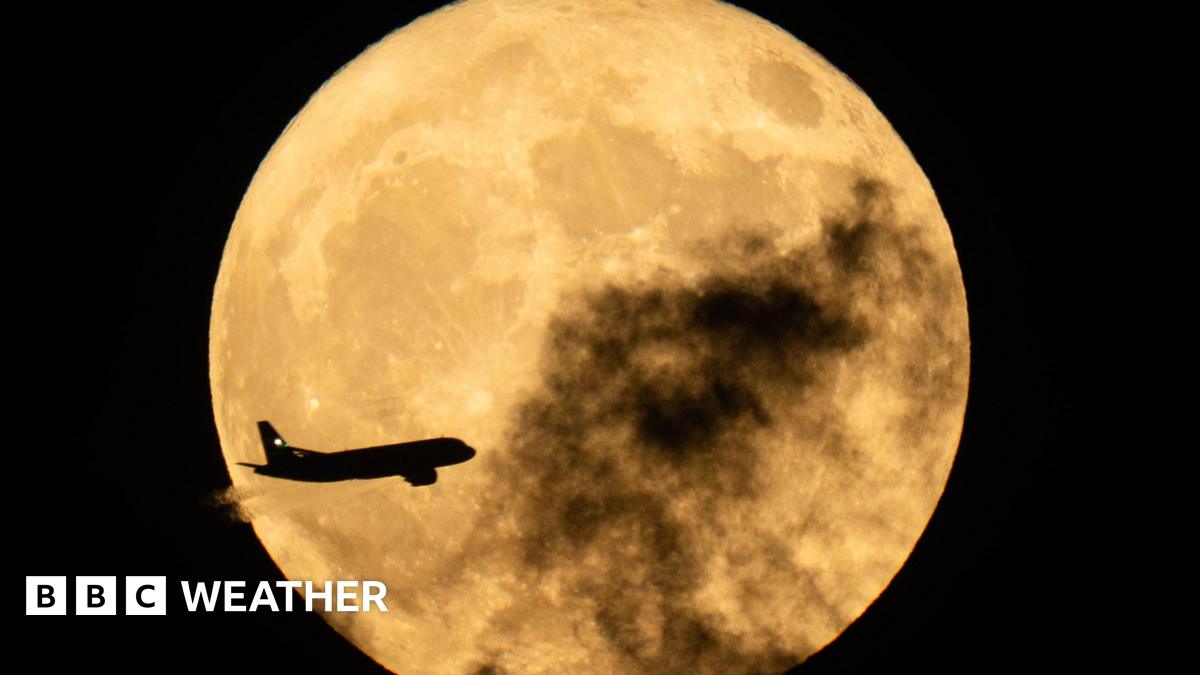
    May full Moon: When to see the ‘Flower Moon’ rise this week

    'First hotel in Scotland' could reopen as business hub

    The methods and mind of Wrexham’s composed icon Phil Parkinson

    Heating oil prices reached record high in NI

    Restore Britain party refunds crypto project's donations

    UK terrorism threat level raised to severe after Golders Green attack

    What we know about the Golders Green stabbings

    The city caught in the middle of the big energy shift debate

    Wrexham: When the first Hollywood season ended in final-game tears

  • Business
    • All
    • Companies
    • Connected World
    • Economy
    • Entrepreneurship
    • Global Trade
    • Technology of Business

    Chip shops sell cheap catfish as ‘traditional fish and chips’

    Fertiliser boss says war puts 10 billion meals a week at risk

    Five takeaways from the Bank of England

    Meta shares slide as investors weigh Big Tech's AI spending spree

    Claimants in Johnson & Johnson talcum powder case rise to 7,000

    Interest rates expected to be held as uncertainty over Iran war continues

    Face serum advert banned over 'five years younger' claim

    What is the windfall tax on oil and gas companies?

    A fresh financial crisis may be coming – it won't play out like the last one

  • Tech
  • Entertainment & Arts

    Dancers say Lizzo ‘needs to be held accountable’ over harassment claims

    Freddie Mercury: Contents of former home being sold at auction

    Harry Potter and the Cursed Child marks seven years in West End

    Sinéad O’Connor: In her own words

    Tom Jones: Neighbour surprised to find singer in flat below

    BBC presenter: What is the evidence?

    Watch: The latest on BBC presenter story… in under a minute

    Watch: George Alagiah’s extraordinary career

    BBC News presenter pays tribute to ‘much loved’ colleague George Alagiah

    Excited filmgoers: 'Barbie is everything'

  • Science
  • Health
  • In Pictures
  • Reality Check
  • Have your say
  • More
    • Newsbeat
    • Long Reads

NEWS

No Result
View All Result
Home Business Economy

How much money does the UK government borrow, and does it matter?

May 20, 2025
in Economy
7 min read
242 11
0
491
SHARES
1.4k
VIEWS
Share on FacebookShare on Twitter


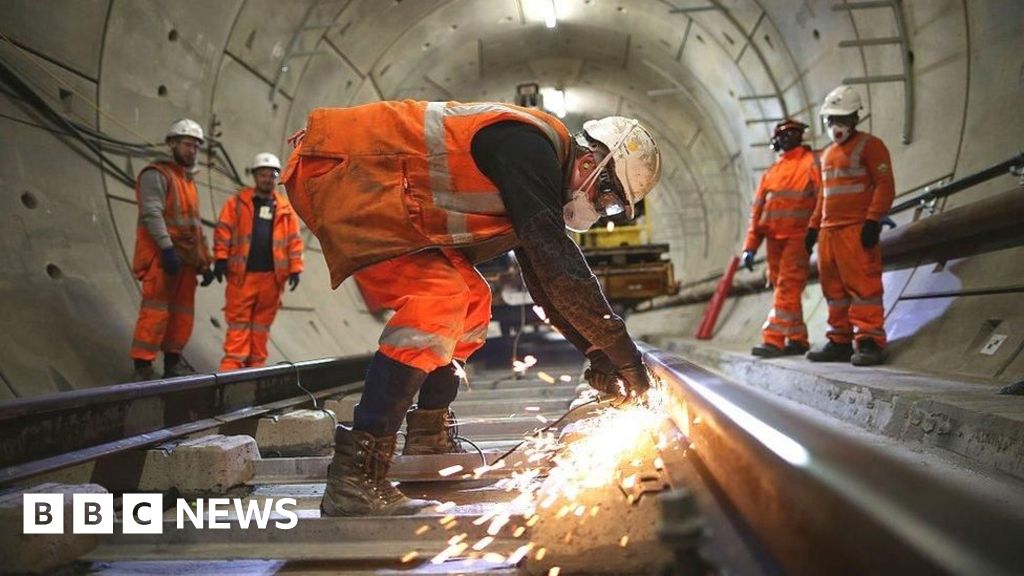
Getty Images Five workers in fluorescent orange workwear in underground tunnelGetty Images

Governments borrow to fund “day-to-day” spending and infrastructure projects like the Elizabeth Line

The UK government generally spends more than it raises in tax.

To fill this gap it borrows money, but that has to be paid back – with interest.

Why does the government borrow money?

The government gets most of its income from taxes. For example, workers pay income tax and National Insurance, everyone pays VAT on certain goods, and companies pay tax on profits.

It could, in theory, cover all of its spending from taxes and that sometimes happens.

But, if it can’t, the government covers the gap by raising taxes, cutting spending or borrowing.

Higher taxes mean people have less money to spend, so businesses make less profit, which can be bad for jobs and wages. Lower profits also mean companies pay less tax.

So, governments often decide to borrow to boost the economy. They also borrow to pay for big projects, like new railways and roads.

How does the government borrow money?

The government borrows money by selling financial products called bonds.

A bond is a promise to pay money in the future. Most require the borrower to make regular interest payments.

UK government bonds – known as “gilts” – are normally considered very safe, with little risk the money will not be repaid.

Gilts are mainly bought by financial institutions in the UK and abroad, such as pension funds, investment funds, banks and insurance companies.

The government sells short and long-term gilts to allow it to borrow money over different time periods, with varying interest rates.

How much is the UK government borrowing?

The amount the government borrows fluctuates from month to month.

For instance, it tends to borrow less in January, when many people pay a large chunk of their annual tax bill in one go.

So, it is more helpful to look across a whole year, or the year-to-date.

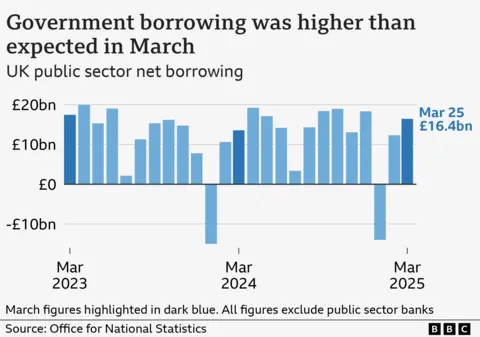
In the last full financial year, to March 2025, the government borrowed £151.9bn.

Borrowing in March alone stood at £16.4bn, which was £2.8bn more than a year earlier.

A bar chart showing the UK's public sector net borrowing, excluding public sector banks, from March 2023 to March 2025. In March 2023, public sector net borrowing stood at £17.5 billion. It then fell to £13.6 billion in March 2024, before rising to £16.4 billion in March 2025.

The total amount the government owes is called the national debt. It is currently about £2.8 trillion – or £2,800,000,000,000.

That is roughly the same as the value of all the goods and services produced in the UK in a year, known as the gross domestic product, or GDP.

The current level is more than double that seen from the 1980s through to the financial crisis of 2008.

The combination of the financial crash and the Covid pandemic pushed the UK’s debt up.

But, in relation to the size of the economy, UK debt figures are still low compared with much of the last century. They are also less than the equivalent figures for some other leading economies.

How much money does the government pay in interest?

The larger the national debt, the more interest the government pays.

That cost was not as great when interest rates were low during the 2010s, but became more noticeable after the Bank of England started raising interest rates in 2021.

The amount of interest the government pays on national debt also varies from month to month.

It was £4.3bn in March 2025. That was the highest March figure since monthly records began in 1997, though only £200m above the previous record set in March 2023.

In early January 2025, interest rates for long-term borrowing rose to their highest levels this century, before falling back.

Why does it matter if governments borrow more and pay more interest?

If the government has to set aside more cash for paying debts and interest, it may mean it has less to spend on public services.

Some economists fear the government is borrowing too much, at too great a cost. Others argue extra borrowing helps the economy grow faster – generating more tax in the long run.

The increase in projected long-term interest rates seen in January prompted some economists to warn that the government was on course to miss its own borrowing targets.

Labour decided to stick to a rule followed by the previous government that the total amount of money owed must have fallen as a proportion of the UK economy in five years’ time.

In October’s Budget, Chancellor Rachel Reeves changed the definition of debt that the government would use in the target to enable her to raise more money for investment.

It will now track a different, broader measure of debt called public sector net financial liabilities (PSNFL). This includes, for example, the money the government gets from people repaying their student loans.

Downing Street said there was “no doubt about the government’s commitment to economic stability”, and that “meeting our fiscal rules is non-negotiable”.

What is the difference between debt and deficit?

Debt is the total amount of money owed by the government that has built up over years.

The deficit is the gap between the government’s income and the amount it spends.

When a government spends less than its income, it has what is known as a surplus.

Debt rises when there is a deficit, and falls in those years when there is a surplus.



Source link

Tags: borrowgovernmentMatterMoney

Related Posts

Five takeaways from the Bank of England

May 1, 2026
0

Given events in the Middle East, it was already inevitable that domestic energy bills will rise this summer. The...

Interest rates expected to be held as uncertainty over Iran war continues

April 30, 2026
0

Future base rate changes are hard to predict as analysts judge the economic impact of the Iran war. ...

A fresh financial crisis may be coming – it won't play out like the last one

April 29, 2026
0

Several warning lights are flashing that have some wondering whether we are in the foothills of another financial crisis....

  • Australia helicopter collision: Mid-air clash wreckage covers Gold Coast

    523 shares
    Share 209 Tweet 131
  • UK inflation: Supermarkets say price rises will ease soon

    515 shares
    Share 206 Tweet 129
  • Ballyjamesduff: Man dies after hit-and-run in County Cavan

    510 shares
    Share 204 Tweet 128
  • Somalia: Rare access to its US-funded 'lightning commando brigade

    508 shares
    Share 203 Tweet 127
  • Google faces new multi-billion advertising lawsuit

    508 shares
    Share 203 Tweet 127
  • Trending
  • Comments
  • Latest

Australia helicopter collision: Mid-air clash wreckage covers Gold Coast

January 10, 2023

UK inflation: Supermarkets say price rises will ease soon

April 19, 2023

Ballyjamesduff: Man dies after hit-and-run in County Cavan

August 19, 2022

Stranger Things actor Jamie Campbell Bower praised for addiction post

0

NHS to close Tavistock child gender identity clinic

0

Cold sores traced back to kissing in Bronze Age by Cambridge research

0

BBC Inside Science – Why is Europe the fastest-warming continent?

May 1, 2026

May full Moon: When to see the ‘Flower Moon’ rise this week

May 1, 2026

F1's Alex Albon on getting ready for the Miami GP – and his 14 cats

May 1, 2026

Categories

Science

BBC Inside Science – Why is Europe the fastest-warming continent?

May 1, 2026
0

Available for 35 daysThe latest European State of the Climate report has found that Europe is once again getting...

Read more

May full Moon: When to see the ‘Flower Moon’ rise this week

May 1, 2026
News

Copyright © 2020 JBC News Powered by JOOJ.us

Explore the JBC

  • Home
  • News
  • Sport
  • Worklife
  • Travel
  • Reel
  • Future
  • More

Follow Us

  • Home Main
  • Video
  • World
  • Top News
  • Business
  • Sport
  • Tech
  • UK
  • In Pictures
  • Health
  • Reality Check
  • Science
  • Entertainment & Arts
  • Login

Copyright © 2020 JBC News Powered by JOOJ.us

Welcome Back!

Login to your account below

Forgotten Password?

Create New Account!

Fill the forms bellow to register

All fields are required. Log In

Retrieve your password

Please enter your username or email address to reset your password.

Log In
This website uses cookies. By continuing to use this website you are giving consent to cookies being used. Visit our Privacy and Cookie Policy.
News
More Sites

    MORE

  • Home
  • News
  • Sport
  • Worklife
  • Travel
  • Reel
  • Future
  • More
  • News

    JBC News