






Jonathan JosephsBusiness reporter, BBC News
 AFP via Getty Images
President Trump’s favourite word is tariffs. He reminded the world of that in his pre-Christmas “address to the nation”.
With the world still unwrapping the tariffs “gift” from the first year of his second term in office, he said they were bringing jobs, higher wages and economic growth to the US.
That is hotly contested. What is less debatable is that they’ve refashioned the global economy, and will continue to do so into 2026.
The International Monetary Fund (IMF) says that although “the tariff shock is smaller than originally announced”, it is a key reason why it now expects the rate of global economic growth to slow to 3.1% in 2026. A year ago, it predicted a 3.3% expansion this year.
For the head of the IMF, Kristalina Georgieva, things are “better than we feared, worse than it needs to be”. Speaking on a podcast recently she explained that growth had fallen from a pre-Covid average of 3.7%.
“This growth is too slow to meet the aspirations of people around the world for better lives,” she said.
Other forecasts for 2026 are even more pessimistic than that of the IMF.
Yet the impact of the tariffs on the global economy was not as bad as it could have been, notes Maurice Obstfeld of the Peterson Institute for International Economics, who is also a former chief economist at the IMF. He says this is the case because “countries didn’t retaliate strongly against the US”.
Obstfeld adds: “And the one country that did forcefully hit back, which is China, induced the US to back down very quickly. So we certainly avoided a trade disaster.”
However, after five rounds of trade talks, the world’s two biggest economies still have more tariffs and other trade restrictions in place against each other than when Trump took office for the second time.
The tariffs have pushed up costs for many businesses and increased uncertainty, which makes it harder to plan for and invest in the future.
Despite the resilience seen so far, “these frictions and uncertainties take their toll over time”, such as through efficiency loses, according to Obstfeld.
Some of the damage of tariffs has been mitigated by lower interest rates, a fall in the value of the dollar, businesses finding clever ways around them, and, crucially, the many exemptions they contain.
This may help explain why the UN trade agency UNCTAD is forecasting that the value of global trade grew 7% last year to reach more than $35tn (£26tn).
Yet Obstfeld says the loopholes in US tariffs are a double-edged sword. “The exemptions mean lower tariffs in practice, but they also introduce a lot of uncertainty about how you get them.”
Countries including the UK, South Korea and Japan have managed to navigate those mysteries and agree trade deals with Trump. Others will hope they can do so during 2026.

 AFP via Getty Images
Whilst some economists have expressed doubt about how strongly the US is now growing, between July and September it expanded by 4.3%, the strongest annual growth in two years.
“This is a very, very resilient economy, and I don’t see why that wouldn’t continue going forward,” says Aditya Bhave, a senior economist at Bank of America.
He thinks tariffs have added between 0.3% and 0.5% to US inflation, which in November was 2.7%, but “we probably haven’t seen the full impact” yet. That matters given the US economy is driven by consumer spending, and that it accounts for 26% of the global economy, according to the IMF.
Cost of living pressures are still a problem for people in many parts of the world, but there are some encouraging signs for them. In the eurozone, inflation has stabilised and is now running at 2.1%. But in the UK it’s 3.2%, which as in the US, remains well above the central banks’ 2% target.
Others major influences on the global economy this year could include the renegotiation of the US Mexico Canada Agreement (USMCA) trade deal that Trump signed in his first term in office.
Meanwhile, EU member states are due to vote on whether to ratify a South American trade deal that was signed more than a year ago.
And back in the US, there is a lot riding on a Supreme Court decision on the legality of Trump’s tariffs.
 AFP via Getty Images
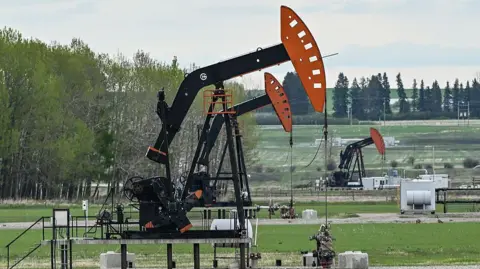
One key input into the world economy is oil, and Wall Street bank Goldman Sachs expects the price of benchmark Brent Crude to fall around 8% this year to around $56 a barrel.
That forecast is based on strong production in the US and Russia, rather than Trump’s intervention in Venezuela, which is unlikely to lead to more oil on global markets in the short term.
With oil used for energy and transport, another downward pressure on prices could be the resumption of global shipping through the Red Sea. A week before Christmas shipping giant Maersk sent a container ship through it for the first time in almost two years.
Attacks by Houthi rebels based in Yemen, that were linked to the war in Gaza, mean major shipping companies have avoided it. Instead they’ve taken the longer and more expensive route around southern Africa.
Maersk says that whilst it was “a significant step forward, we are not at a point where we can set a date on any potential wider network change back to the trans-Suez corridor”.
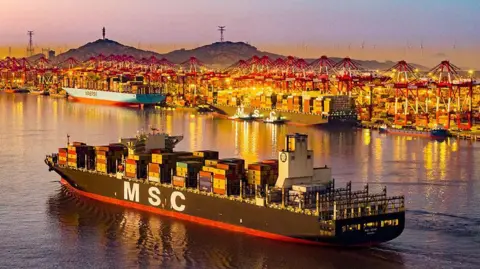
One of the most important destinations for container ships is China. It’s where they pick up the toys, electronics, clothing and other goods that the country makes for the rest of the world.
However, Beijing’s trade relations with the US continue to cast a shadow over the global economy.
The latest available data suggests the value of goods the world’s two biggest economies sold each other fell for the third consecutive year in 2025.
Unlike a year ago, there wasn’t even a nod towards those strains, or the many domestic economic pressures in President Xi’s 2026 new year message.
However, he did forecast the world’s second-biggest economy would reach the landmark size of $20tn this year, and said that China is “ready to work with all countries to advance world peace and development”.
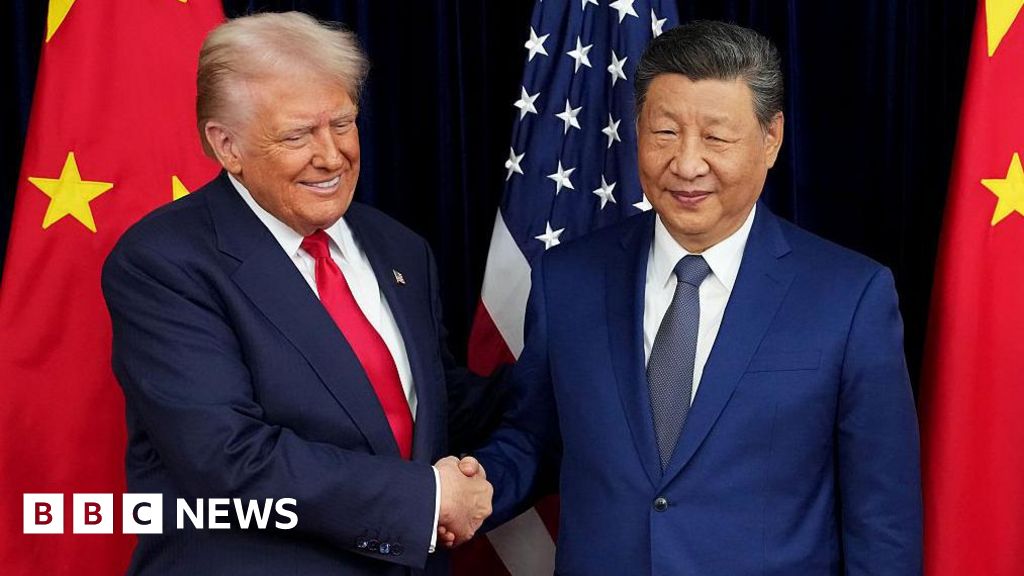
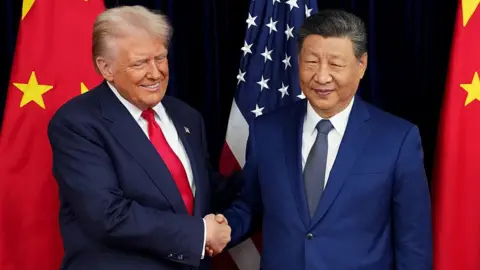
Tariffs, US sourcing of rare earth metals, and Chinese access to high-end US computer chips, have dominated talks between the two sides, but there are many other issues to be resolved when Xi hosts Trump in April, according to James Zimmerman who chairs the American Chamber of Commerce in China.
“A lot is riding on that [meeting],” he says. “Our expectations are indeed low.” But he adds that its “very, very important” that there is a sustained dialogue even if it takes time to deliver results.
“Beijing wants a fair shake at being able to compete globally. They do feel that the environment in certain places has been very restrictive towards Chinese companies. Part of that is the over emphasis on security concerns.”
On the other side, Zimmerman says that US concerns include “how China manages its manufacturing output”. “Overcapacity is an issue that is affecting a lot of different economies.”
He explains that China has shown its strength in manufacturing consumer goods, but that it needs to show it can make adjustments when demand for them falls, “so that there is not a situation where you have massive dumping of consumer goods around the world”.
In Europe, the continent’s reliance on cheap Chinese imports is growing, according to research from Dutch bank ING.
This is something that the EU is looking to crack down on in the coming months.
 AFP via Getty Images
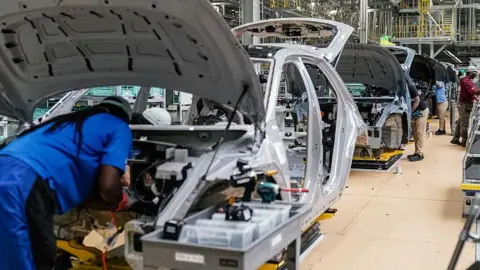
Back in the US, limiting the inflow of foreign-made goods is a key part of Trump’s trade policy. His Trade Representative Jamieson Greer recently wrote that re-industrialisation and increasing “manufacturing’s share of our economy” was in the US national interest.
In a hint towards tariffs staying in place, he argued that new investments in making cars, ships and pharmaceuticals in the US wouldn’t be happening without them.
However, since Tump’s second term began, the number of Americans in manufacturing jobs has fallen slightly to just under 12.7 million.
Obstfeld says that despite tariffs the US economy has continued to grow because of “resilient consumers who want to spend their money anyway”, and the huge investment in AI that has sent stock markets to record highs.
With some of Trump’s key policy aims, such as creating new manufacturing jobs, still to be achieved Obstfeld adds: “I don’t think tariffs are going to go away as a matter of policy or of discussion.”