


























News
  • Login
  • Home
  • News
  • Sport
  • Worklife
  • Travel
  • Reel
  • Future
  • More
Friday, May 1, 2026
No Result
View All Result

NEWS

3 °c
London
8 ° Wed
9 ° Thu
11 ° Fri
13 ° Sat
  • Home
  • Video
  • World
    • All
    • Africa
    • Asia
    • Australia
    • Europe
    • Latin America
    • Middle East
    • US & Canada

    Police say they believe abducted child was murdered as body found in Outback

    Violence in Australian town after arrest of man over girl's murder

    Man sentenced to death for murder of toddlers at Ugandan nursery

    Singapore court fines women for pro-Palestinian walk

    Trump says US studying troop cuts in Germany, as spat with Merz intensifies

    US soldier accused of betting on Maduro's removal pleads not guilty to fraud charges

    Israel intercepts Gaza flotilla near Crete and detains 175 activists

    Oscar goes missing after Academy Award winner is blocked from taking it on flight

    Bondi shooting inquiry calls for gun reform and more security at Jewish festivals

  • UK
    • All
    • England
    • N. Ireland
    • Politics
    • Scotland
    • Wales

    May full Moon: When to see the ‘Flower Moon’ rise this week

    'First hotel in Scotland' could reopen as business hub

    The methods and mind of Wrexham’s composed icon Phil Parkinson

    Heating oil prices reached record high in NI

    Restore Britain party refunds crypto project's donations

    UK terrorism threat level raised to severe after Golders Green attack

    What we know about the Golders Green stabbings

    The city caught in the middle of the big energy shift debate

    Wrexham: When the first Hollywood season ended in final-game tears

  • Business
    • All
    • Companies
    • Connected World
    • Economy
    • Entrepreneurship
    • Global Trade
    • Technology of Business

    Chip shops sell cheap catfish as ‘traditional fish and chips’

    Fertiliser boss says war puts 10 billion meals a week at risk

    Five takeaways from the Bank of England

    Meta shares slide as investors weigh Big Tech's AI spending spree

    Claimants in Johnson & Johnson talcum powder case rise to 7,000

    Interest rates expected to be held as uncertainty over Iran war continues

    Face serum advert banned over 'five years younger' claim

    What is the windfall tax on oil and gas companies?

    A fresh financial crisis may be coming – it won't play out like the last one

  • Tech
  • Entertainment & Arts

    Dancers say Lizzo ‘needs to be held accountable’ over harassment claims

    Freddie Mercury: Contents of former home being sold at auction

    Harry Potter and the Cursed Child marks seven years in West End

    Sinéad O’Connor: In her own words

    Tom Jones: Neighbour surprised to find singer in flat below

    BBC presenter: What is the evidence?

    Watch: The latest on BBC presenter story… in under a minute

    Watch: George Alagiah’s extraordinary career

    BBC News presenter pays tribute to ‘much loved’ colleague George Alagiah

    Excited filmgoers: 'Barbie is everything'

  • Science
  • Health
  • In Pictures
  • Reality Check
  • Have your say
  • More
    • Newsbeat
    • Long Reads

NEWS

No Result
View All Result
Home Tech

Is small the new big?

January 14, 2026
in Tech
9 min read
240 13
0
491
SHARES
1.4k
VIEWS
Share on FacebookShare on Twitter


Zoe KleinmanTechnology editor
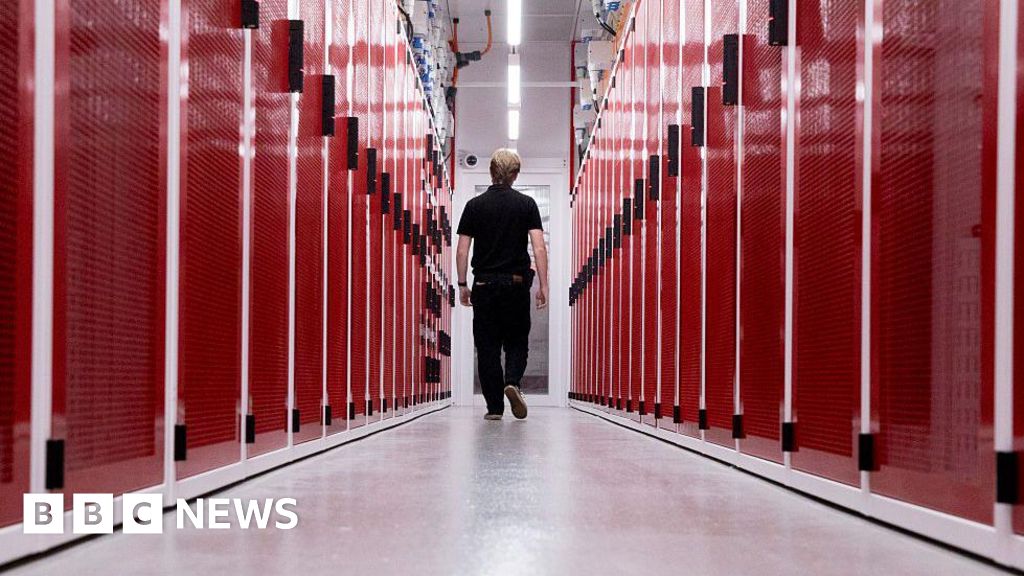
AFP via Getty Images A worker at a data centre in Sydney, Australia, walking down the middle of two rows of red-faced computer serversAFP via Getty Images

Large numbers of vast data centres continue to be build around the world

One day the mighty data centre could be toppled into obsolescence by the humble smartphone, said Perplexity CEO Aravind Srinivas on a recent podcast.

Speaking to host Prakhar Gupta, the AI chief argued that people will eventually use powerful, personalised AI tools that will be able to run on the hardware already inside their devices.

This will be instead of the AI relying on transmitting data to and from enormous data centres, and using remote computers to function, as is generally the case now.

Apple’s AI system, Apple Intelligence, already runs some features on specialised chips inside the firm’s latest range of products. The tech giant says this means that its AI tools can operate more quickly, and also keep private data more secure.

Microsoft’s Copilot+ laptops also include on-device AI processing.

But these are all premium-priced gadgets. In general, not many current devices have that capability. AI requires powerful processing that’s beyond the means of standard equipment.

“It’s long term ‘if and when’ powerful and efficient AI can run on local devices,” says Jonathan Evans, director of consultancy company Total Data Centre Solutions.

The data centre industry certainly isn’t shrinking in terms of demand. But is it getting smaller in other ways?

Data centres are traditionally huge buildings, packed full of powerful computers that carry out a large number of digital tasks in addition to driving AI, ranging from video streaming and online banking, to AI processing and data storage.

It’s likely that anything you have an online login for uses a data centre somewhere in the world. Big companies own them, smaller ones lease capacity inside them.

Yet a few years ago I heard about a tiny data centre, the size of a washing machine, that was being operated in Devon, UK. In addition to its computing power, the heat it was releasing was warming a public swimming pool.

This was the first time I’d encountered a data centre that wasn’t a giant warehouse, and I was initially very sceptical about the whole thing.

Since then I’ve heard of plenty of other examples. In November 2025, a British couple revealed they were heating their home via a small data centre housed in their garden shed.

A month later, I had dinner with a university professor who told me he had a GPU – a powerful computer processor used to drive AI – under his desk. And as it churned away, it was also keeping his office warm.

At the same time, the tech companies are investing billions of dollars in enormous data centre plants around the world. There are around 100 new ones underway in the UK alone. Data centres are energy hungry, and there are significant concerns about their environmental impact.

Nvidia CEO Jensen Huang calls data centres “AI factories”. The argument in favour of them is that we need them to enable rapidly-evolving AI technology.

For a long time, the AI sector insisted that there was an apparently exponential “scaling” rule which meant that the more computing power you threw at AI, the better it became – although that seems to have slowed.

But I’m increasingly hearing voices in the tech sector who question the rationale that this all has to be housed within remote and massive data centres.

Evans says there’s a case for “smaller ‘edge’ data centres near large populations”, which would reduce latency and result in faster response times.

“Small is definitely the new big,” says Mark Bjornsgaard. He was the founder of DeepGreen – the company that made the swimming pool data centre.

He thinks every public building should instead house a small data centre, working in a large network with each other where required, and providing heating as a by-product.

“London is just one giant data centre that hasn’t been built yet,” he says.

AFP via Getty Images A woman with nails painted bright red holds her mobile phoneAFP via Getty Images

Currently if you ask the AI on your phone a question, the answer will come from a data centre

Amanda Brock, the head of business organisation OpenUK, shares this view. “The data centre myth will be a bubble that will burst over time, I think,” she tells me. Although she didn’t want to put a date on it.

She thinks derelict buildings and closed shops should be repurposed into small data centres instead.

Some are looking a little further afield than high streets and cities: space.

“Space offers a unique opportunity to rethink data structure, where small, scalable data centres in orbit can deliver efficiency, performance and flexibility,” says Avi Shabtai, the CEO of Ramon Space, one firm developing the technology.

Back on terra firma, Brock agrees with Perplexity’s Srinivas that fewer data centres will be required, and that she instead thinks “processing will move to a handheld device, or a set-top box, or a router in your home”.

This might also become more likely if it’s not only the data centres that are shrinking – but also the AI tools themselves.

There’s been huge hype around Large Language Models – massive, powerful AI models trained on vast amounts of data, which run the AI chatbots we use to generate content. But we have also become familiar with their tendency to make mistakes.

It happens in part because of their incredibly broad remit.

As the AI ethics campaigner Ed Newton Rex once put it to me: an AI tool designed to spot signs of cancer does not also need to be able to write song lyrics in the style of Taylor Swift.
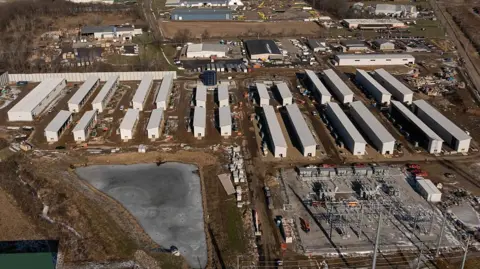
AFP via Getty Images A huge, multi-building data centre in Ohio, USAFP via Getty Images

Data centres are criticised for their energy and water consumption

Businesses increasingly agree, and are opting for bespoke enterprise AI tools instead: more expensive but trained on their own data, which is not then used in the training of other products, and primed to carry out tasks specific to the company.

These smaller, private tools tend to perform more accurately, and can require less computing. It is also more likely that it can all be stored on the premises.

“I’ve spoken to multiple people who aren’t seeing the benefits of using generic AI tools,” says Dr Sasha Luccioni, AI and climate lead at machine-learning firm Hugging Face.

“We are already seeing a paradigm switch between large models taking huge resources, to smaller models being more bespoke and running more locally and tailored to business uses.”

But would a plethora of small data centres present a headache for national security?

“The counter argument here is that small targets have less impact if they are penetrated,” says Prof Alan Woodward from Surrey University, a computer security expert.

“Larger centres can be big points of failure, as we’ve seen recently with huge AWS [Amazon Web Services] centres going down.”

There’s also an environmental benefit to a move away from large data centres, adds Luccioni, who says they “are taking more and more resources”. “It makes sense to not use them all of the time.”



Source link

Tags: Bigsmall

Related Posts

Will AI lead to more accurate opinion polls?

May 1, 2026
0

It's cheaper and faster to collect people's opinions using AI, but will it make polls more accurate? Source...

Musk accuses OpenAI lawyer of trying to 'trick' him in combative testimony

April 30, 2026
0

Elon Musk was cross-examined on the third day of the trial over his lawsuit against Sam Altman and OpenAI....

Musk says basis of charitable giving at stake in OpenAI lawsuit

April 29, 2026
0

The case over OpenAI's history and public commitments could have major implications for the future of AI. Source...

  • Australia helicopter collision: Mid-air clash wreckage covers Gold Coast

    523 shares
    Share 209 Tweet 131
  • UK inflation: Supermarkets say price rises will ease soon

    515 shares
    Share 206 Tweet 129
  • Ballyjamesduff: Man dies after hit-and-run in County Cavan

    510 shares
    Share 204 Tweet 128
  • Somalia: Rare access to its US-funded 'lightning commando brigade

    508 shares
    Share 203 Tweet 127
  • Google faces new multi-billion advertising lawsuit

    508 shares
    Share 203 Tweet 127
  • Trending
  • Comments
  • Latest

Australia helicopter collision: Mid-air clash wreckage covers Gold Coast

January 10, 2023

UK inflation: Supermarkets say price rises will ease soon

April 19, 2023

Ballyjamesduff: Man dies after hit-and-run in County Cavan

August 19, 2022

Stranger Things actor Jamie Campbell Bower praised for addiction post

0

NHS to close Tavistock child gender identity clinic

0

Cold sores traced back to kissing in Bronze Age by Cambridge research

0

BBC Inside Science – Why is Europe the fastest-warming continent?

May 1, 2026

May full Moon: When to see the ‘Flower Moon’ rise this week

May 1, 2026

F1's Alex Albon on getting ready for the Miami GP – and his 14 cats

May 1, 2026

Categories

Science

BBC Inside Science – Why is Europe the fastest-warming continent?

May 1, 2026
0

Available for 35 daysThe latest European State of the Climate report has found that Europe is once again getting...

Read more

May full Moon: When to see the ‘Flower Moon’ rise this week

May 1, 2026
News

Copyright © 2020 JBC News Powered by JOOJ.us

Explore the JBC

  • Home
  • News
  • Sport
  • Worklife
  • Travel
  • Reel
  • Future
  • More

Follow Us

  • Home Main
  • Video
  • World
  • Top News
  • Business
  • Sport
  • Tech
  • UK
  • In Pictures
  • Health
  • Reality Check
  • Science
  • Entertainment & Arts
  • Login

Copyright © 2020 JBC News Powered by JOOJ.us

Welcome Back!

Login to your account below

Forgotten Password?

Create New Account!

Fill the forms bellow to register

All fields are required. Log In

Retrieve your password

Please enter your username or email address to reset your password.

Log In
This website uses cookies. By continuing to use this website you are giving consent to cookies being used. Visit our Privacy and Cookie Policy.
News
More Sites

    MORE

  • Home
  • News
  • Sport
  • Worklife
  • Travel
  • Reel
  • Future
  • More
  • News

    JBC News