





 Getty Images
It’s long been known that our lifestyles can help to keep us healthier for longer. Now scientists are asking whether new technology can also help slow down the ageing process of our brains by keeping track of what happens to them as we get older.
One sunny morning, 76-year-old Dutch-born Marijke and her husband Tom welcomed me in for breakfast at their home in Loma Linda, an hour east of Los Angeles.
Oatmeal, chai seeds, berries, but no processed sugary cereal or coffee were served – a breakfast as pure as Loma Linda’s mission.
Loma Linda has been identified as one of the world’s so-called Blue Zones, places where people have lengthier-than-average lifespans. In this case, it is the city’s Seventh-Day Adventist Church community who are living longer.
They generally don’t drink alcohol or caffeine, stick to a vegetarian or even vegan diet and consider it a duty of their religion to look after their bodies as best they can.
This is their “health message”, as they call it, and it has put them on the map – the city has been the subject of decades of research into why its residents live better for longer.
Dr Gary Fraser from the University of Loma Linda told me members of the Seventh-Day Adventist community there can expect not only a longer lifespan, but an increased “healthspan” – that is, time spent in good health – of four to five years extra for women and seven years extra for men.
Marijke and Tom had moved to the city later in life, but both were now firmly embedded in the community.

There’s no great secret to Loma Linda. Its citizens are simply living a really healthy life, keeping mentally stimulated and valuing the community a religion can often provide.
There are regular lectures on healthy living, musical get-togethers and exercise classes.
I chatted to Judy, who lives with 112 others at an assisted living facility where there was always the “ability to have heart-opening, brain-opening conversations”, she told me.
“What I didn’t realise was how important socialisation is to your brain… without it, it seems to shrink and go away,” Judy said.
Science has long recognised the benefits of social interactions and avoiding loneliness.
But now it’s also possible to identify whose brains are ageing faster than they should, so they can be tracked and in future potentially be treated better preventatively.
As we move towards more personalised, predictive, preventative healthcare models, early diagnosis will be crucial in all areas of health – powered by the incredible possibilities of AI and big data.


Computer models that assess how our brains age and predict their decline were shown to me by Andrei Irimia, associate professor of gerontology and computational biology at the University of Southern California.
He had created them using MRI scans, data from 15,000 brains and the power of artificial intelligence to understand the trajectory of both brains that are ageing healthily and those in which there is a disease process, such as dementia.
“It’s a very sophisticated way to look at patterns that we don’t necessarily know about as humans, but the AI algorithm is able to pick up on them,” he said.
Prof Irimia did, of course, take a look inside my head.
I’d had a functional MRI scan ahead of my visit and, after analysing its results, Prof Irimia told me I had a brain age eight months older than my chronological age (although apparently the bit that controls talking wasn’t ageing so much. I could have told him that). However, Prof Irimia suggested that the results fall within a two-year error margin.
Private companies are starting to commercialise this technology, too. One firm, Brainkey, is offering the service in a variety of clinics around the world. Its founder Owen Philips told me that in future, getting an MRI should become easier.
“It’s becoming much more accessible for people to get an MRI scan, and the images coming off them are getting even better and better,” he said.
“I don’t mean to nerd out there. But the technology is just getting to a point where we are able to see things much earlier than we could in the past. And that means we can understand exactly what’s happening in an individual patient’s brain. With AI, we can support that.”
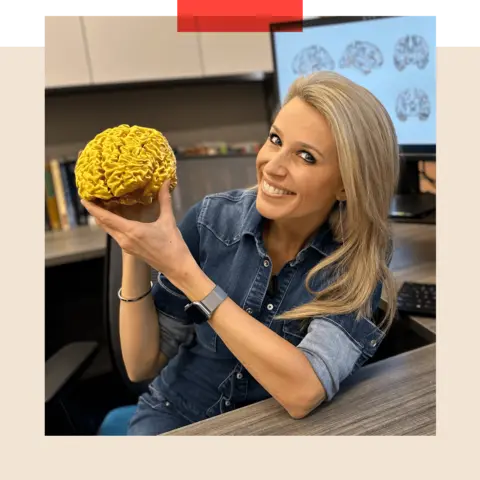
In contrast to what Prof Irimia’s analysis of my MRI scan had told me, Brainkey’s estimate knocked a year off my brain’s biological age. I was also presented with a 3D-printed model of it, which appeared substantial and, I was assured, was life-sized.
The aim here is not just a more precise approach to treatment, but also to be able to quantify how well any interventions are working.
Dramatic increases in life expectancy over the past 200 years have given rise to a host of age-related diseases. I did wonder whether, if we all lived long enough, dementia might come knocking at all our doors.
Prof Irimia said this was a theory many have investigated albeit not proven, adding that the aim was to find a way to keep on pushing dementia back, hopefully beyond our life expectancies.
And all of this takes us back to the same point. Every scientist and doctor, as well as those Blue Zoners, say lifestyle is key. Good diet, keeping active, mentally stimulated and happy are crucial to how our brains age.
There’s another important factor too, according to Matthew Walker, professor of neuroscience and psychology at the University of California, Berkeley, and author of the best-selling book Why We Sleep.
“Sleep is the single most effective thing you can do every day to reset your brain and body health,” he evangelised. “There is no operation of your mind that is not wonderfully enhanced when you get sleep, or demonstrably impaired when you don’t get enough.”
He spoke of our brains’ cleansing system, which functions during our slumber by washing away the beta-amyloid and tau proteins – these are “two of the main culprits underlying Alzheimer’s”.
Changes in sleep patterns are also associated with dementia. Prof Walker described how we don’t just see this in our 60s or 70s – it can begin during our 30s. So, identifying those changes through sleep tracking could potentially become a “model of midlife prevention”.
Fauna Bio, a biotech company on the outskirts of San Francisco, is collecting data on ground squirrels during and after hibernation. In this state of torpor, as it is known, the squirrels’ body temperature drops and their metabolic rate is reduced to just 1% of normal.
During this time, they appear to be able to regrow neurons and remake the connections their brains had lost. The company’s aim is to try and create drugs to replicate this process in humans, without them needing to spend half the year underground. Even if some may long for that.
Untreated depression has also been shown to raise our risk of dementia. Professor Leanne Williams of Stanford University has identified a method of “visualising” some forms of depression on the brain using an MRI scan, and thus seeing if treatment has worked.
This may be able to help scientists understand more abotu the root causes of mental health conditions such as depression, as well as providing a way to quantify how treatment is going for a patient.
Few have put more faith in science to achieve longevity than Bryan Johnson – the tech entrepreneur spending millions in an effort to reverse his biological age.
Dozens of supplements, 19 hours a day of fasting, workouts that make him look as though he’s going to burst and an array of (sometimes controversial) treatments are what he hopes will turn back the clock.
But as 103-year-old Mildred, who I visited in Loma Linda said forcefully, “You absolutely need to be very careful with your diet, it’s true, but I’m not down for, ‘You’ve got to do this, and this, and this, and absolutely not touch this! ‘”. She thinks it’s more important we live a little, and let’s face it, she should know.
BBC InDepth is the new home on the website and app for the best analysis and expertise from our top journalists. Under a distinctive new brand, we’ll bring you fresh perspectives that challenge assumptions, and deep reporting on the biggest issues to help you make sense of a complex world. And we’ll be showcasing thought-provoking content from across BBC Sounds and iPlayer too. We’re starting small but thinking big, and we want to know what you think – you can send us your feedback by clicking on the button below.