

By Robert Plummer, BBC News
 Getty Images
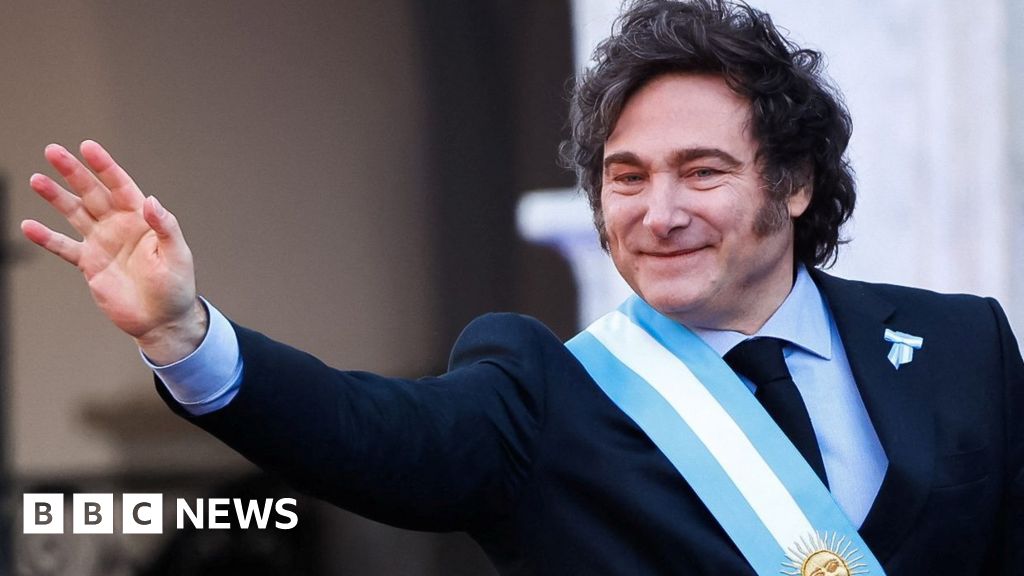
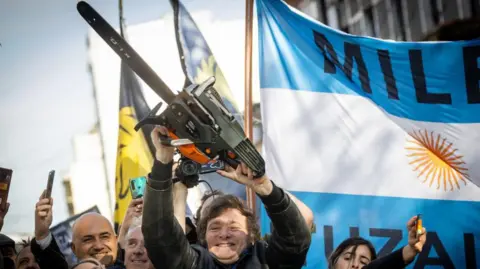
When Javier Milei was campaigning last year to become the president of Argentina, he brandished a chainsaw to symbolise his determination to substantially cut public spending.
Now six months into his right-wing presidency, how is his shock therapy for both the country’s government and economy working?
“The changes our country needs are drastic,” Mr Milei said shortly after being elected. “There is no room for gradualism.”
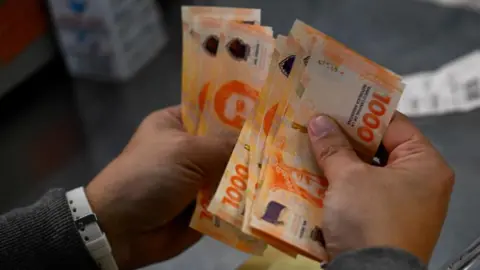
And he certainly took swift action. In his initial package of measures, he devalued Argentina’s currency, the peso, by 50%, slashed state subsidies for fuel, and cut the number of government ministries by half.
The quick reduction in public spending has helped Argentina swing from a fiscal deficit – the difference between the government’s spending and income – of 2tn pesos ($120bn; £93bn) in December of last year to a surplus of 264.9bn pesos in April.
Argentina also reported a surplus in January, February and March, marking the first time it had achieved this monthly target since 2012.
However, Mr Milei, who describes himself as a libertarian, has made cutting inflation his main priority, telling the BBC last year that it was “the most regressive tax that most afflicts people”.
Inflation has slowed – in April the month-on-month rate fell to 8.8%, the first time since October that it was not in double figures. This inflation measure is closely followed in countries like Argentina that have long had high inflation.
Yet when it comes to the more globally-recognised annual inflation rate, this hit 289.4% in April. To put that into perspective, in the UK the annual rate is currently just 2.3%.
And although official growth figures are not yet available for the period since Mr Milei took office on 10 December, there is evidence that Argentina’s economy has contracted sharply, with consumer spending dropping off in the first three months of this year.

 Getty Images
Meanwhile, other pledges that Mr Milei made while campaigning, such as replacing the peso with the US dollar and abolishing the central bank, have taken a back seat recently.
The problem for President Milei is that his La Libertad Avanza coalition (in English – Freedom Advances) does not command a majority in the Argentine Congress. And it has found it hard to strike cross-party deals.
Mr Milei wants Congress to grant him the power to privatise more than two dozen state-owned companies, including the state airline, the railways, the postal service, and the national water supplier.
His initial “omnibus” bill, containing the privatisation plans and hundreds of other economic measures, failed to pass a second reading in February. A streamlined version, resubmitted to Congress in April, cleared the lower house but has yet to be approved by the Senate.
The president also faces strong opposition from trade unions, who have taken to the streets in protest, saying that workers’ rights will suffer from the wholesale deregulation of the economy.
Juan Cruz Díaz, managing director of Argentina-based geopolitical risk consultancy Cefeidas Group, says Mr Milei’s economic policies in office are as radical as those promised during the campaign, just somewhat delayed.
“His administration has been forced to slow down these reforms, given the political and social roadblocks it has faced,” says Mr Díaz.
He adds that specific factors causing the president to tread cautiously are “the deterioration of people’s purchasing power and the fear of increased social unrest”.
This comes as there has been no let-up in the number of people living in poverty, which has risen from about a quarter of the population in 2017 to more than half now.
However, the International Monetary Fund, which over the decades has lent more money to Argentina than to any other country, gave the government high marks in May, saying that its performance was “better than expected” and that its economic programme was “firmly back on track”.
As to whether President Milei can get more policies agreed by parliament, Mr Díaz says that while some sectors of the opposition are open to dialogue with the government, left-leaning parties are completely opposed to his agenda. These include the Peronist faction controlled by ex-President Cristina Fernández de Kirchner.
“In this context, the government’s ability to negotiate and build consensus is being tested on a daily basis, a test that Milei himself often hinders with certain outbursts and unnecessary confrontational statements,” says Mr Díaz.
In fact, many Argentines are seeing Mr Milei’s ebullient personality as more of a hindrance than a help.
In its latest survey, the Zuban Córdoba political consultancy firm found that 54% of respondents thought the president was paying more attention to his international political image than to solving Argentina’s problems.
That perception has no doubt been bolstered by Argentina’s current diplomatic row with Spain, which has led Madrid to recall its ambassador to Buenos Aires.
 Capital Economics
Kimberley Sperrfechter, emerging markets economist at research group Capital Economics, says the central problem for President Milei is that he has to overcome “years and years of economic mismanagement” in Argentina.
“One key factor is that the government has been spending way beyond its means [for decades],” she says. “And that deficit has been financed by the central bank printing money to finance the government spending.”
This printing helped cause the country’s soaring inflation.
Argentina, the world’s eighth-largest country, has in fact been in decline for more than a century. Its downfall serving as a cautionary tale of how the wealth of a nation can be frittered away.
Before World War One, it ranked as one of the world’s 10 richest countries.
But a subsequent slow economic contraction was substantially accelerated by the populist policies – and overspending – of President Juan Perón, who was in power from 1946 to 1955.
There were some short-lived free-market reforms in the 1990s under President Carlos Menem, who privatised many of the firms that Perón had nationalised, and made serious attempts to restore faith in the Argentine currency.
But things took a sharp turn for the worse at the end of 2001, when the country suffered a catastrophic economic meltdown and a massive $102bn (£80bn) debt default.
Argentina had essentially locked itself into a currency regime that gave it no flexibility, by fixing the peso at parity with the dollar. That, coupled with the government’s habitual overspending, had exposed it to the ups and downs of the US economy, and left it powerless when a run on Argentina’s banks ensued in 2001.
In the two decades following that crisis, the country has mostly been governed by left-wing protectionists, who basically muddled through without tackling Argentina’s deep-rooted problems.
Now, with a right-wing libertarian administration in power, the country is attempting to chart a new course – and that means getting the government’s finances on a sound footing.
To help President Milei’s government achieve this, research firm Consensus Economics says the administration is focusing on Argentina’s vast agricultural exports of grain, soya, meat and wine.
“Policymakers are pinning their hopes on agricultural exports bringing in badly needed foreign currency as they hope to build up the central bank’s depleted [foreign exchange] reserves and, in turn, boost the state’s financial credibility,” says Consensus.
 Reuters
Yet Ms Sperrfechter thinks the Argentine economy is at a “tipping point” at the moment, and Mr Milei cannot rely on public support, despite his election victory.
“It’s not that people were convinced by his policies, it was more of a protest vote,” she says. “Things could not continue the way they had been.”
Ms Sperrfechter feels that despite the devaluation of the peso, the currency continues to be overvalued, possibly by as much as 30%. The exchange rate is still being managed, instead of being fully free to rise or fall, she says, and this is holding back growth and harming competitiveness.
“With Argentina, you never really know, but I think the shine is coming off,” Ms Sperrfechter says. “The optimism is going to fade, and the economy is going to struggle.”